Repository navigation
units illyrian_peltasts
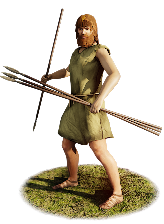
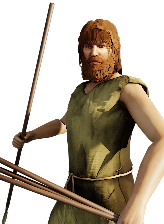
Class: missile · Category: infantry · Men per unit: 40
One peculiarity of the Illyrians’ style of warfare was that their slaves fought alongside them, with some rich individuals being able to field several hundred slaves. Deployed as skirmishers, and equipped with neither shield nor armour, these men are expected to harass enemy formations prior to the proper infantry’s engaging the enemy line of battle. Only suitable for ambushing, missile combat, and harassing the enemy flanks and rear, these slave-conscripts are generally unable to engage in close combat for any duration of time.
Slavery was an important part of the economy for many ancient societies, with the Illyrians being no exception. Their local ‘big men’ or elites often traded local resources such as cereals, hides, timber, metal ores, as well as human resources like mercenaries and, of course, slaves (Wilkes, The Illyrians (1996), p. 109). Strabo’s account of Italic and later Roman commercial activity in Istria, possibly with the Histri, also provides valuable information on what the Illyrians could have been trading. They “load on wagons and carry inland the products of the sea, and wine stored in wooden jars, and also olive oil, while the former [the Italics] get in exchange slaves, cattle, and hides” (Strab. 5.1.8.).
Slave trade could provide a large income, and the Illyrians' regular pillaging and raiding of their neighbours must have provided numerous slaves. In 231 BC, the Ardiaei under Queen Teuta bribed a garrison of 800 Gallic mercenaries to allow them to enter the Epirote city of Phoinike (Phoenice). Subsequently, the Illyrians looted and enslaved its entire population, forcing the Epirotes to offer attractive peace terms (Wilkes (1996), pp. 157-8). This action sent shockwaves around Greece, as Polybius (2.6) tells of the widespread horror among the Greeks to find “the most securely placed and powerful city of Epirus thus unexpectedly reduced to slavery, they one and all began to feel anxious, not merely as in former times for their property in open country, but for the safety of their own persons and cities”. How dare the barbarian enslave the civilised Greek! This relationship was not entirely one-sided, however, as Livy notes that in 170 BC during the Third Macedonian War, the Macedonians under Perseus took the Penestae settlement of Uscana (Hyskana), capturing the entire population of “Uscanians and Illyrians [who] were sold as slaves to the Penestae” (Liv. 43.18). Not every Illyrian society treated slaves the same. Pseudo-Skylax (21.1/2) describes Liburnian society as an oddity “ruled by women; and the women are (wives) of free men, but mingle with their own slaves and with the men of the nearby lands”.
Those slaves who formed a part of Illyrian armies were, of course, given the most menial tasks, and were the most expendable component of the Illyrian host. According to Theopompus (FGrH 115 F40), the Ardiaei were supposed to have possessed more than 300,000 serfs at the height of their power, whose legal situation was identical to that of the Helots of Sparta, and was therefore a significant source of potential manpower during war. According to Agatharchidis, the Dardanoi also possessed many slaves; some of them more than a thousand each. As a final illustration of this phenomenon, Justin notes that one Dardanian raid upon Macedonia resulting in over 20,000 prisoners being taken (Justin, 29.4). These slaves were primarily responsible for agricultural labour, but, like the helots of Sparta, could also be forced to accompany their masters to war.
| Rank in roster | ||
|---|---|---|
| Men per unit | 40 |
███······· 30% |
| Attack | 10 |
██········ 19% |
| Charge bonus | 2 |
█········· 11% |
| Defence | 13 |
█········· 5% |
| · armour | 1 |
█········· 0% |
| · defence skill | 12 |
█········· 9% |
| · shield | 0 |
█········· 0% |
| Morale | 4 |
█········· 0% |
| Discipline | Low | |
| Training | Untrained | |
| Recruitment cost | 809 dn |
█········· 1% |
| Upkeep per turn | 296 dn |
█········· 8% |
| Turns to recruit | 2 |
| Primary | Secondary | |
|---|---|---|
| Attack | 10 | 3 |
| Charge bonus | 2 | 2 |
| Type | thrown · archery | melee · simple |
| Damage | piercing | piercing |
| Projectile | javelin | — |
| Range | 60 | — |
| Ammunition | 7 | — |
| Properties | Thrown | — |
| Primary | Secondary | |
|---|---|---|
| Total | 13 | — |
| Armour | 1 | — |
| Defence skill | 12 | — |
| Shield | 0 | — |
| Hit points | 1 |
| Ground: scrub / sand / forest / snow | 8 / 0 / 8 / 0 |
| Charge distance | 30 |
| Formations | Square |
Technical stats
| Time between blows (primary / secondary) | 2.5 s / 2.5 s |
| Extra fatigue in hot climates | 0 |
| Collision mass per man (1.0 is normal) | 0.81 |
| Spacing between men: close / loose | 1.2 × 2.8 m / 2.16 × 5.04 m |
| Default ranks | 5 |
In battle: Can hide in long grass · Very good stamina
A core roster unit for 9 factions, each able to raise it anywhere they hold the right building:
Ardiaei · Daesitiates · Dardania · Delmatae · Histri · Iapodes · Illyrian Kingdom · Labeatae · Liburni