Repository navigation
Elmer FEM Accuracy
Where the Elmer bridge's errors come from, how big each one measured on E01 and E02, what that means
for the coil board, and what the bridge leaves out of the physics. Every number here is from the runs
on the Elmer_Integration branch (Examples/E01_circular_loop/results*.json,
Examples/E02_coaxial_loops/results*.json and the coil board's
Examples/Inductive Coils/S0d2_1x_OD23_2L_tiny_TX3top_Cut/Results/).
Each line changes one thing and keeps the rest; all are L at 10 kHz.
| Source | Test | Effect on L |
|---|---|---|
| The copper's mesh | level 0.75 → 1 → 1.3 (59,782, 85,712, 125,043 nodes) | +0.54 %, then +0.12 % |
| The iterative solve | level 1 at 1500 and at 3000 iterations | +0.17 % with the doubled cap |
| The air's mesh | level 0.75 with the air graded twice as finely (grade 0.25, tet_grade 0.35; 88,760 nodes against 59,782), then four times (0.125 and 0.175; 166,471 nodes) |
+2.3 %, then +1.1 % |
| The air domain | level 0.75 in a domain twice as big (120 mm in radius and half height instead of 60) | +0.26 %: the 60 mm domain holds L down by about 0.3 %, since the bigger one keeps about an eighth of that |
| The reference's open-loop share | with the sheet across the gap, the coil's voltage is the flux through the whole circle, so L is the closed ring's L times the share of the circle the current runs in; the reference ends that share at the round ends' centres, but the current runs on into the half-discs | the reference is a lower bound: up to 0.8 % higher (56.44 nH) with the current taken on to the gap's faces |
| Elmer against the reference | Grover's ring formula with the trace's GMD | −3.1 % at level 1.3; −0.46 % at level 0.75 with the air four times as fine |
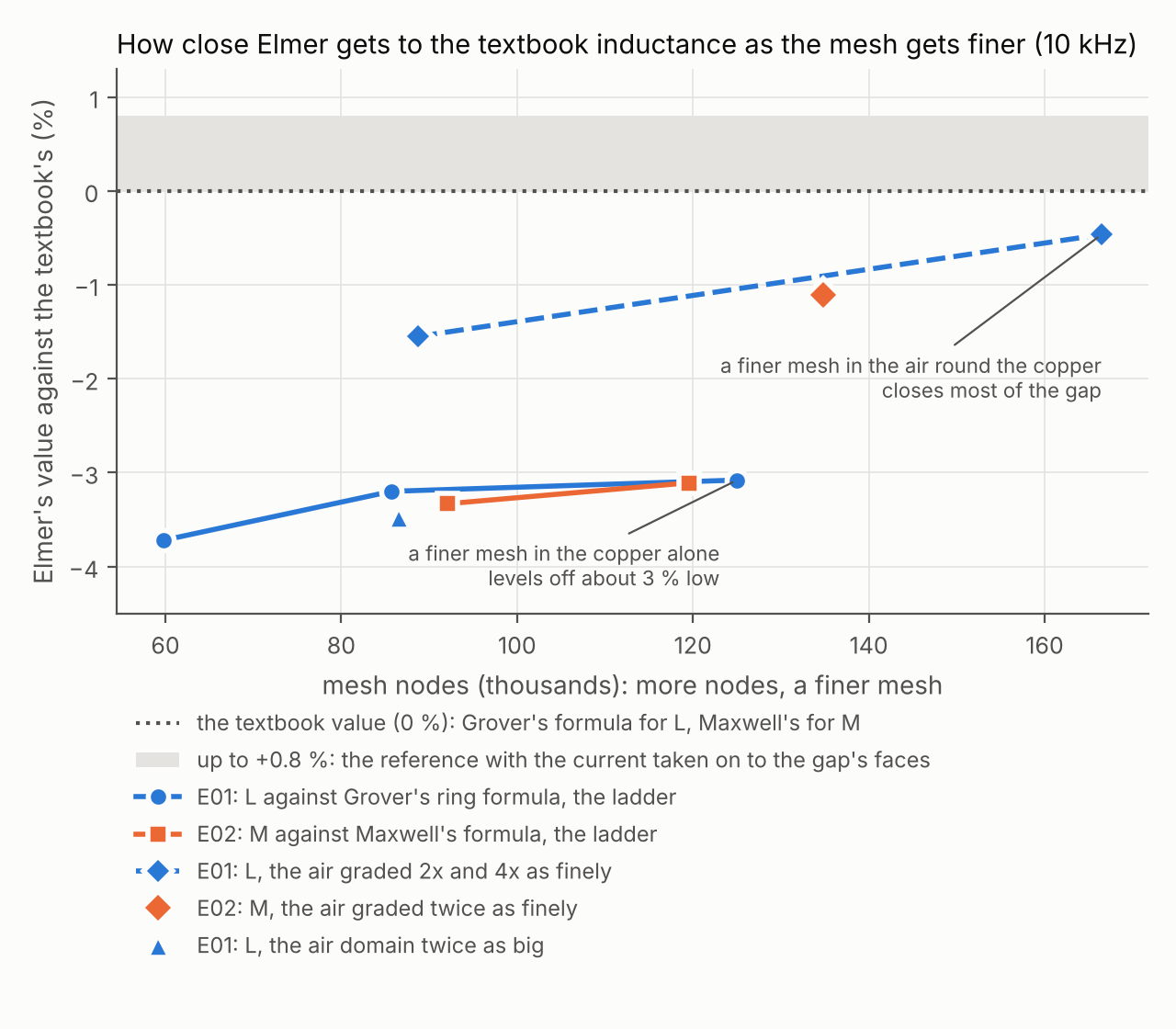
E01's L and E02's M against the mesh's size, from the runs in the table. The ladder in the first line refines only the copper's mesh: a level divides h_edge, h_in and
dz_copper and leaves the air's grading as it is. Its small last step made the answer look
converged, but it measured the copper alone. Grading the air twice as finely, at the coarsest copper
mesh, moved L three and a half times as far as the whole ladder did, with about as many nodes as
level 1. Most of a thin trace's inductance is in the field close round it, and with grade 0.5 the
elements there
grow from 0.12 mm at the copper's edge to 0.62 mm a millimetre away (the size is h_edge +
grade × distance); the tetrahedra above and below grow by tet_grade per mm of height in the same way. R did
not move, since it depends on the copper's mesh alone, and the circuit's L and the field energy's
still agreed. The board under the copper is not meshed apart from the air: a board or mask part that
lies wholly outside the copper's heights is merged into it
(Elmer FEM Walkthrough), so the air's grading
covers it too.
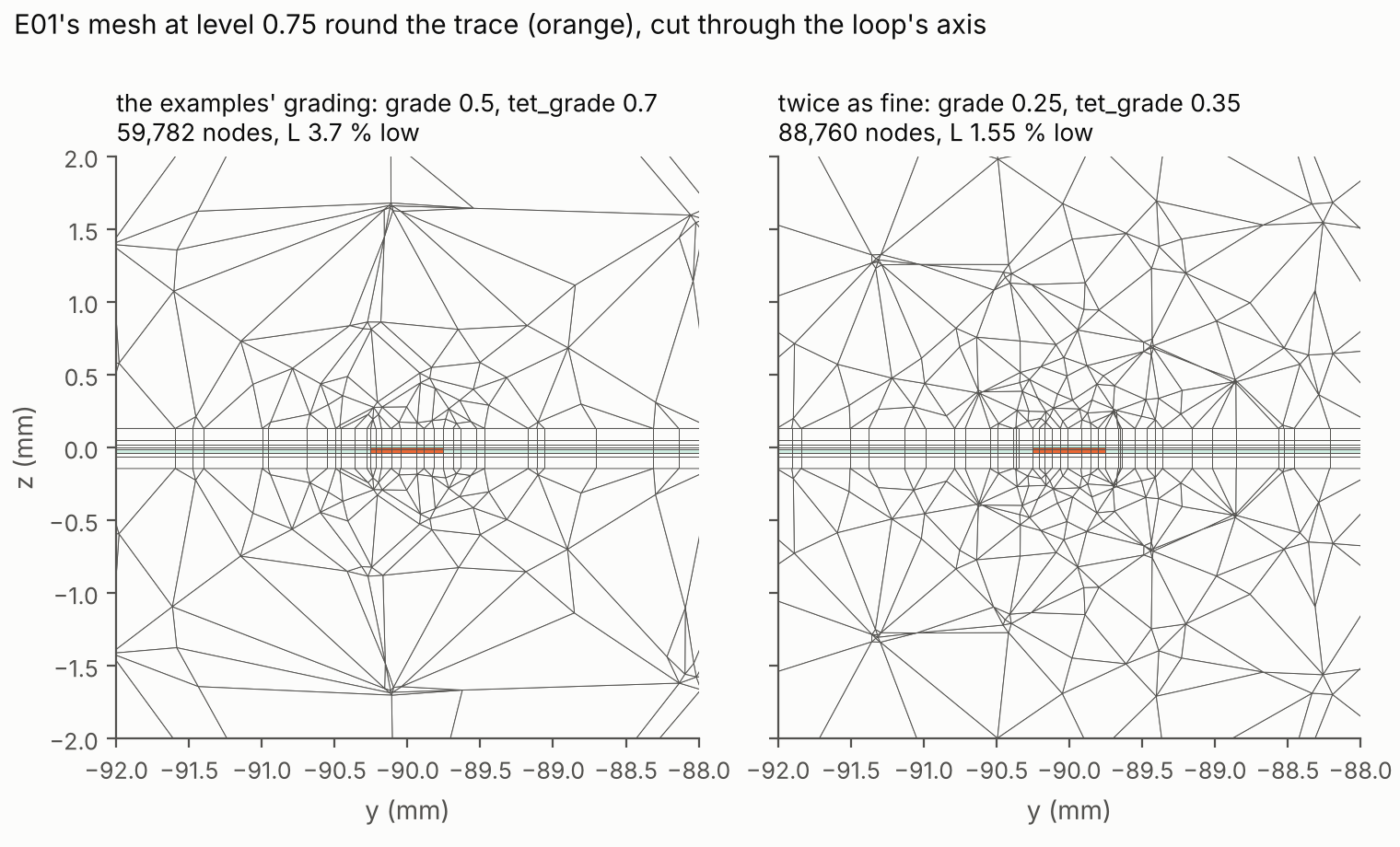
On E02 the same change raised M by 2.3 % as well, from 3.3 % to 1.1 % under Maxwell's formula: the air holds L and M down alike. Graded four times as finely, the air brings E01's L to 0.46 % under the reference, with 166,471 nodes. Each halving of the grading halved the change, so the air's mesh is converging but not done, and the copper's ladder showed another +0.7 % from level 0.75 to 1.3; the domain holds L down by about 0.3 % more. Against that stands the reference's own band, from 0 to +0.8 %: what is left is of the same size, and E01 cannot measure it. A ladder that refines the air with the copper is the fix this points to; it is not yet in the bridge (Future Upgrades And Planning).
At 10 kHz the BiCGStab(l) solve reaches a relative residual of about 1e-6 within 1500 iterations and
stalls there: the conduction term jωσ is too small, next to the curl-curl term, to steady the system
without a gauge. At 3.5 MHz the same case converges to 1e-7 in under 1200 iterations. The bridge
caps the iterations (max_iter) and lets the run go on (Linear System Abort Not Converged = False), so a 10 kHz answer carries an iteration error:
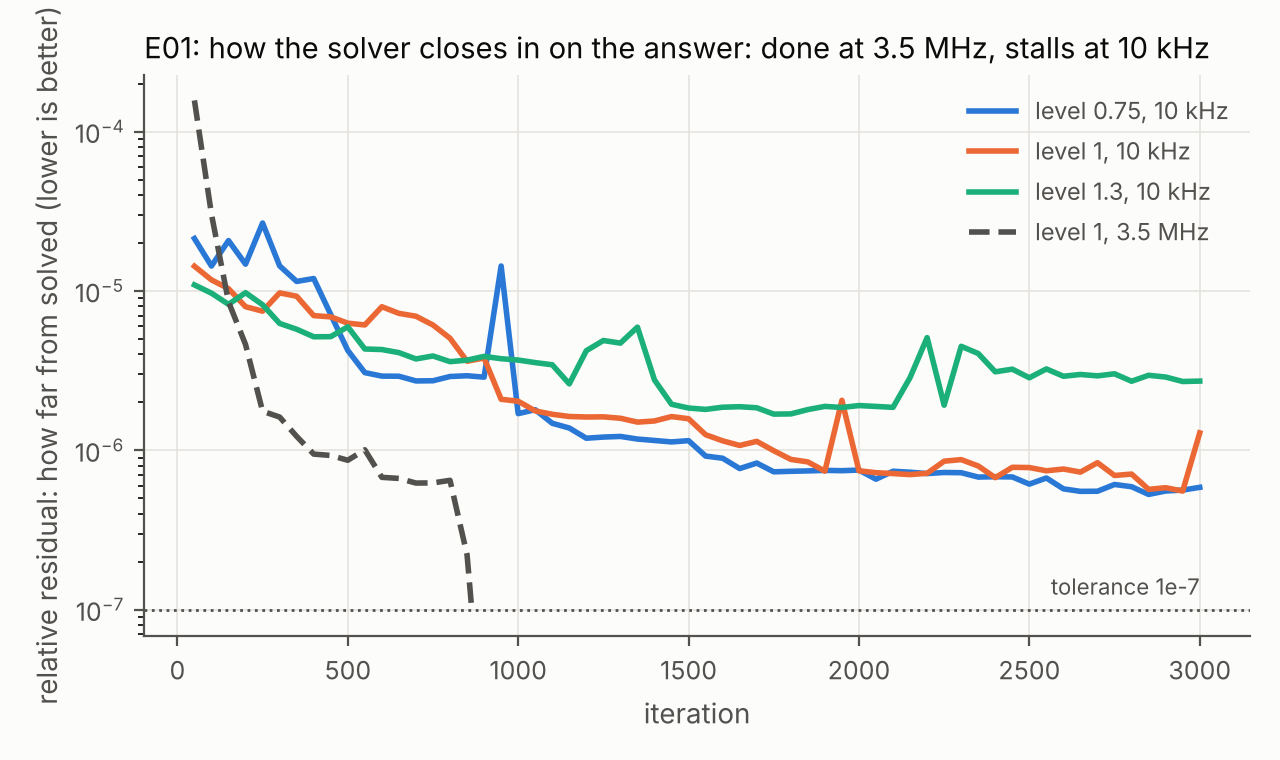
The linear solver's residual on E01, 15 and 16 November.
| E01, level 1, 10 kHz | 1500 iterations | 3000 iterations | Change |
|---|---|---|---|
| L from the circuit | 54.11 nH | 54.20 nH | +0.17 % |
| L from the field's energy | 54.15 nH | 54.18 nH | +0.05 % |
| R | 61.52 mΩ | 61.53 mΩ | +0.01 % |
| The residual at the end | 1.5e-6 | 1.3e-6 |
The iteration error is of the same size as the change from level 1 to 1.3, so the three levels do not follow one power of the mesh size, and no value extrapolated to a zero mesh size is quoted. R settles first, the field's energy next, the circuit's voltage last. At 3.5 MHz, where the solve converges, none of this applies.
The bridge has moved on since these runs. Its README says that with the coils' scalar potentials left out (the default today) and GCR with the shifted ILU(1), E01 converges to 1e-10 in 400 iterations; E01's committed results are still those of the older solve above. On the coil board at 3.5 MHz the iterative solve no longer stalls but converges too slowly to read M, so the coil board uses the direct solve, which has no iteration error at all.
| What | In the bridge | What it does to the numbers |
|---|---|---|
| Displacement current | none: the magneto-quasi-static A-V formulation | no capacitance between turns and no self resonance; the answer holds only well below the coil's self resonance, which another solver has to find (Solvers Comparison) |
| The insulators | FR-4, solder mask and air are all μr 1, σ 0 | right for the magnetic field; εr plays no part without displacement current |
| The copper's conductivity | 5.8 × 10⁷ S/m, one value for all copper | copper at 20 °C; R rises about 0.4 % per kelvin above that, which the bridge does not follow |
| The copper's shape | KESE's solids, extruded straight through the board: a 2.5D mesh | the etched trapezoid and the copper's roughness are not in the mesh |
| The terminals | two electrodes on the gap's faces and a sheet across the gap | the gap's own short piece of current path is not counted; E01's reference accounts for it with the open-loop share. On the coil board each receiver's 0.2 mm cut is made in the model only: the real board's leads to the IC are not in it |
S0d2_1x_OD23_2L_tiny_TX3top_Cut has no textbook answer, so its accuracy rests on what E01 and E02 measured and on checks inside its own runs:
| Source | On the coil board | What it does to the numbers |
|---|---|---|
| The linear solve | direct (MUMPS) on every solve | no iteration error |
| The two readings of the TX | L from its voltage against L from the field energy, R from its voltage against R from the eddy power | within 0.004 % on all 81 solves, where 1 % is allowed: the ports and the circuit read back what the field holds |
| The copper's mesh | level 0.25 only, on every gap; not refined on this board | not measured here |
| The air's mesh | the examples' grading (grade 0.5, tet_grade 0.7) |
on E01 and E02 it held L and M about 3 % low; the same is likely here, so L TX and M are lower bounds |
| A mesh per angle | every angle gets its own mesh, so the stator's mesh differs a little from angle to angle | the second half turn repeats the first: at six of eight angles M is the same to the last digit, at 225° and 315° within 0.03 nH, against a 4.51 nH amplitude at 1 mm |
| The angle error | SIN and COS each fitted with a sine, offset and gain calibrated out | an error that scales SIN and COS alike leaves it as it is; mesh noise between angles adds to it |
| Quantity | On boards like E01 and E02 |
|---|---|
| L and M at 10 kHz | 3 to 4 % low with the examples' air grading; 0.46 % low on E01 with the air graded four times as finely, of the size of the reference's own uncertainty; rising with every refinement: a lower bound |
| L and M at 3.5 MHz | the same mesh error; the iterative solve converges, so no iteration error on top |
| R at 10 kHz | within 0.5 % |
| R at 3.5 MHz, skin and proximity effect | no exact reference, and not yet settled with the mesh: it fell 1.2 % from level 0.75 to level 1; the change against 10 kHz (+29 %) and the RX's share on E02 (+1.5 mΩ) behave as they should |
| L from the circuit against L from the energy | within 0.05 %: a check on every run, at no cost |
| Quantity | On the coil board |
|---|---|
| The shape of SIN and COS, their match and their phase | equal within 0.06 %, 90.06 to 90.18° apart; the angle error of 0.2 to 0.9° rms (electrical) includes the mesh's noise between angles |
| M and L TX | lower bounds, probably by a few percent, from the air's mesh as on E01 and E02 |
| How much the rotor lowers L TX | a ratio of two L values on like meshes; errors that lower both alike may largely cancel, but that is not shown yet |
| R TX | the DC value, 0.377 Ω, against the generator's 0.38 Ω; at 3.5 MHz level 0.25 allows wedge layers up to 72 µm, so each 35 µm foil gets a single layer, where E01 at level 1 has two, and the skin effect is only coarsely resolved |
A ladder that refines the air with the copper, run on the coil board with two air gradings, is the next check these numbers need (Future Upgrades And Planning).
| Previous | Next |
|---|---|
| Accuracy | PyPEEC Accuracy |