Repository navigation
OpenAPI Specification Modernized
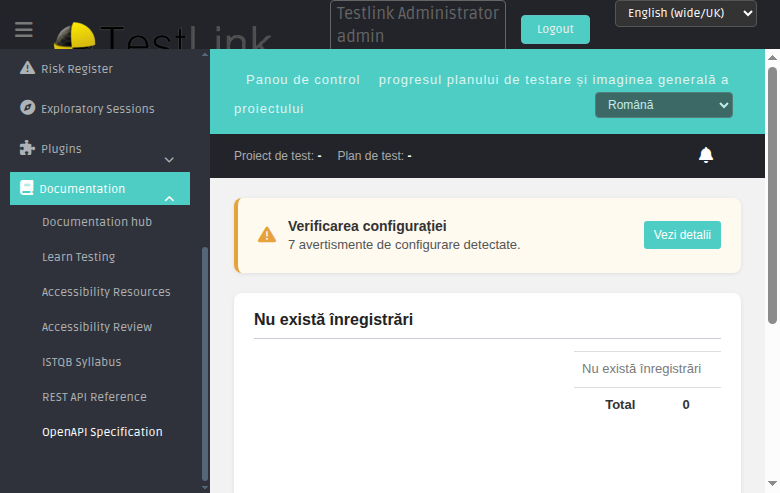
Net-new in-app OpenAPI 3.1 specification viewer/publisher for TestLink 2.0.1, added as the Documentation ASIDE section's seventh entry (below Documentation, Learn Testing, Accessibility Resources, Accessibility Review, ISTQB Syllabus and REST API Reference). TestLink 1.9.20 shipped no machine-readable API artifact at all, and neither did the 2.0.1 BFF layer — this screen generates a real OpenAPI document from the live installation and serves it as JSON or YAML. Tracking issue #1944, parent feature #1072.

- Parent enhancement #1072 (documented REST API / OpenAPI / webhooks). Its
REST-reference half was closed by the #1937
apiReferencehub; the acceptance criterion "Publish an OpenAPI specification" was still unmet. - The ledger's TODO section is empty (every ASIDE entry already maps to a modern
.html+ BFF), so a genuine net-new Documentation-hub screen was taken instead of a legacy port. - Integrators need a machine-readable contract they can feed to Swagger UI, Redoc, code generators or CI tooling — not just a human-readable page.
| Layer | File |
|---|---|
| Screen |
gui/templates/documentation/openApiSpec.html (Dashio standalone HTML/JS/CSS) |
| BFF |
api/openapi/index.php (GET|HEAD ?action=init, GET|HEAD ?action=spec[&format=json|yaml]; session auth + same-origin guard + session-inactivity check) |
| Wiring |
$actions->openApiSpec in lib/functions/common.php, consumed by api/aside/index.php section 12 (Documentation) |
| i18n |
oas.* (53 keys) + footers.openApiSpec in all 10 client bundles; $TLS_title_openapi_spec in all 19 server locales |
-
About this specification — intro card with a live
OpenAPI 3.1.0badge. - Metric tiles — API version, BFF module count, documented path count and operation count, all read from the generated document.
-
Spec endpoints — the two live routes
/api/openapi/index.php?action=spec(JSON) and…&format=yaml, both with a download disposition. -
Security scheme — the shared request contract:
sessionCookie(apiKeyin cookiePHPSESSID), theX-Requested-With: XMLHttpRequestCSRF header on state-changing verbs, same-origin enforcement and session inactivity. - Documented operations — the 15 curated integrator operations (auth, aside, projects, plans, test case edit, set results, results import, CI/CD publish, attachments, reports, self-description) with method, path, tag and summary.
-
Shared error envelope — the nine HTTP statuses (400/401/403/404/405/409/
413/422/500) and their stable machine codes, as exported in
components.responses. -
Module inventory — every BFF module on this installation (162 today),
exported in the spec as
x-testlink-modules; the list is produced by globbingapi/<area>/index.php, so it can never drift from reality. -
Related in TestLink — deep links (current
tproject_id/tplan_id,target=_top) to the REST API Reference, CI/CD Result Publishing, Automation Test Reports and the Documentation hub. - Toolbar — Refresh, Download JSON, Download YAML, Copy spec URL and a live filter over operations, paths and modules with a translated no-match state.


Machine-code state cards replace raw failures: 401 (session — shows the
Log in action → /login.php?note=expired), 403, 400, 405 and
500, each with the translated message and the raw HTTP nnn - code line.
The page content is hidden while a state card is shown.

The ASIDE Documentation section gains the entry right after REST API
Reference (icon fas fa-file-code), loading the screen in the mainframe in
context (tproject_id / tplan_id):
GET|HEAD /api/openapi/index.php?action=init (default) →
{ "status":"ok", "auth":{...}, "ctx":"tproject_id=..&tplan_id=..",
  "specMeta":{"openapi":"3.1.0","version":"2.0.1","moduleCount":162,
              "pathCount":11,"opCount":15,"specUrl":"...","specUrlYaml":"..."},
  "featured":[{"method","path","tag","summary"}...], "errors":[{"http","codes"}...],
  "related":[...], "modules":["/api/.../index.php"...] }
GET|HEAD ?action=spec[&format=json|yaml] → the OpenAPI 3.1 document
(application/json or text/yaml, Content-Disposition: attachment):
{ "openapi":"3.1.0", "info":{...}, "servers":[...], "tags":[...],
  "paths":{...}, "components":{"securitySchemes":{"sessionCookie":{...}},
  "schemas":{"Error","JsonObject"},"responses":{"E400".."E500"}},
  "security":[...], "x-testlink-contract":{...}, "x-testlink-modules":[...] }
Errors: 400 unknown_action|bad_format, 401 not_authenticated|session_expired,
403 foreign-origin (bffSameOriginGuard() on state-changing methods only),
405 method_not_allowed. Every screen label is returned as an i18n key
(oas.*); the spec document itself is machine-facing English by design.
- Browser suite Issue #1944 = 19/19 PASS (append-only suite in
tmp/TLU_Test_Cases.md; gateTLU_REQUIRE_SUITE="Issue #1944" bash ai/verify_test_suites.sh→ 34 PASS / 0 FAIL, no suite lost). -
bash ai/verify_i18n_coverage.sh→ 9/9 bundles, 8842 keys, 0 missing. - YAML output parses with PyYAML (
paths=11,openapi=3.1.0). - Event Viewer clean (only
LOGINAUDIT rows, no Error/Warning). - Console clean on the screen; inline script validated with
node --check.
- The spec's
info,tagsand path summaries are deliberately English — an OpenAPI document is a technical artifact for tools, not a UI surface. The UI around it is fully localized. - The module inventory is discovered from the filesystem (same authoritative
source as the
apiReferencehub), so a newly added BFF module shows up in the spec automatically.