Repository navigation
Test Specification Health
Screen: gui/templates/testcases/tcSpecHealth.html
BFF: api/tcspechealth/index.php
ASIDE: Test Specification → Test Specification Health (new entry,
$TLS_href_tc_spec_health, present in all 19 server locales)
Action: $actions->tcSpecHealth in lib/functions/common.php
TestLink 1.9.20 asked the question "does this name already exist?" for the
single test case being created (lib/testcases/nameCheck.php → the modern
nameCheck.html screen) and showed nothing else. The project-wide answer was
never visible: a suite that carried three cases with the same name, a case with
an empty summary, a case that no requirement covers or a case that nobody ever
executed stayed invisible until the review meeting.
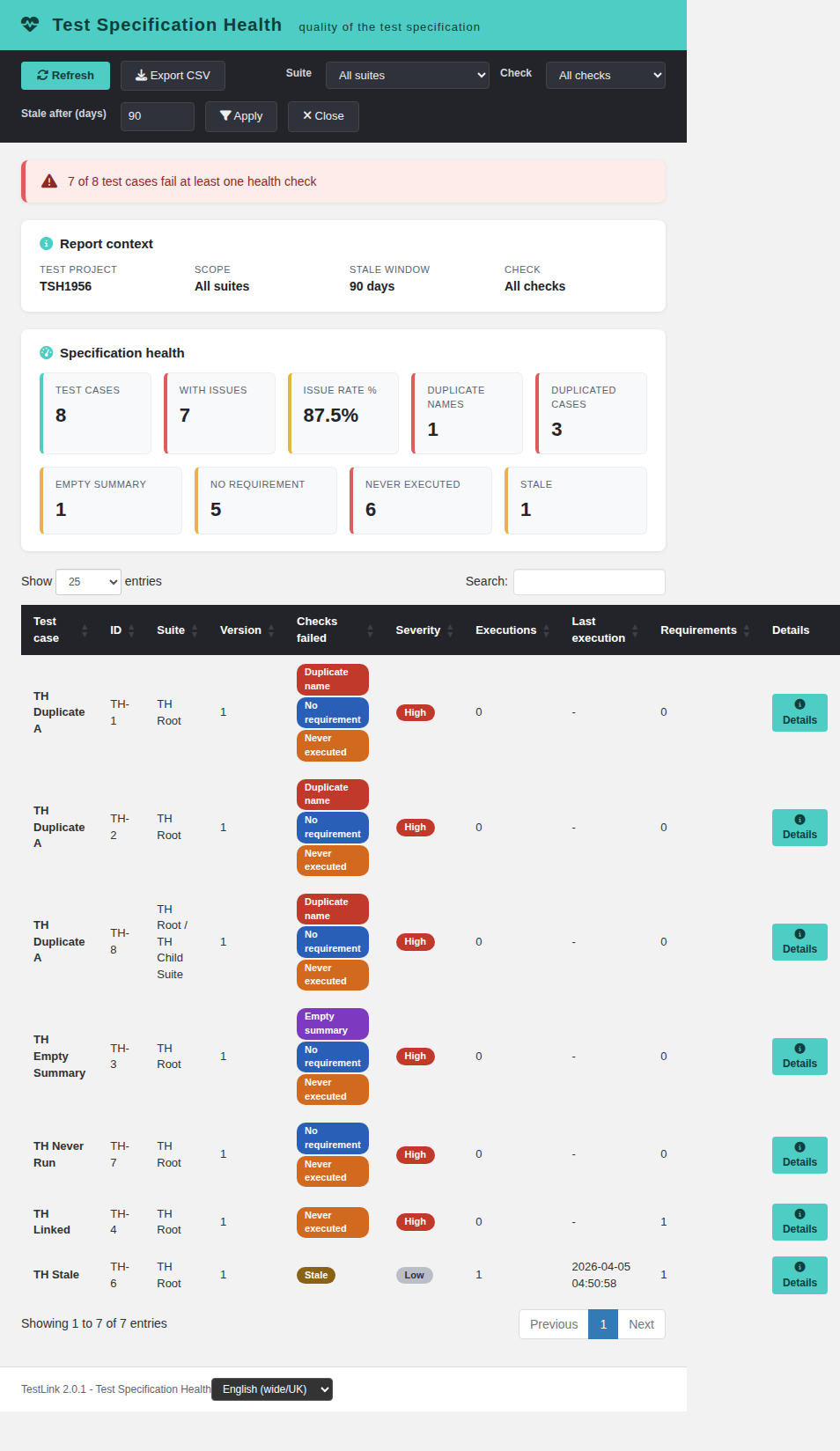
This screen closes that gap. For every test case of a test project it computes the health checks it fails and shows them together with the data needed to fix them (summary, steps, linked requirements, execution history).
The screen is read only — it never writes a test case.
| Check | Meaning | Severity |
|---|---|---|
duplicate_name |
another test case of the same project carries the same name (names are compared case-insensitively and after trimming, like the 1.9.20 duplicate check) | high |
empty_summary |
the latest version of the case has an empty summary | medium |
no_requirement |
no requirement in force is linked to the case (a link with is_active = 0 does not count) |
medium |
never_executed |
the case has no execution at all, in any test plan of the project | high |
stale |
the case was last executed more than N days ago (default 90, 1..3650) | low |
- A case that fails several checks gets the highest severity of them (high > medium > low).
- The severity of a check never changes its meaning:
duplicate_nameandempty_summaryare structural defects,no_requirementandnever_executedare coverage gaps,staleis only a reminder. - A healthy case is not listed — the report shows only the cases that fail something; the KPI cards still count the whole project.
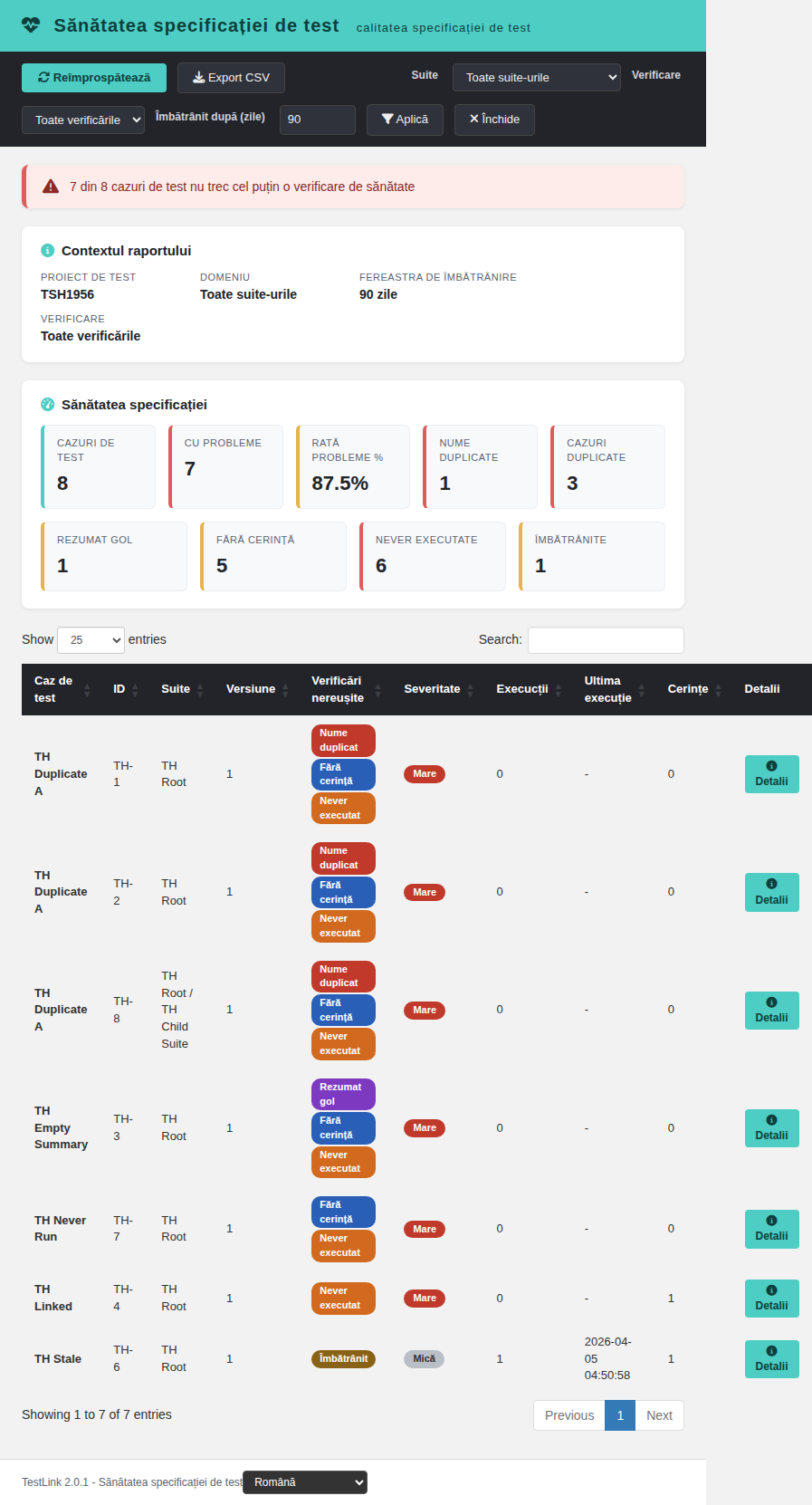
- Teal Dashio header with the subtitle quality of the test specification and
the client-side
TLi18nlocale switcher (10 locales) in the footer. - Toolbar: Refresh, Export CSV, the Suite and Check filters, the Stale after (days) field, Apply and Close.
- Report context panel: test project, scope (suite), stale window, check.
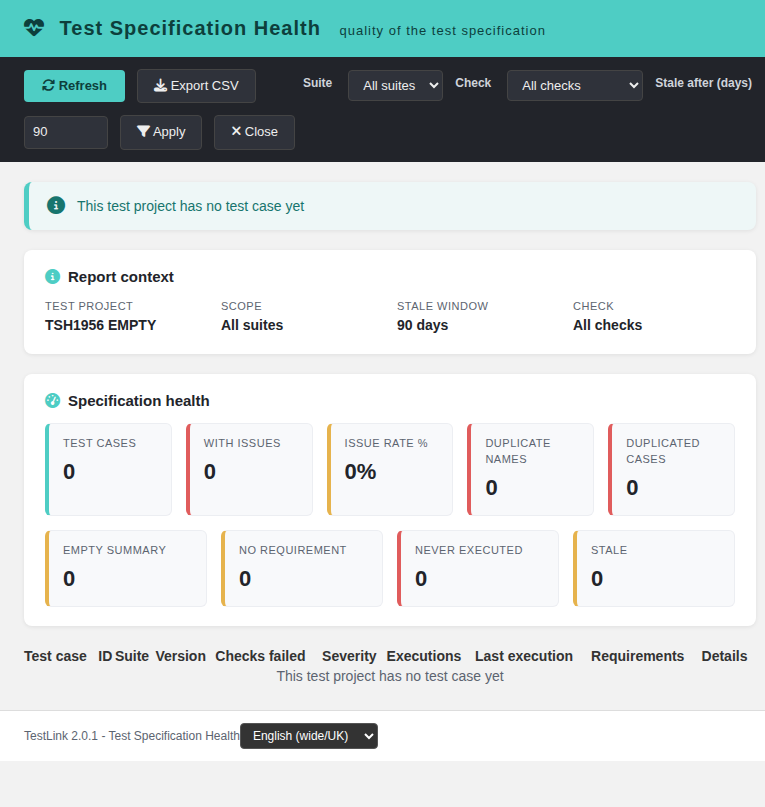
- Verdict banner: N of M test cases fail at least one health check, an "all clean" variant and a "this project has no test case yet" variant.
- Nine KPI cards: test cases, with issues, issue rate %, duplicate names, duplicated cases, empty summary, no requirement, never executed, stale.
- DataTable (10 columns, searchable, sortable): test case, external id, suite path, version, the failed checks as badges, the severity, the executions, the last execution, the number of linked requirements and the Details action.
-
Details modal: the check list of the case, the duplicate counter, the
summary, the steps (actions / expected result), the linked requirements and
the requirement versions. The modal moves the focus inside itself, traps
Tab, makes the backgroundinertand gives the focus back to the row button when it closes. -
CSV export of the current result set (UTF-8 BOM,
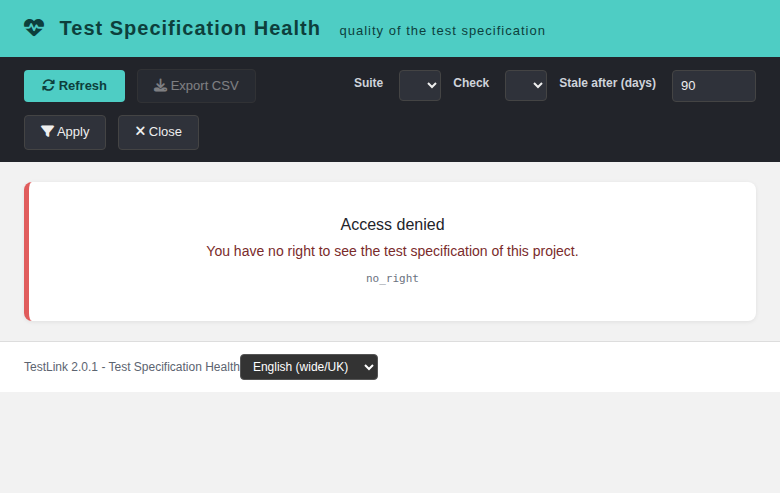
;separator, a formula-injection guard). - State cards for 400 / 401 / 403 / 404, each keeping the machine code of the BFF visible.
- Suite — the scope of the report: the whole project or one suite (including its sub-suites — the ancestry is walked up from the suite of the case, so selecting a parent suite does not drop the cases of its children).
- Check — one health check or all of them. The KPI cards and the banner always describe the whole analysed scope (they are the health of the scope); the table shows only the rows that match the check.
- Stale after (days) — the staleness window (1..3650, default 90); the value is clamped in the browser before the request.
| Route | Answer |
|---|---|
GET ?action=init&tproject_id=N |
the context + the suites of the project |
GET ?action=report&tproject_id=N[&suite_id=S][&check=C][&stale_days=D] |
the summary + the rows |
GET ?action=case&tproject_id=N&tcase_id=T |
the details of one case (steps, requirements) |
- Session based, read only (no write verb at all),
bffSameOriginGuard+bffEnforceSession. - The right
mgt_view_tcis checked on the addressed project before the project is resolved (the #1697 no-oracle lesson): a caller without the right gets403 no_rightfor an existing and for a missing project. - Machine codes:
not_authenticated/session_expired(401),no_right(403),tproject_not_found/tcase_not_found(404),invalid_request(400),method_not_allowed(405).
- The unit is the test case (
nodes_hierarchynode type 3); the analysed version is its latest version (node type 4 →tcversions.id). - The tree is walked with a recursive CTE over
nodes_hierarchy, so a suite scope includes the sub-suites. - The external id is the project prefix + the project-level counter of
the case (
tcversions.tc_external_id,TH-1), the same contract the legacy test-spec print used. - The executions of a case are counted over all the test plans of the project; the last execution timestamp is the newest one.
- The requirements of a case come from
req_coverage— only the links that are in force (is_active = 1) count. ONE rule feeds theno_requirementcheck, the counter of the row and the list of the details modal, so the modal can never print "no requirement" for a case the report counts as covered. - The duplicate groups and the duplicated cases are counted over the whole project, not over the filtered scope, so the counter of the modal ("3 test cases of this project carry this name") is the real one and the tiles do not change when a suite is filtered.
-
api/aside/index.php— the new item of the Test Specification section, gated onview_tc(the right the BFF enforces). -
lib/functions/common.php—$actions->tcSpecHealth. -
gui/templates/i18n/*.json—tsh.*(81) +footers.tcSpecHealthin all 10 client bundles (ai/verify_i18n_coverage.sh9/9 PASS). -
locale/*/strings.txt—$TLS_href_tc_spec_healthin all 19 server locales.
-
The closure scope bug — the evaluation closure of the report did not
list
$externalId/$projectPrefixin itsuselist, so the external id column came back empty (the variables are file scope, they are not inherited). Fixed before the first commit. - The empty project wording — a project without any test case showed the table message "No test case fails a health check in this scope", which claims that healthy cases were filtered out. The table now shows "This test project has no test case yet" when the project holds no case at all.
- Browser (EN + RO): render, the 9 KPI cards, the suite filter, the check filter, the stale window, the details modal, the CSV export, the empty project, 400 / 403 / 404 state cards, the anonymous redirect to the login page — console clean (no error / warning).
- API: the report of the fixture project (
tmp/fixtures_1956.php) returnstotal_cases 8,cases_with_issues 7,issue_rate_pct 87.5,duplicate_groups 1,duplicate_cases 3,empty_summary 1,no_requirement 5,never_executed 6,stale 1— the healthy case is not listed. - Fixture:
tmp/fixtures_1956.php(projectTSH1956with the prefixTH, the empty projectTSH1956 EMPTY, the usertshnorightswith the role 3). - Suite:
Issue #1956intmp/TLU_Test_Cases.md.