Admin Bill Number Serial Per Admission Type
By default, all inpatient admissions of a given department or institution share one bill-number sequence for Inward Deposit payments, and a separate shared sequence for Post Final Bill (post-discharge) Payments. This article explains an optional setting that lets each Admission Type (for example "BHT" ward admissions vs. "OPD Card" admissions) run its own independent serial for these two payment types instead.
This is an administrator-level decision — it changes how bill numbers are generated hospital-wide, not something billing staff configure themselves.
Some institutions track and reconcile BHT-ward admissions separately from OPD-Card (or other) admission categories — for example, for internal auditing, separate cashier reconciliation, or reporting that expects each admission category's payments to run in its own numbered range. Without this setting, deposit and post-final-payment bill numbers for all admission types are interleaved in a single sequence, which makes it harder to tell at a glance which numbered range belongs to which category.
| Payment | Affected when enabled |
|---|---|
| Inward Deposit (pre-discharge payment) | Yes |
| Post Final Bill Payment (post-discharge payment) | Yes |
| Deposit/Post-Final cancellations and refunds | No — unaffected, unchanged |
| Any other bill type (OPD, Pharmacy, Purchase Orders, etc.) | No — unaffected, unchanged |
Every Admission Type (e.g. BHT, OPD Card, CT Card) has a short Code, set on the Admission Types admin page:

When this setting is turned on, that code is inserted into the Inward Deposit and Post Final Payment bill numbers, and each admission type gets its own counter, starting from that admission type's existing bill history so no numbers are skipped or repeated:
| Setting | Example bill number |
|---|---|
| Off (default) | WardINWPAY/145 |
| On, patient admitted under BHT | WardINWPAY/BHT/62 |
| On, patient admitted under OPD Card | WardINWPAY/OPDCARD/14 |
The two admission types above are only an example — the counters split by whatever Admission Types the institution has actually configured.
- Go to Administration → Manage Institutions → Application Options.
- Click List Application Options, then filter the Key column for
Unique Serial Per Admission. - Click Edit Option on the row for
Bill Number Generation Strategy - Unique Serial Per Admission Type for Inward Payments. - Toggle Key Value to On.
- Click Save.
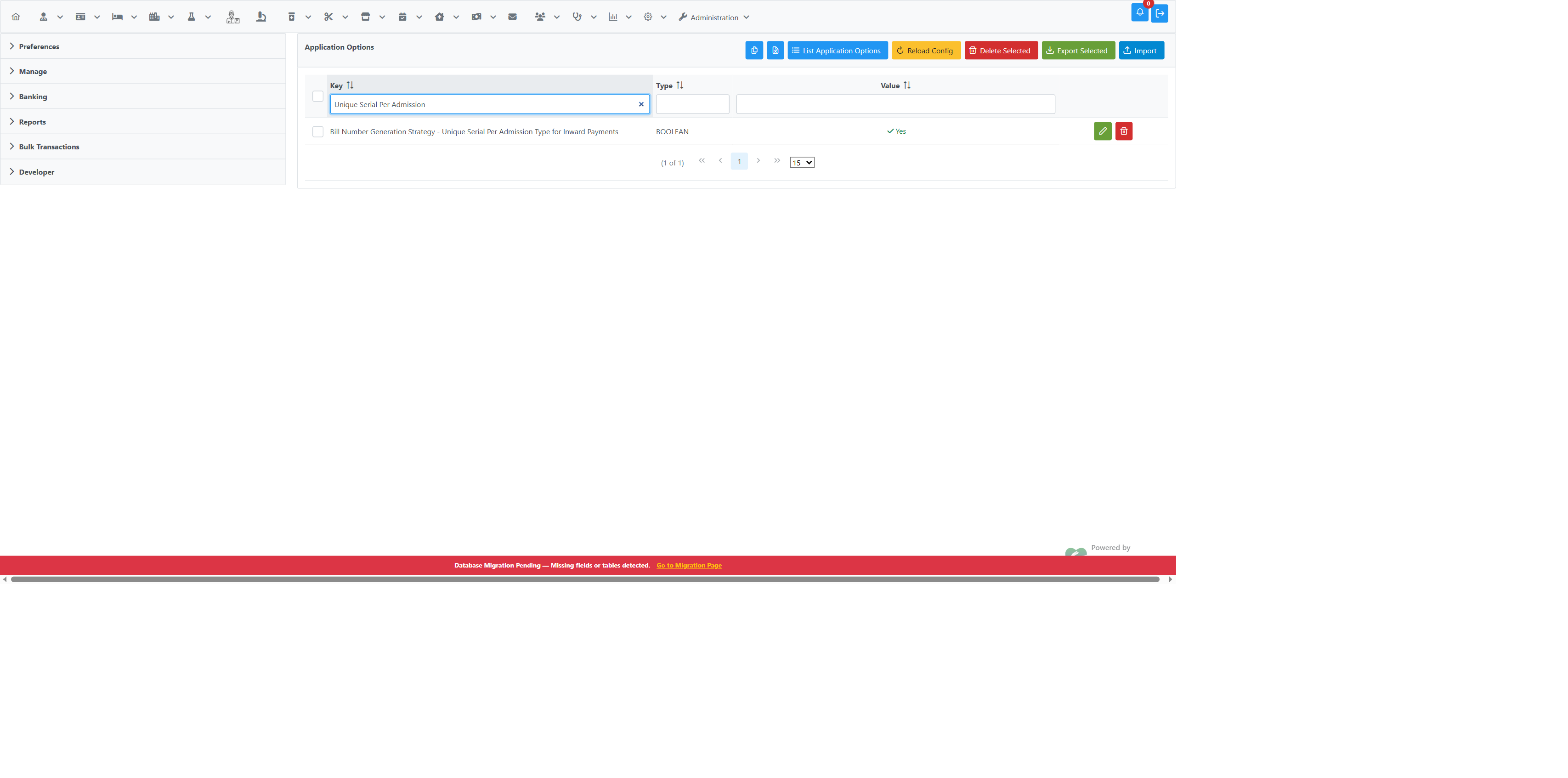
The setting takes effect for the next Inward Deposit or Post Final Payment bill created — no application restart is required.
- Applies hospital-wide. This is an application-level option, not per-department or per-admission-type — it turns the behaviour on for every Inward Deposit and Post Final Payment bill across the whole installation.
- Give every relevant Admission Type a short, distinct Code first. The code is what appears in the bill number, so blank or duplicate codes will produce confusing bill numbers. See Admin — Inpatient Admission Types.
- Existing bill numbers are not renumbered. Turning this on only changes bill numbers going forward; past deposit/post-final-payment bills keep their original numbers.
- A patient with no Admission Type recorded still uses the shared legacy sequence, even with this setting on.
Toggle the same Key Value back to Off and Save. New bills immediately return to the single shared sequence per department/institution; the per-admission-type counters are simply not used again (they are not deleted, so re-enabling later resumes from where each one left off).
- Admin — Inpatient Admission Types — where the Admission Type Code used in the bill number is configured
- Admin — Inpatient Module Behaviour (Config Keys) — other Inward-related configuration keys, including the equivalent BHT-number setting
- Application Options — general guide to finding and editing configuration keys
- Admin — Application-Level Configuration — how application-level options work