Repository navigation
Argus Recon Toolkit Installation Guide
Source and visual review: November 17, 2026. No toolkit installation, launch, target scan, API use or personal investigation was performed.
This guide covers the Python-based Argus reconnaissance toolkit.
The older jasonxtn/argus link redirects there. At review, GitHub reported the
repository was not archived; its main commit was
f51c0442802f
from December 10, 2025. That status does not establish ongoing maintenance,
software integrity or compatibility with a particular host.
The inspected package metadata declares Python >=3.10, not a requirement for Python 3.12+. Validate the interpreter and dependency resolution for the revision you actually select.
Provide a source-reviewed Debian/Ubuntu setup path using an isolated Python package environment. This is a single-tool installation reference, not a general OSINT methodology or a verified field-assessment procedure.
Separates repository selection, environment creation, dependency installation and launch. Explains interpreter selection and the difference between package isolation and a security sandbox.
Help a reader prepare a documented environment while distinguishing a successful package install, a successful launch and valid assessment results.
- Preparing a new authorized research environment on Debian/Ubuntu.
- Diagnosing an externally managed Python installation or interpreter mismatch.
- Returning to an existing checkout without assuming its location or activation state.
Use a supported Debian/Ubuntu release and confirm the available Python version against the selected upstream revision. A minimal starting package set is:
sudo apt update
sudo apt install git python3 python3-venv
python3 --version
Native build tools and development headers may be needed if a dependency must compile from source. Install the packages required by the actual error and host distribution; they do not guarantee a successful build.
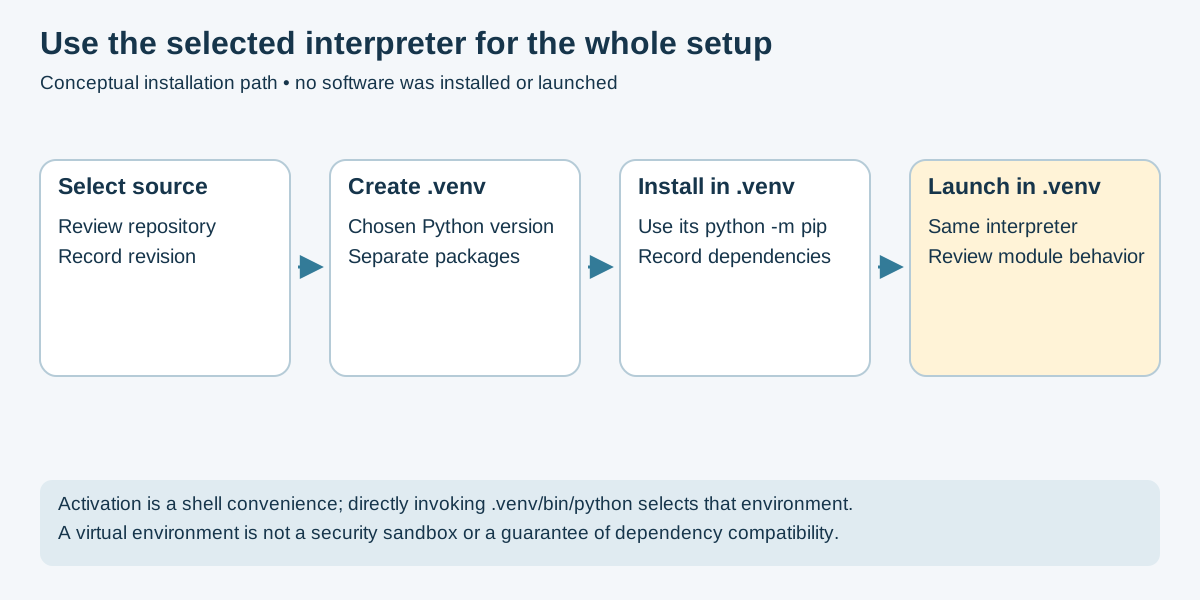
Figure 1 — Original conceptual environment-selection diagram based on Python's venv documentation. It is not a tested installation record.
Choose a working directory, then clone into the explicitly named directory:
git clone https://github.com/divinelabio/Argus.git argus
cd argus
git rev-parse HEAD
Review and record the selected revision and its dependency files. The examples
below run from that checkout. A later clone of main can contain different code
from the reviewed snapshot.
python3 -m venv .venvThe externally managed environments specification protects marked interpreter installations from conflicting package-manager changes. It does not require every Linux Python use to happen in a virtual environment. A venv is the approach used here; do not work around the marker with a system-wide forced pip install.
Activation is optional when using the environment's interpreter explicitly. For Bash/Zsh convenience:
source .venv/bin/activateActivation adjusts this shell's command search path; a prompt change alone is
not a compatibility test. Subsequent examples use .venv/bin/python so interpreter
selection remains explicit without relying on activation.
Inspect the environment's pip first:
.venv/bin/python -m pip --versionIf the chosen dependencies require newer packaging/build tools, update them inside this environment and record the resulting versions:
.venv/bin/python -m pip install --upgrade pip setuptools wheelThis retrieves packages and may change dependency resolution; it is not a reproducible lock or an unconditional requirement for every future release.
The inspected checkout has a broad requirements file
and a different dependency list in pyproject.toml. They are not interchangeable
lockfiles. This source-checkout path follows the requirements-file approach
documented upstream:
.venv/bin/python -m pip install -r requirements.txt
.venv/bin/python -m pip check
.venv/bin/python -m pip freeze > installed-packages.txt
Keep the revision, Python version, platform and resolved dependency record
together. pip check checks installed dependency relationships, not full import
coverage, security or network-module functionality. Open version bounds can
resolve differently over time. pip freeze
records installed packages; it does not calculate a lockfile or certify that
the same environment can be rebuilt on another platform.
The inspected module entry point supports:
.venv/bin/python -m argusDo not assume every module is passive because the toolkit is described as OSINT. Review the selected module, destinations, credentials, authorization and collection limits before an approved run. Starting a UI does not establish that external providers or every module are available.
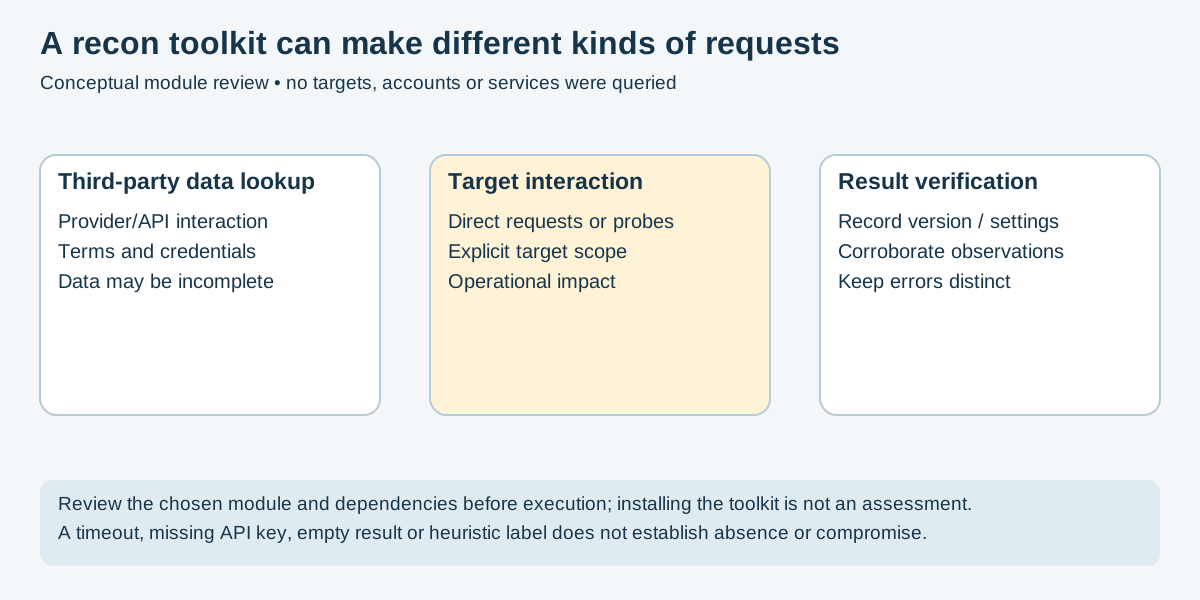
Figure 2 — Original conceptual module-review model. The upstream project includes both data lookups and direct network/web analysis; the diagram is not a record of any run or a claim that a module's results are correct.
Return to the actual checkout path, not an assumed ~/argus location:
# Replace this with the directory where you cloned the project.
cd /path/to/argus
.venv/bin/python -m argus
No activation is required for this explicit interpreter path. If the checkout or environment moved, recreate and validate the environment rather than assuming a copied venv is portable.
- Canonical upstream repository and the pinned source links above establish the inspected identity and code layout.
- Python venv explains activation, interpreter paths and environment limitations.
- Externally managed environments explains the packaging boundary.
Commands are documentation examples reviewed against sources. They were not executed in a clean Debian/Ubuntu installation, and no dependency or module compatibility is certified. Protect any future API credentials and exports; record failures and uncertain results separately from validated findings.
- README.md - OSINT section index
- OSINT_TOOLS_CATALOG.md - Full tool catalog context
- Playbook/README.md - Investigator playbook
- Source verification - Corroboration and provenance limits
- Legal terms - Scope and authorized use
📄 Source: OSINT/argus_osint.md | ✏️ Suggest an edit | ⬅️ Back to Open Source Intelligence (OSINT)