Repository navigation
PhantomDrive Experimental Hidden Encrypted USB Research Guide
Last reviewed: 2026-11-01 (upstream documentation reviewed; build and hardware not tested)
Prerequisites: Encrypted storage fundamentals · Applied cryptography
Warning
Research-only project. The upstream PhantomDrive project explicitly states that its code has not been professionally audited. Use only a disposable microSD card and non-sensitive synthetic files. Do not deploy it for client records, regulated data, or irreplaceable material without independent security evaluation and an appropriate recovery plan.
For the difference between locked ciphertext, mounted plaintext, and the host's remaining attack surface, review the encrypted-storage protection-boundary diagram before experimenting with firmware variants.
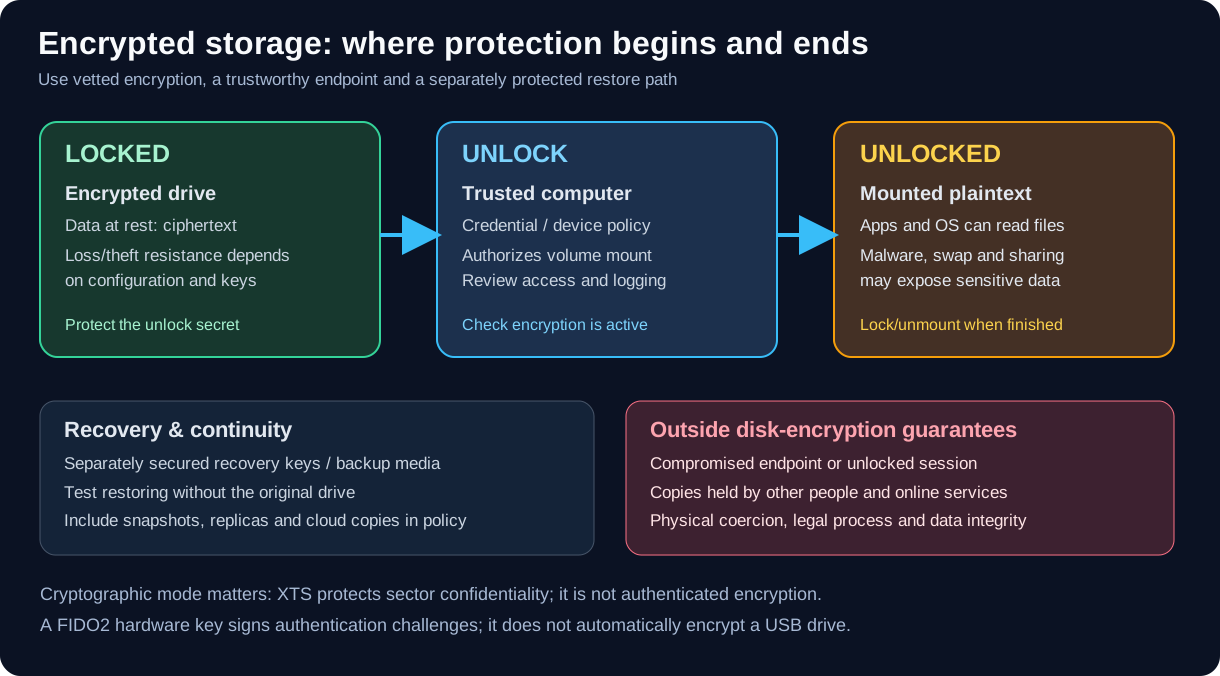
PhantomDrive is an open-source encrypted USB drive experiment with a decoy or visible volume and a second encrypted area that can remain hidden until unlocked.
- Main project: o7-machinehum/phantomdrive
- Controller: WCH CH569W system-on-chip with USB 3, SDIO and AES hardware.
- Hardware design and firmware are published in the project repository.
- Unlock is triggered by writing content containing a password: marker to the locked volume. The drive then changes exposed storage. This is not equivalent to proven plausible deniability.
- The repository documents builds using AES-256-CTR or AES-256-XTS with PBKDF2-HMAC-SHA256 at 100,000 or 600,000 iterations, depending on the firmware variant. The build parameters affect the encrypted on-disk format.
Important
Verify the firmware actually flashed. Do not assume XTS simply because it appears in the main README. CTR and XTS have materially different storage-security considerations, and changing the AES mode or PBKDF2 settings can make existing data inaccessible without migration.
PhantomDrive is a useful lab for investigating USB mass storage presentation, on-device key derivation, AES encryption modes, FAT32 decoy volumes, microcontroller firmware trust and the gap between hidden storage and independently verified confidentiality.
| Concern | Why it matters |
|---|---|
| No professional audit | Security claims have not been independently established |
| CTR build options | Reusing counter-derived keystream across rewritten sectors can leak relationships between plaintext versions |
| XTS build options | XTS addresses different storage confidentiality requirements but does not authenticate writes |
| Password-file unlock | Content-based marker detection can interact with ordinary writes; the file need not have a particular filename |
| Host artifacts | Shell history, editors, file indexing, swap, backups and logs may retain entered secrets or access history |
| Firmware and KDF changes | Incompatible builds can make stored data unreadable |
| Hidden partition | Not a guarantee against forensic discovery, physical attack, tamper detection or compelled disclosure |
| Sudden removal / corruption | In-place operations and FAT filesystems need controlled testing and recoverable backups |
- Read the current upstream README and any test documentation at the commit you will use.
- Assemble only supported hardware according to published schematics and bill of materials; verify the board revision and power requirements.
- Prepare a dedicated Linux lab machine or VM with authorized USB access and a blank, disposable microSD card. Disconnect any other removable drives that could be mistaken for the target.
- Clone the upstream repository for local inspection:
git clone https://github.com/o7-machinehum/phantomdrive.git
cd phantomdrive
git rev-parse HEAD
git submodule status- Inspect the exact revision's README, Makefile, firmware options, and test results. Follow the upstream build/flash instructions only after validating toolchain and board compatibility. The upstream references the patched HydraUSB3 xPack toolchain and the WCH USB ISP programmer; those steps are hardware- and revision-dependent.
- Record firmware variant (CTR or XTS), KDF rounds, commit hash, test media identifier, and observations in a lab notebook. Never publish passwords or test credentials.
- Use a fresh random lab-only password. Prefer the upstream's interactive or controlled input workflow over entering secrets in a command line; do not paste a real secret into a shell command, editor with swap/autosave, ticket, or shared chat.
- With synthetic data only, inspect the decoy view, unlock via the current official procedure, and verify the expected encrypted view appears. Safe-eject before disconnecting.
- Power-cycle, test correct and incorrect credentials, file readability, and SHA-256 hashes. Treat any corruption or unexpected unlock as a test failure.
- Record findings, securely dispose of the lab-only media or reinitialize it as appropriate, and preserve independent copies of your dummy test set.
lsusb
lsblk -o NAME,MODEL,SIZE,TRAN,FSTYPE,MOUNTPOINTS
sha256sum ./test-files/example.bin
The final hash command is for a local dummy test file. Compare it with the hash of its independently retained original; hashing alone does not prove encryption safety.
- Does firmware authenticate itself or support secure boot? If so, is the mechanism independently verified?
- Is the password derivation salted per device or per volume? How are salt, keys and reset conditions handled?
- Are password attempts limited, and can unauthorized writes falsely trigger unlock detection?
- Can changing exposed volumes leak state to the operating system or USB monitoring tools?
- What happens on power loss during an in-place operation?
- What is actually tested: encryption round trips, repeated-sector rewrites, corrupted sectors, power cycling, and filesystem recovery?
- Does a claimed decoy partition withstand the specific forensic adversary in your threat model? Do not assume so.
Operator input only: Record real measurements, revision, sources and timestamps in a private lab record. For a skipped or unavailable test write Not tested with a reason; for unknown device provenance write Not recorded. Blank cells are not a successful unlock/cryptographic validation.
| Field | Record |
|---|---|
| Date/operator | |
| Board revision and serial | |
| Upstream URL and exact commit | |
| Build mode / KDF rounds | |
| Test-media model and size | |
| Test-file SHA-256 before / after | |
| Lock/unlock observations | |
| Wrong-password outcome | |
| Power-cycle and recovery result | |
| Known limitations / follow-up issues |
- Encrypted Drives and Removable Storage
- SoloKeys: different category of cryptographic device
- Hardware Security Keys and Passkeys
- Hardware Hacking
- OPSEC
- Upstream PhantomDrive
Section Index | Master Index | Legal Notice
📄 Source: Cryptography/phantomdrive-guide.md | ✏️ Suggest an edit | ⬅️ Back to Cryptography
- 🗺️ Browse by Topic
- 📂 All Repository Files
- 🧭 Learning Paths
- 📖 Master Guide
- 🔤 Glossary
- ⚖️ Legal & Disclaimer
📘 Foundations & Learning
🛡️ Defense & Investigations
- Incident Response
- Open Source Intelligence (OSINT)
- Reverse Engineering
- Operations Security (OPSEC)
- Compliance
☁️ Platforms & Infrastructure
📡 Hardware, Wireless & Field Projects
- PNWC Cyberdeck
- Hardware Testing
- Hardware Hacking
- Software-Defined Radio
- Wardriving
- uConsole
- Space Security
🧰 Assessment & Field Reference
📦 Downloads & Project Resources
🗂️ Additional Topics