Repository navigation
Cryptographic Algorithm Reference
Important
Educational design-review reference, not an implementation or compliance approval. Use reviewed protocols and vetted libraries; verify applicable standards, parameters and validated-module requirements for the deployment.
Distinguish cryptographic roles and identify candidate algorithms and parameters, including legacy restrictions and post-quantum migration concerns.
Summarize symmetric encryption, key establishment, signatures, hashes and password functions. Separate general engineering guidance from NIST approval status and from the requirements of a particular protocol.
Help a reviewer ask the right algorithm, parameter, implementation and key-lifecycle questions without treating a primitive name as a complete security design.
- Reviewing algorithm and parameter choices in a design or codebase.
- Distinguishing new protection from legacy decryption or signature verification.
- Planning migration based on data lifetime, dependencies and applicable policy.
Source and visual review: November 17, 2026. Selective reference, not an exhaustive algorithm catalog. No cryptographic deployment or operational key change was performed.
- Symmetric Encryption
- Asymmetric Cryptography
- Hash Functions
- Key Derivation Functions (Passwords)
- Post-Quantum Algorithms
- Resources
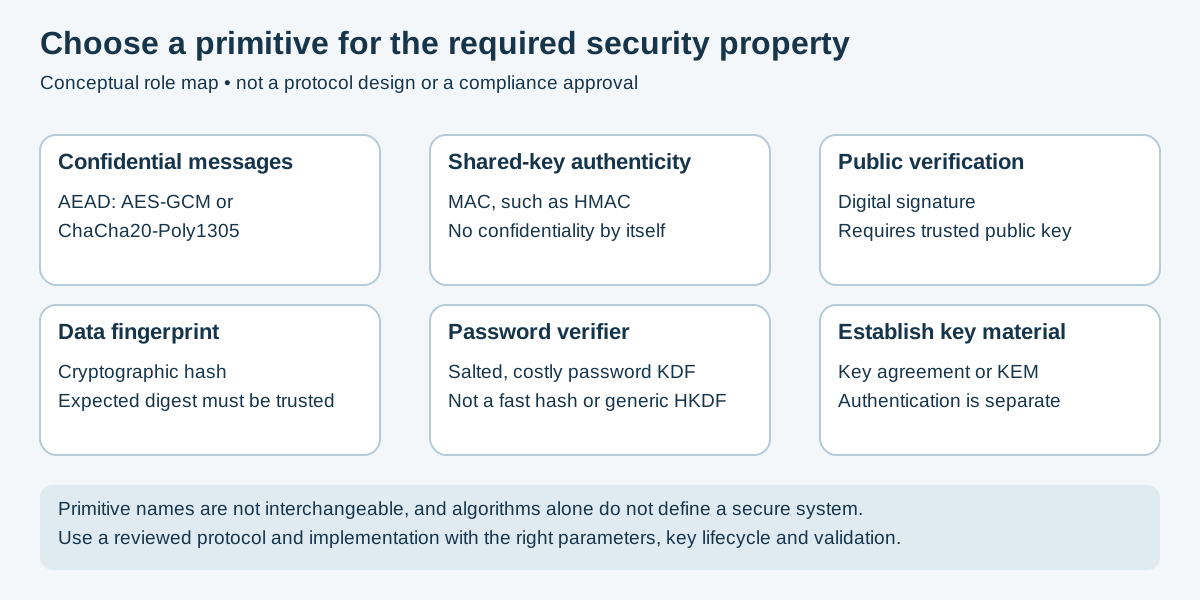
Original conceptual role map. A hash needs a trusted comparison value; a signature needs a trusted verification key. The diagram is a design-review aid, not a secure protocol specification.
A shared secret key supports efficient bulk protection. Prefer an authenticated encryption construction supported by the protocol rather than composing modes and authentication ad hoc.
| Algorithm / Construction | Review Guidance |
|---|---|
| AES-128-GCM / AES-256-GCM | Common AEAD choices. Nonce generation, tag length, message limits and key lifetime must follow the construction and protocol. |
| ChaCha20-Poly1305 | IETF AEAD construction with a 256-bit key; useful where implementation/platform support fits. See RFC 8439. |
| AES-CBC / AES-CTR | Confidentiality modes alone do not authenticate. Use only a reviewed protocol that supplies authentication; avoid designing a new composition. |
| AES-ECB | Unsuitable for general message confidentiality because repeated blocks reveal structure. Specialized internal uses do not make it a message-encryption default. |
| TDEA / 3DES | NIST disallows applying new protection after 2023; specified legacy processing is a separate category. See NIST's withdrawal notice. |
| DES / RC4 | Do not choose for new protection. Migration and any required legacy processing need explicit policy. |
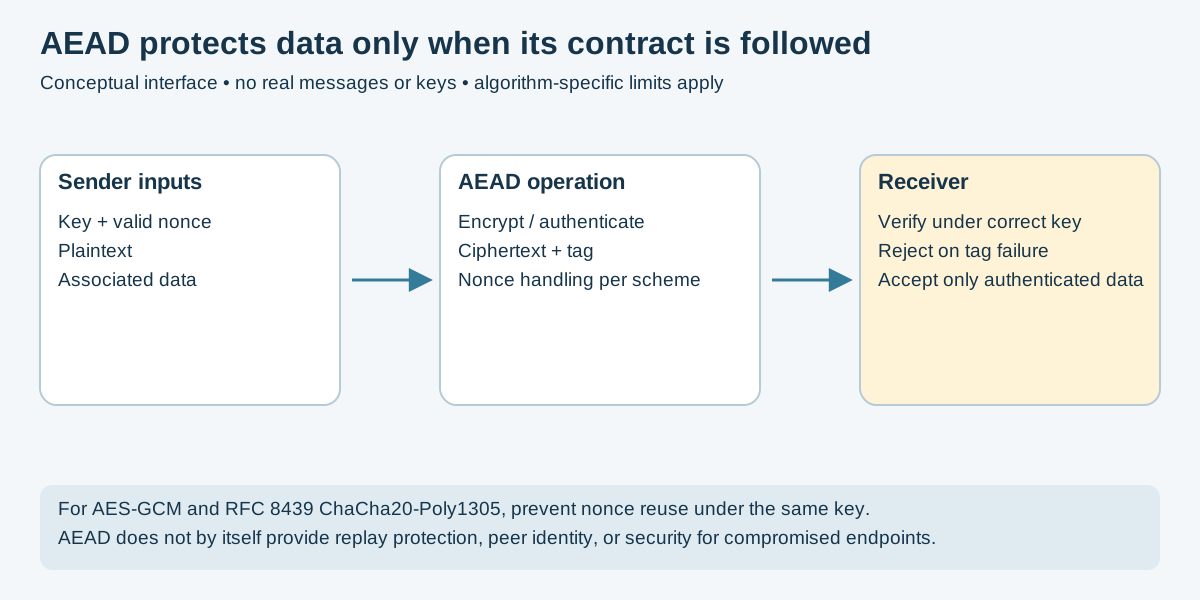
Original conceptual AEAD interface. NIST GCM guidance and RFC 8439 define construction-specific requirements. Associated data is authenticated, not encrypted.
For the GCM and ChaCha20-Poly1305 constructions above, prevent reuse of a nonce with the same key. Follow the protocol's nonce scheme rather than assuming random generation is always sufficient. Reject authentication failure without releasing unauthenticated plaintext. AEAD does not alone establish peer identity or prevent replay.
Public/private key schemes have different roles: key agreement or encapsulation establishes secret material; signatures authenticate messages under a verification key. Neither role is interchangeable with bulk encryption.
| Algorithm / Family | Role And Limits |
|---|---|
| X25519 | A key-agreement function using Curve25519; not a signature. Use the complete protocol, validation and KDF requirements. See RFC 7748. |
| Ed25519 | An EdDSA signature scheme; not key agreement. Deterministic signing does not remove implementation, side-channel or key-management risks. See RFC 8032. |
| ECDSA / ECDH with P-256 or P-384 | Signature and key-agreement uses respectively; nonce/validation requirements differ. Check protocol and approved implementation requirements. |
| RSA | Choose strength, padding and key lifetime under policy. RSA-2048 and RSA-3072 do not provide identical classical strength; neither solves the quantum threat. |
| RSA at or below 1024 bits | Do not use for new protection. Any legacy verification/decryption must be assessed under its separate policy. |
| DSA | Do not select for new signature generation; FIPS 186-5 retains a separate legacy-verification allowance. |
| Static DH versus ephemeral DH | Ephemeral secrets can support forward secrecy in a correctly authenticated protocol when managed and erased appropriately. The algorithm name alone is insufficient. |
FIPS 186-5 concerns digital signatures, not a universal approval of every protocol using the named curves. For RSA, RFC 8017 distinguishes RSAES-OAEP encryption, RSASSA-PSS signatures and the separate PKCS #1 v1.5 encryption/signature encodings. Prefer the protocol's modern supported schemes; do not conflate weaknesses of legacy encryption padding with a blanket claim that all PKCS #1 v1.5 signatures are broken.
These classical public-key families require a post-quantum transition plan. Increasing RSA or elliptic-curve key sizes does not make them quantum-resistant.
A hash is a deterministic digest, not encryption and not sender authentication. Integrity comparison is useful only when the expected digest is itself trusted.
| Family | Review Guidance |
|---|---|
| SHA-256 / SHA-384 / SHA-512 | SHA-2 fixed-length digests; choose output length and use under the actual protocol. |
| SHA-3 / SHAKE | Different standardized constructions; SHAKE is an extendable-output function, so output length is part of the design. |
| BLAKE2 / BLAKE3 | Distinct modern families with different specifications and modes. Suitability does not imply NIST/FIPS approval. |
| SHA-1 | Avoid for new designs. Collision-sensitive uses and legacy HMAC/verification have distinct transition categories; see NIST's SHA-1 policy. |
| MD5 | Broken collision resistance; do not use as an adversarial security fingerprint. |
Use a supported MAC such as HMAC, a signature, or an AEAD construction when authentication is required. The appropriate choice depends on shared-key versus public-verification requirements. A bare digest does not supply those properties.
A password verifier needs a salted, deliberately expensive password function. A fast digest can make offline guesses cheap; the actual guessing difficulty also depends on password entropy, cost parameters and attacker resources.
| Function | Review Guidance |
|---|---|
| Argon2id | Memory-hard option described in RFC 9106; choose memory, time and parallelism parameters within the application's resource budget. |
| scrypt | Memory-hard password KDF specified in RFC 7914. |
| bcrypt | Mature password-hashing option; input-length and encoding limits depend on the implementation. Do not silently truncate or invent a prehash scheme. |
| PBKDF2 | CPU-cost password derivation; not memory-hard. Approval depends on parameters and implementation, not the name alone. |
| Fast MD5/SHA digest of a password | Inappropriate as a standalone password-storage design, even with a salt. |
Generate a fresh salt per password using the library's documented mechanism, store salt and cost/version metadata with the verifier, and benchmark the cost. Salts are not secret keys. Rate-limit online attempts independently.
HKDF (RFC 5869) derives keys from input keying material; it is not a deliberately slow password-hardening replacement. Consult the password-storage guide and applicable validated-module policy when selecting an implementation.
NIST's first three finalized PQC standards were published in August 2024:
| Standard | Algorithm | Role |
|---|---|---|
| FIPS 203 | ML-KEM, derived from CRYSTALS-Kyber | Key encapsulation to establish shared secret material; not bulk-data encryption or a signature. |
| FIPS 204 | ML-DSA, derived from CRYSTALS-Dilithium | Digital signatures. |
| FIPS 205 | SLH-DSA, based on SPHINCS+ | Stateless hash-based digital signatures. |
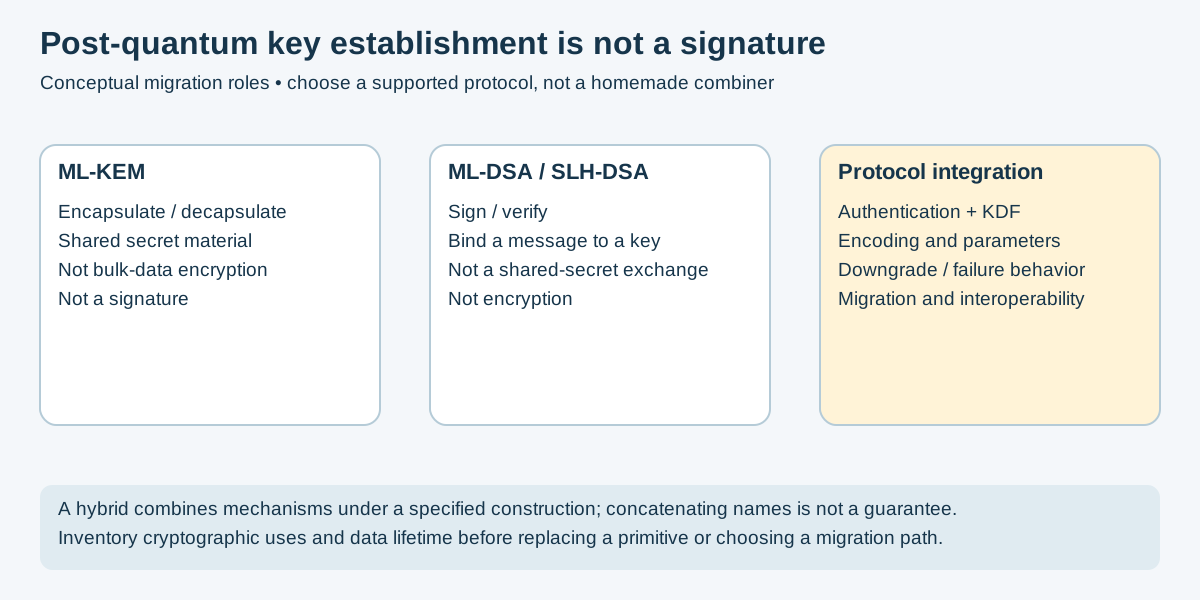
Original conceptual role comparison. Standards-derived names are not interchangeable with every pre-standard submission or parameter encoding. Use the finalized specifications, applicable errata and supported implementations.
The final NIST IR 8547, published in October 2026, describes transition from quantum-vulnerable key establishment and signatures. Use it with applicable organization/protocol requirements rather than the former vague "near-term" RSA recommendation. Inventory dependencies and data-protection lifetime, including long-lived confidentiality needs.
A hybrid can combine classical and post-quantum mechanisms, but its security depends on the construction, authentication, combiner and implementation. Do not treat "use both" as an automatic guarantee or assemble a protocol by concatenating primitives. Use a supported, reviewed integration and test interoperability and failure behavior. See the README PQC section.
- NIST SP 800-131A Rev. 2 — final transition guidance.
- SP 800-131A Rev. 3 — initial public draft; draft proposals are not a final revision.
- NIST IR 8547 — final PQC transition report, October 2026.
- NIST PQC project.
- FIPS 186-5 — signatures.
- RFC 8439 — ChaCha20-Poly1305.
- RFC 9106 — Argon2.
- RFC 8017 — RSA encodings.
- README.md — Cryptography index.
- applied-crypto.md — Applying algorithms correctly.
- Classical/ — Classical ciphers and their limitations.
📄 Source: Cryptography/algorithms.md | ✏️ Suggest an edit | ⬅️ Back to Cryptography