Repository navigation
AI Agent Reliability Idempotency and Failure Recovery
Last reviewed: 2026-11-24
An agent is reliable when it does the intended work within its boundaries, detects failures, and recovers without duplicating or corrupting side effects. A successful model answer is not necessarily a successful workflow.
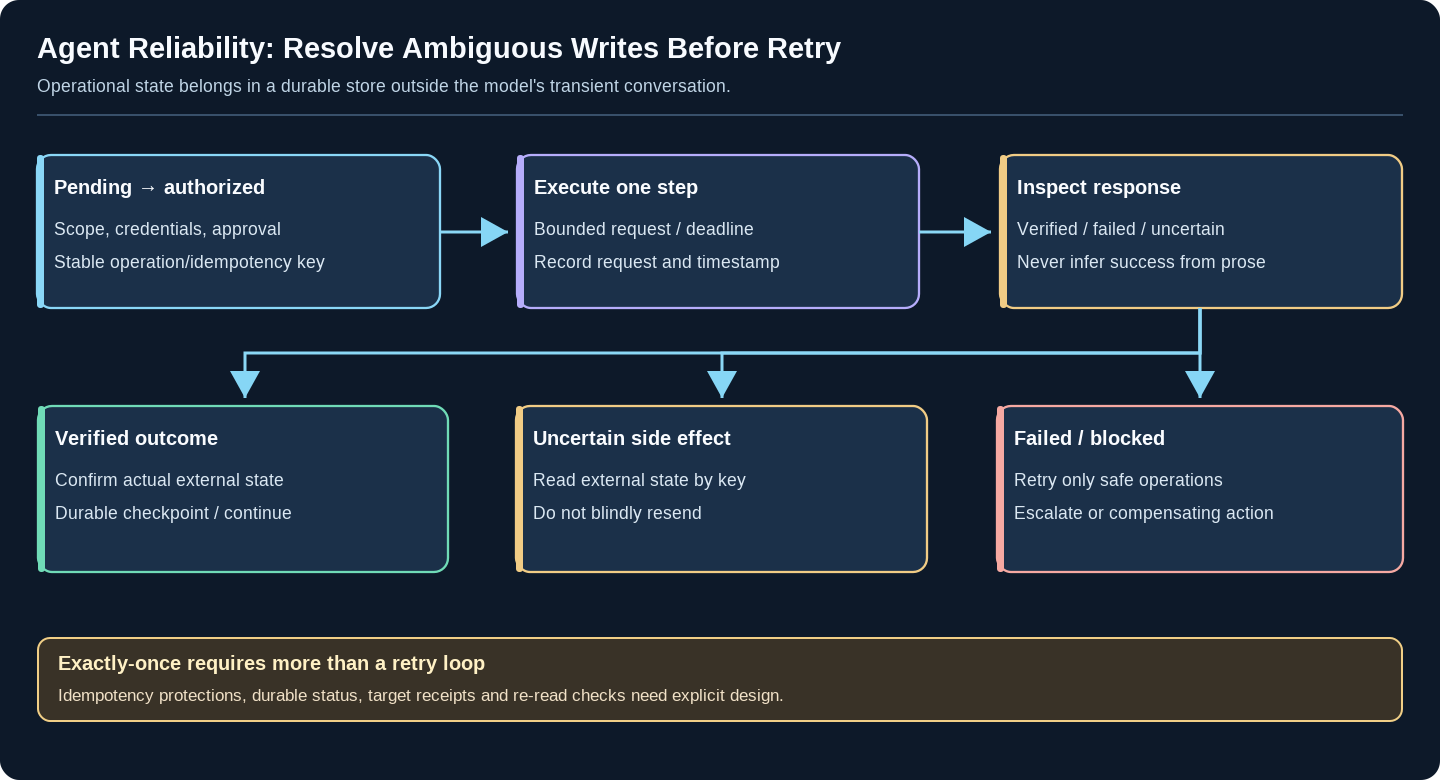
Conceptual state and evidence boundaries. A network timeout after a write attempt is an unknown outcome, not proof that no write occurred. Check the target state with a stable operation key before a repeat. Retrying without this readback can duplicate tickets, emails or permission changes.
Use explicit statuses in a persistent store: PENDING, RUNNING, WAITING_APPROVAL, VERIFYING, SUCCEEDED, FAILED, BLOCKED, CANCELLED. State must be stored outside the model's transient reasoning.
| Failure | Example | First Response |
|---|---|---|
| Transient read failure | Network timeout while fetching a file | Bounded retry with backoff |
| Ambiguous write | Ticket API times out after receiving request | Check remote state using idempotency key |
| Authorization denial | 403 or missing approved scope | Stop; do not switch credentials |
| Schema or contract drift | Tool rejects old argument shape | Review API version, update tests |
| Model reasoning error | Uses wrong asset ID | Validate identity and reject write |
| Duplicate delivery | Two webhook events for same alert | Deduplicate and record |
| Partial success | 2 of 4 tasks completed | Record per-step state and compensating actions |
| Irreversible action | Email sent / account deleted | No blind replay; escalate |
A reliable step records:
task_id: LAB-TRIAGE-014
operation: ticket.create_draft
scope: authorized-lab
input_hash: "sha256:EXAMPLE"
idempotency_key: "LAB-TRIAGE-014-draft-v1"
requires_approval: false
preconditions: ["case exists", "caller authorized", "no existing draft"]
expected_postcondition: "exactly one draft linked to case"
verify_with: "ticket.read_by_external_key"
on_timeout: "read_before_retry"
on_failure: "mark blocked; preserve evidence"
Keep intent, action request, tool acknowledgement, and verified postcondition separate. Most API acknowledgements prove the request was handled, not that downstream asynchronous work is finished.
In distributed systems, "exactly once" is hard; practical workflows often use at-least-once delivery plus idempotent handlers.
# Illustrative application-side pseudocode. Replace with transactional DB ops.
def handle_event(event, db, client):
    key = event["event_id"]
    with db.transaction():
        record = db.get_operation(key)
        if record is not None:
            if record.status == "SUCCEEDED":
                return record.result
            # RUNNING, UNKNOWN or FAILED is not proof of success or safe replay.
            raise NeedsReconciliation(key)
        # Atomic unique insert prevents concurrent local reservations.
        db.reserve_unique(key, status="RUNNING")
    try:
        result = client.create_draft(
            case_id=event["case_id"],
            idempotency_key=key,
        )
        # Read back the target; do not infer success from a timeout.
        confirmed = client.get_draft(result["id"])
        db.mark_completed(key, confirmed["id"])
        return confirmed
    except Exception:
        db.mark_unknown(key)  # reconcile before retry
        raise
The pseudocode is not atomic across a database and remote API; a unique local record alone cannot prevent duplicates if the remote endpoint lacks idempotency. Use remote idempotency support where available, a transactional outbox if appropriate, and reconciliation by external key. On replay, reconcile an existing RUNNING or UNKNOWN operation with the remote service before making another request. If the endpoint has no idempotency support and no reliable lookup by operation key, keep the action blocked for manual resolution; a timeout or missing result does not prove that the side effect did not occur.
- Classify errors as retryable or terminal. 400 validation, 401/403 permission and missing authorization usually need review, not retries.
- Bound retries, set operation-specific timeouts, and use exponential backoff with jitter.
- Respect documented
Retry-Afterand rate limits. - Do not retry non-idempotent side effects until remote state is reconciled.
- Use circuit breakers to avoid storms during widespread outages.
- Route exhausted failures to a dead-letter queue or
BLOCKEDstate with an owner. - Capture the original failure context and exact next safe action.
Backoff example: initial delay 1 second, double through a configured cap with random jitter; stop after an explicit attempt/time budget. Values should be tuned to API limits and business impact.
Checkpoint after each meaningful outcome with task ID, environment, source commit, tool result, readback evidence and next step. Preserve an append-only event log where feasible.
CHECKPOINT 2026-11-09T14:00:00-08:00
Project: authorized Wazuh lab
Milestone: M3 test false-positive control
Last verified: synthetic alert reached rule 100001
Not verified: benign login burst, duplicate webhook handling
Remote writes: none
Branch/commit: EXAMPLE_SHA
NEXT: run benign fixture under controlled test, record expected vs actual
STOP IF: production alert routing discovered or scope uncertain
On resume, inspect live service and repository state first, then decide whether a task should run. Do not trust a stale note or prior assistant claim.
For a reversible change, plan backup and rollback before a write. A compensating action may undo some effects but is not guaranteed equivalent to a transaction. For a sent email or disclosed secret, rollback is impossible; containment and incident response are required.
| Operation | Precondition | Verification | Recovery |
|---|---|---|---|
| Create draft | User and case known | Read draft ID/content | Delete draft with approval |
| Update Git branch | Expected prior SHA | Fetch new SHA and diff | Revert reviewed commit |
| Deploy lab rule | Backup/config checksum | Rule test + service health | Restore prior config |
| Send message | Exact approver + recipient | Delivery record | Cannot unsend reliably |
| Delete data | Retention/legal hold checks | Readback with audit | Restore if protected backup exists |
- Disconnect a read-only fetch for one request: expect bounded retry and recorded recovery.
- Timeout a draft write after remote persistence: expect readback, no duplicate.
- Submit duplicate alert IDs: expect one triage case.
- Advance Git branch between planning and writing: expect optimistic lock failure, not forced overwrite.
- Remove authorization before an action: expect block, no credential fallback.
- Simulate agent restart between approval and write: expect approval revalidation, not replay.
Measure: incorrect side effects, duplicated writes, unresolved ambiguous operations, time to detect failure, recovery success, and acceptance-test coverage. Do not treat a low tool-exception count as proof of correctness.
Milestones · Multi-Agent Orchestration · Observability · MCP Permissions
References: OpenAI Running Agents · OpenAI Agents Testing · NIST AI RMF · NIST Generative AI Profile.
📄 Source: AI/agent-reliability-and-recovery.md | ✏️ Suggest an edit | ⬅️ Back to Artificial Intelligence