Repository navigation
Security Control Frameworks
Last reviewed: 2026-11-17 (primary-source documentation review; no assessment or certification performed).
Important
Educational reference, not compliance advice. Framework versions change - verify against the authoritative source and engage a qualified assessor before relying on this for an audit or certification. See the section notice.
A working reference to the major security control frameworks - what each is, when it applies, how it is structured, and how they relate.
Covers NIST CSF 2.0, ISO/IEC 27001:2022, SOC 2, PCI DSS 4.0.1, CIS Controls v8/v8.1, and the NIST SP 800-53 control catalog / SP 800-171 requirements, with version notes verified against each authoritative source.
Let a reader pick the right framework, understand its structure, and see how a single set of technical controls maps across several of them.
- Selecting or comparing frameworks
- Preparing for a certification/audit
- Mapping technical controls to a framework's requirements
- NIST Cybersecurity Framework (CSF) 2.0
- ISO/IEC 27001:2022
- SOC 2
- PCI DSS 4.0.1
- CIS Controls v8
- NIST SP 800-53 & 800-171
- How They Relate
- Resources
Released 2024; the widely used, voluntary, risk-based framework. CSF 2.0's headline change is a new Govern function, making six core functions:
- Govern (GV) (new in 2.0) - organizational context, risk strategy, roles, policy, oversight
- Identify (ID) - assets, risks, and the environment
- Protect (PR) - safeguards (access control, awareness, data security)
- Detect (DE) - find events (monitoring, detection processes)
- Respond (RS) - act on incidents
- Recover (RC) - restore capabilities
- Use it for: a flexible program backbone; maps well to other frameworks.
- Not a certification - it is a framework you self-adopt/assess against.
The leading international, certifiable standard for an Information Security Management System (ISMS). The 2022 revision supersedes 2013.
- ISMS-centric: requires risk assessment, a Statement of Applicability, and continual improvement - not just controls.
- Annex A (2022): 93 controls organized into 4 themes - Organizational, People, Physical, Technological (down from 114 controls / 14 domains in 2013).
- Use it for: an internationally recognized certification via an accredited body.
An attestation report (not a certification) under the AICPA's Trust Services Criteria - common for SaaS/service organizations to assure customers.
- Five Trust Services categories: Security (the required "common criteria"), plus optional Availability, Processing Integrity, Confidentiality, Privacy.
- Type I - design assessed as of a specified date; Type II - design and operating effectiveness over a specified period. Read the report's actual scope, period, exceptions, and complementary user-entity controls; do not infer them from the label.
- Use it for: demonstrating control effectiveness to customers/partners.
PCI DSS addresses entities that store, process, or transmit cardholder/sensitive authentication data, and systems that can affect the cardholder-data environment. Payment brands and acquirers administer compliance programs; it is not a universal statute. Outsourcing processing can reduce scope but does not remove a merchant's applicable responsibilities (PCI SSC outsourcing FAQ).
v4.0.1 (2024) is the active version in the linked PCI SSC material; verify the current library for the engagement. v3.2.1 retired on 31 March 2024 and v4.0 retired on 31 December 2024.
- 12 requirements across 6 goals (network security, data protection, vulnerability management, access control, monitoring, and policy).
- v4.x adds a customized approach option, more MFA, and stronger authentication requirements. The requirements originally future-dated to 31 March 2025 are now effective where applicable; the v4.0.1 release notice did not postpone that date.
- Use it for: payment-card environments - compliance is contractually required. Validation scales from a Self-Assessment Questionnaire (SAQ) to a QSA audit.
The current CIS material covers v8.1; retain exact version IDs when reading older v8 mappings. It is a prioritized, prescriptive set of 18 controls (v8 consolidated the prior 20), each broken into safeguards and grouped into Implementation Groups (IG1-IG3) by organizational risk profile and resources. IG2 includes IG1; IG3 includes all safeguards. They are implementation priorities, not certification or maturity scores (CIS IG guidance).
- IG1 is the "essential cyber hygiene" baseline every org should meet.
- Use it for: a concrete, actionable starting point; maps to CSF, ISO, and others.
- Pairs with the CIS Benchmarks (per-technology hardening) referenced in the Cloud and endpoint guides.
- SP 800-53 (Rev 5) - a comprehensive security/privacy control catalog, organized into families and used by federal and other organizations. SP 800-53B supplies control baselines; selection, tailoring, and assessment are separate tasks (NIST RMF Select).
- SP 800-171 (Rev 3) - published requirements for protecting CUI confidentiality in nonfederal systems. A publication superseding an older NIST revision does not automatically change the revision incorporated into a contract or CMMC assessment. Check the governing rule, contract clauses, transition dates, and official CMMC guidance; record the version actually applicable to the assessment.
- Use them for: US government systems, federal contracting, and the defense industrial base.
These resources overlap in security objectives, but differ in scope, prescriptiveness, assessment method, and evidence. CSF describes outcomes; it does not prescribe a universal technical checklist. Certification, attestation, contractual validation, and a control catalog are different things. Practical guidance:
- Choose one backbone (commonly NIST CSF 2.0 or ISO 27001).
- Reuse a control implementation and evidence where the scopes and requirements actually match. Additional configuration, testing, retention, and assessment may still be necessary.
- Map them to every framework you must satisfy (see Control Mapping).
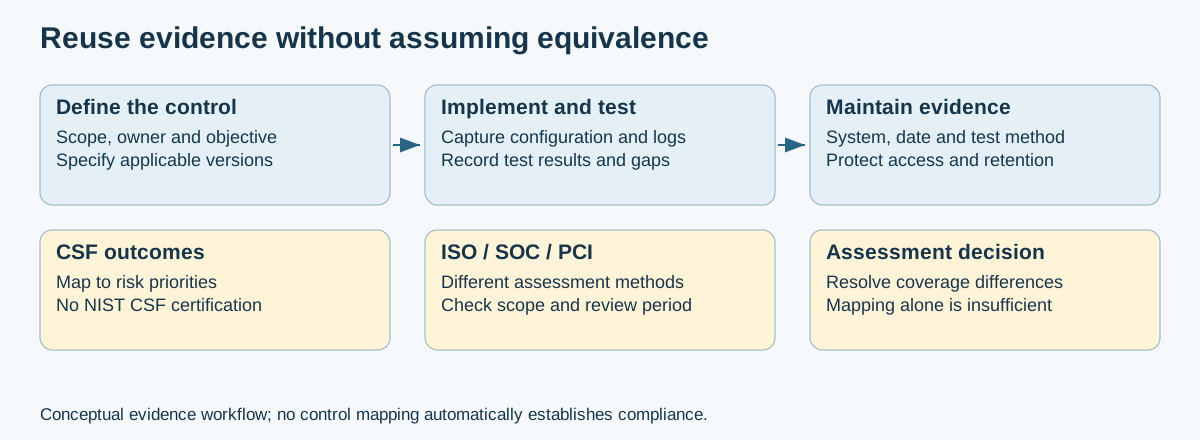
Evidence reuse: a common implementation can support several objectives, but each assessment still checks applicability, coverage, period, and exceptions. This original conceptual figure is not an authoritative crosswalk.
| Control area | CSF 2.0 | ISO 27001:2022 | SOC 2 | PCI DSS 4.0.1 |
|---|---|---|---|---|
| Access control / MFA | PR.AA | A.5.15-.18, A.8.2-.5 | CC6 | Req. 7, 8 |
| Logging & monitoring | DE.CM | A.8.15, A.8.16 | CC7 | Req. 10 |
| Encryption | PR.DS | A.8.24 | CC6 | Req. 3, 4 |
| Vulnerability mgmt | ID.RA / PR.PS | A.8.8 | CC7 | Req. 6, 11 |
| Incident response | RS / RC | A.5.24-.28 | CC7 | Req. 12.10 |
Mappings are indicative; use an authoritative crosswalk (NIST OLIR, SCF) for audit work.
- NIST CSF 2.0 (final)
- ISO/IEC 27001
- AICPA SOC 2 / Trust Services Criteria
- PCI DSS Document Library
- CIS Controls
- NIST SP 800-53 Rev 5 / SP 800-171
- NIST OLIR crosswalks
- README.md - Compliance & GRC section index
- regulations.md - data-protection regulations
- ../IncidentResponse/SIEM/README.md - logging/monitoring controls (CSF Detect, PCI Req. 10)
📄 Source: Compliance/frameworks.md | ✏️ Suggest an edit | ⬅️ Back to Compliance