Repository navigation
Security Relevance
Last reviewed: 2026-10-02
Caution
Authorized use only. The techniques below are for authorized security testing, education, and defensive research. Using them against systems you do not own or lack explicit written permission to test is illegal. See LEGAL.md.
Important
Historical and educational content. Nothing in this section is secure for real data. For protecting information, use the modern algorithms in algorithms.md and applied-crypto.md.
← Cryptanalysis · 🏠 Classical Index
Leet in password cracking, IDN homograph attacks, and filter evasion versus Unicode normalization.
Leet substitutions add almost no strength to a password. Cracking tools apply them automatically as rules to every word in a wordlist. Hashcat ships rule files for exactly this purpose, including leetspeak.rule, unix-ninja-leetspeak.rule and Incisive-leetspeak.rule:
# Try every wordlist entry with common leet substitutions
hashcat -a 0 -m <hash-mode> hashes.txt wordlist.txt -r rules/unix-ninja-leetspeak.rule
P@55w0rd falls almost as quickly as password. Length and randomness (a passphrase or a password manager) matter; character swaps do not.
Internationalized Domain Names (IDNs) allow Unicode labels, which can be visually confusable with other names. A look-alike can use mixed scripts or be written entirely in one script; for example, a Cyrillic-only label such as ѕсоре can resemble Latin scope. Preserve the original Unicode hostname and its canonical ASCII/Punycode form (A-label), then assess both using an IDN policy appropriate to the application.
- Browser display behavior depends on client and context; do not rely on every suspicious label being shown in Punycode (
xn--...). IDN processing commonly converts A-labels back to Unicode for display. - Check script restrictions, mixed-script and whole-script confusables, registry/TLD context and known-good allowlists. A mixed-script-only check will miss some look-alikes.
- Unicode UTS #39 defines confusable-detection mechanisms, including skeletons. A skeleton match is a review signal, not proof of spoofing; legitimate internationalized names can also be flagged.
- Do not replace the identifier with a confusable skeleton for routing, authentication or authorization. Keep the original and canonical forms for comparison and audit.
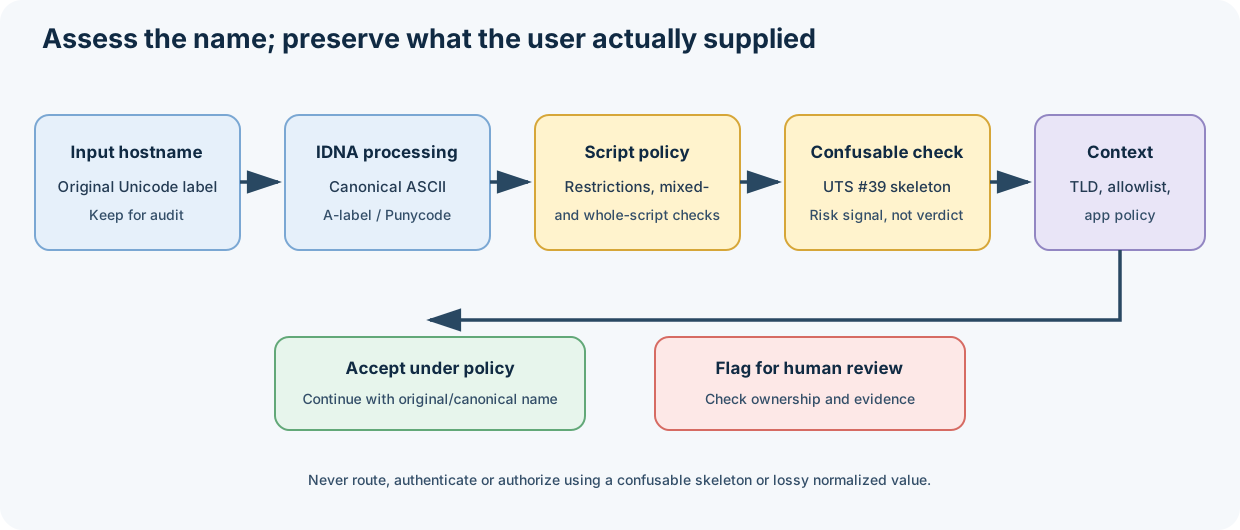
Keep the submitted Unicode hostname and canonical ASCII/Punycode form; use script and confusable checks as context signals, not as replacements for the identifier.
Content filters often apply Unicode NFKC normalization before matching. It folds many styled alphabets back to plain ASCII, but not all of them:
| Input | After NFKC | Caught by filter? |
|---|---|---|
Fullwidth HACK
|
HACK |
✅ |
Circled ⒽⒶⒸⓀ
|
HACK |
✅ |
| Fraktur / Bold / Script / Double-struck | HACK |
✅ |
Small caps ʜᴀᴄᴋ
|
ʜᴀᴄᴋ (unchanged) |
❌ |
Cyrillic homoglyphs НАСК
|
НАСК (unchanged) |
❌ |
Leet H4CK
|
H4CK (unchanged) |
❌ |
There is no universal normalization chain that safely detects every evasion. For identifier checks, retain the submitted value and compute documented comparison forms separately. Use Unicode confusable checks as a risk signal; treat leet substitutions as context-specific heuristics. Tune against legitimate language and identifiers, test false positives and bypass cases, and never use a normalized or confusable skeleton as the identity or authorization value.
import unicodedata
unicodedata.normalize("NFKC", "HACK")   # -> 'HACK'
unicodedata.normalize("NFKC", "ʜᴀᴄᴋ")       # -> 'ʜᴀᴄᴋ' (unchanged)
← Cryptanalysis · 🏠 Classical Index
- ../applied-crypto.md - correct password storage
- ../../Documentation/hcxtoolshashcat.md - hashcat rule-based attacks in practice
- ../../Tradecraft/osint-threat-intel.md - lookalike-domain discovery with dnstwist
- ../../AI/offensive_ai.md - homoglyph attacks against ML filters
- ../../GLOSSARY.md - acronyms
⬅️ Back to Master Index | 🎯 Role Navigation | Legal Notice
📄 Source: Cryptography/Classical/security.md | ✏️ Suggest an edit | ⬅️ Back to Cryptography