Repository navigation
Part IV The User Segment
User segment attack guide - covering SATCOM terminal vulnerabilities (Viasat KA-SAT style attacks), GNSS spoofing and jamming, VSAT security assessments, and maritime/aviation satellite terminal exploitation.
Covers: ODU/IDU terminal architecture, Ku/Ka-band link exploitation, modem firmware extraction and analysis, GNSS spoofing mechanics (civilian GPS L1 C/A is unencrypted), VSAT terminal default credentials and web interface vulnerabilities, and the regulatory landscape for GNSS interference.
Assess the security of satellite user terminals - the most accessible segment of a space system from an attacker's perspective - identifying credential exposure, firmware vulnerabilities, and GNSS signal integrity weaknesses.
- Security assessment of a maritime, aviation, or enterprise SATCOM installation
- GNSS spoofing resilience testing in an authorized lab environment
- Understanding how the 2022 Viasat attack worked and how to defend against it
- CubeSat ground terminal security review
Satellite
    │
  [RF Link]
    │
Outdoor Unit (ODU)
  ├─ Low-Noise Block Downconverter (LNB)
  └─ Block Upconverter (BUC) [for TX]
    │
  Coax / ODU-IDU cable
    │
Indoor Unit (IDU) / Modem
  ├─ IP gateway / router
  ├─ Management interface (web UI, SNMP, TR-069)
  └─ LAN port → user devices
| Component | Attack Vector | Notes |
|---|---|---|
| Web management UI | Default credentials, authentication bypass, command injection | Common on VSAT modems |
| SNMP | SNMPv1/v2c with public community string | Often exposes full config and stats |
| TR-069 / CWMP | ACS server compromise → mass terminal takeover | Provisioning protocol; used in Viasat attack |
| Firmware | Extraction → analysis → custom image | UART, JTAG, or update file extraction |
| RF uplink | Jamming, signal capture | Physical proximity required |
| Over-the-air updates | Unsigned firmware delivery | If OTA updates lack integrity checks |
# Extract firmware from update file or NAND dump
binwalk -e firmware.bin

# Identify architecture and entry point
file rootfs/bin/busybox
strings rootfs/bin/satellite_daemon | grep -E "(password|key|token|secret)"

# Emulate with QEMU for dynamic analysis
qemu-mips-static -L rootfs/ rootfs/bin/satellite_daemon

# Check for hardcoded credentials
grep -r "admin\|root\|password\|default" rootfs/etc/ --include="*.conf"- Hardcoded credentials - Factory default admin accounts that cannot be changed (documented in multiple Iridium, Hughes, ViaSat, and Intellian advisories)
- Pre-auth RCE - Command injection in web UI before authentication (multiple CVEs across major vendors 2020–2024)
- Unencrypted management - HTTP instead of HTTPS; Telnet instead of SSH
- Insecure firmware updates - No signature verification on update packages
- Debug interfaces - UART/JTAG left exposed in production hardware
| Research | Findings |
|---|---|
| IOActive - SATCOM Security (2014) | Pre-auth RCE in Iridium, BGAN, Hughes, ViaSat terminals |
| Black Hat 2020 - Ruben Santamarta | Revisited SATCOM vulnerabilities; aviation safety implications |
| DEFCON 30 (2022) - Starlink | Physical fault injection on Starlink dish; custom firmware execution |
| System | Operator | Frequencies |
|---|---|---|
| GPS | USA (Space Force) | L1 (1575.42 MHz), L2 (1227.60 MHz), L5 (1176.45 MHz) |
| GLONASS | Russia | L1 (~1602 MHz), L2 (~1246 MHz) |
| Galileo | EU | E1 (1575.42 MHz), E5 (1176.45 / 1207.14 MHz) |
| BeiDou | China | B1 (1561.098 MHz), B2, B3 |
| NavIC | India | L5, S-band |
GNSS signals arrive at Earth's surface at approximately -130 dBm - roughly 20 dB below thermal noise. This extreme weakness makes them trivially susceptible to interference:
- Open signals and authentication - GPS L1 C/A is an open civilian signal. Galileo's E1-B navigation message can carry OSNMA authentication data: the Initial Service became operational on July 24, 2025. OSNMA requires a compatible receiver implementation and authenticates navigation-message data; it does not by itself authenticate ranging measurements or guarantee the final position/time solution.
- Passive reception - A receiver cannot challenge a satellite over the navigation signal, but lack of an uplink does not rule out broadcast-message authentication such as OSNMA.
- Public signal structure - PRN codes and navigation-message formats are public; authentication and encryption are separate properties.
Jamming
Broadband noise or CW interference on GNSS frequencies. Low technical barrier - cheap jammers widely available (though illegal in most jurisdictions).
- Effective range: meters to kilometers depending on power
- Impact: loss of PNT - navigation, timing systems fail
- Detection: Receiver-specific AGC and carrier-to-noise ratio (C/N₀) changes can flag possible interference. Establish a receiver/band baseline and corroborate across independent sources; these indicators do not identify every jammer or attack.
- Countermeasures: Antenna nulling (CRPA), inertial navigation fallback, multi-frequency receivers
Spoofing
Transmitting counterfeit GNSS signals that a receiver accepts as legitimate, causing false position/time output. Technically more complex than jamming.
Spoofer generates:
  └─> Valid PRN codes for visible satellites
  └─> Accurate navigation message (ephemeris, almanac)
  └─> Correct Doppler shift for claimed position/velocity
  └─> Higher power than authentic signal

Receiver accepts spoofed signal → reports false position/time
Spoofing attack progression:
- Meaconing - Simply re-broadcast authentic signals (introduces delay = false position)
- Simple spoofing - Static false position, no correlation with authentic signal timing
- Sophisticated spoofing - Gradually drag receiver position; preserves carrier phase continuity to avoid detection
Spoofing Tools (Research Context)
| Tool | Description |
|---|---|
| GPS-SDR-SIM | Open-source GPS L1 C/A signal simulator (TX requires HackRF or USRP) |
| GNSS-SDRLIB | Multi-constellation SDR receiver and signal generator |
| Spirent GSS7000 | Commercial GNSS simulator (lab use) |
⚠️ Legal Warning: Transmitting counterfeit GNSS signals is illegal under FCC regulations and equivalent international law. GNSS spoofing of aviation, maritime, or emergency services is a federal crime. Testing must occur in a shielded RF enclosure.
| Incident | Year | Method | Impact |
|---|---|---|---|
| Russian Black Sea spoofing | 2017–ongoing | Large-scale GPS spoofing | Dozens of ships reported false positions in Moscow |
| Tehran GPS spoofing (RQ-170 capture) | 2011 | Alleged GPS spoof | US drone landed in Iran (disputed) |
| Contested GPS jamming - Ukraine/Eastern Europe | 2022–present | Broadband L1/L2 jamming | Aviation GPS outages across Eastern Europe |
| Dallas ADS-B GPS disruption | 2022 | Ground-based interference | FAA NOTAM; flight delays |
| Countermeasure | Description |
|---|---|
| Galileo OSNMA | Operational service authenticates E1-B navigation-message data on compatible receivers; it does not by itself authenticate ranging measurements or guarantee a position solution |
| GPS civilian signal authentication research | Chips-Message Robust Authentication (Chimera) is a research concept combining navigation-data and spreading-code authentication; do not infer operational deployment from the 2017 paper |
| Multi-constellation / multi-frequency | Adds signal diversity, but is not proof of authenticity |
| Receiver Autonomous Integrity Monitoring (RAIM) | Provides receiver integrity checks, but is only partially effective against some misleading signals; no alert does not prove signal authenticity |
| Signal strength / AGC / C/N₀ monitoring | Receiver- and band-specific changes can indicate interference; baseline and corroboration are required, and detection is incomplete |
| IMU integration | Inertial cross-checks can reveal some PVT inconsistencies; performance depends on the sensor and error growth |
| Clock anomaly detection | Time disagreements can be a clue; corroborate with independently trusted time because network time may also be wrong or spoofed |
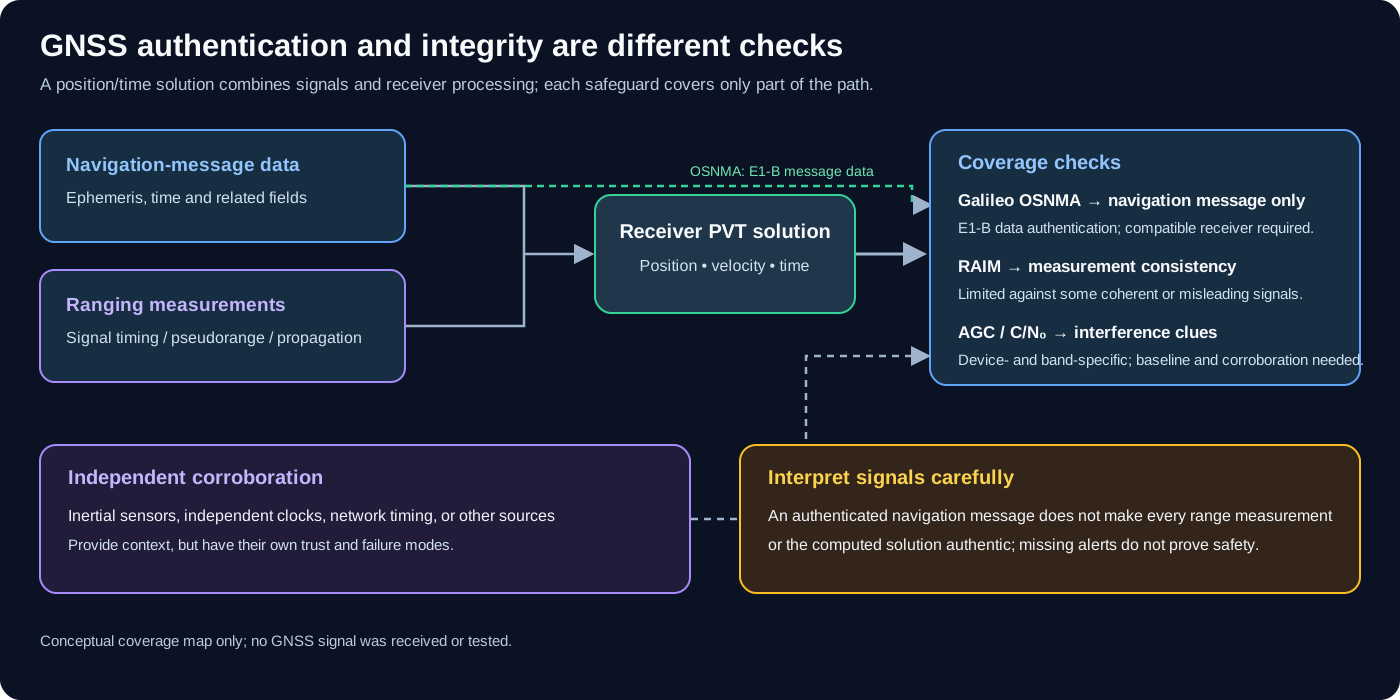
Conceptual coverage map. OSNMA authenticates Galileo navigation-message data on E1-B; RAIM checks consistency; AGC/C/N₀ are receiver-specific interference indicators. No single check proves that the complete navigation solution is authentic.
Sources: Galileo OSNMA service description, OSNMA Service Definition Document, Android GNSS spoof/jam detection limits, FAA RAIM advisory, and Chimera research paper.
| Sector | Key Players | Security Relevance |
|---|---|---|
| Commercial FSS/MSS | Intelsat, SES, Viasat, Hughes, Inmarsat | Large attack surface; widely used for critical comms |
| Proliferated LEO | SpaceX Starlink, Amazon Kuiper, OneWeb | Massive scale; new security models; high-value target |
| Earth Observation | Maxar, Planet, Airbus Defence | Intelligence value; imagery manipulation risk |
| Launch Services | SpaceX, ULA, Arianespace, Rocket Lab | Supply chain; ground systems |
| Defense | Northrop Grumman, L3Harris, Boeing Defense | High-assurance requirements; ITAR-controlled |
| New Space / CubeSat | Various; Spire, Swarm, Astro Digital | COTS hardware; limited security; growing attack surface |
| Organization | Role |
|---|---|
| ITU | International frequency coordination and interference management |
| FCC | US licensing for earth stations, satellites, terminals |
| FAA | Aviation use of GNSS and SATCOM |
| NIST | SP 800-53 controls applicable to federal space systems |
| CCSDS | Protocol standards (also security recommendations - CCSDS 350.x series) |
| CISA | Space Systems Critical Infrastructure guidance |
| DoD / NSA | COMSEC requirements for national security space |
┌───────────────────────────────┐
│         Solar Panels           │
│  ┌─────────────────────────┐  │
│  │    OBC (ARM/LEON/AVR)   │  │
│  │  FSW (RTEMS/FreeRTOS)   │  │
│  ├─────────────────────────┤  │
│  │ ADCS  │ EPS  │ Thermal  │  │
│  ├─────────────────────────┤  │
│  │   Communications        │  │
│  │  UHF TT&C │ S/X payload │  │
│  └─────────────────────────┘  │
└───────────────────────────────┘
┌─────────────────────────────────────┐
│          Solar Arrays               │
│  ┌───────────────────────────────┐  │
│  │     Platform / Bus            │  │
│  │  OBC │ AOCS │ Power │ Thermal │  │
│  ├───────────────────────────────┤  │
│  │         Payload               │  │
│  │  Transponders │ Antennas      │  │
│  │  (C/Ku/Ka-band, military X)   │  │
│  └───────────────────────────────┘  │
└─────────────────────────────────────┘
| Protocol | Layer | Use | Security Notes |
|---|---|---|---|
| CCSDS TM | Data Link | Telemetry framing | Often unencrypted; ASM sync trivially identified |
| CCSDS TC | Data Link | Command framing | Authentication optional per CCSDS 351.0 |
| CCSDS Space Packet | Network | Packet routing | APID-based routing; no inherent authentication |
| CCSDS CFDP | Transport | File delivery | Class 2 provides acknowledged delivery; no encryption |
| DVB-S2/S2X | Physical | Broadcast downlink | Conditional access systems (CAS) for pay-TV |
| AX.25 | Data Link | Amateur/CubeSat TT&C | No authentication; widely used in educational sats |
| IP over SATCOM | Network | Broadband terminals | Standard IP vulnerabilities apply |
| Device | Freq Range | TX | Typical Use |
|---|---|---|---|
| RTL-SDR | 500 kHz – 1.75 GHz | No | Passive monitoring, GNSS monitoring |
| HackRF One | 1 MHz – 6 GHz | Yes | Full analysis; lab TX |
| USRP B210 | 70 MHz – 6 GHz | Yes | Research-grade wideband |
| Airspy HF+ | 9 kHz – 31 MHz / 60–260 MHz | No | HF, VHF precision |
| LimeSDR | 100 kHz – 3.8 GHz | Yes | Flexible; multi-channel |
📖 Use These Techniques Responsibly: Authorization is MANDATORY
- README.md - SpaceSecurity section index
- PartI.md - Foundations: threat actors and attack taxonomy for user segment threats
- PartIII.md - Space segment: flight software vulnerabilities
- ../SDR/sdr_hacking.md - SDR hacking: GPS spoofing and SATCOM signal analysis tools and techniques
Space systems are critical infrastructure - treat them accordingly.
Repository: ULTIMATE CYBERSECURITY MASTER GUIDE
Maintained by: Pacific Northwest Computers
⭐ Star this repo if you find it useful! ⭐
📄 Source: SpaceSecurity/PartIV.md | ✏️ Suggest an edit | ⬅️ Back to Space Security