Repository navigation
Playbooks
Operational playbooks for incident response, security operations, and team collaboration
Part of the ULTIMATE CYBERSECURITY MASTER GUIDE


Training-to-field progression: Safe CTF and cybersecurity learning pathways maps exercises into scoped PNWC assessment and reporting workflows.
Field system: PNWC Cyberdeck Public Reference covers architecture, an authorization-first assessment process and evidence-handling examples. The new Portable Wireless Device Workflow covers Flipper, Pineapple, Bruce and Marauder as supervised field tools. The private portal is not part of this public companion.
| Reference | Description |
|---|---|
| PNWC Cyberdeck Public Reference | Portable network assessment architecture, staged authorization, evidence handling and offline-only hashing |
| Staged Client Assessment Map | Consent-first phases and tool integration |
| Atomic Red Team, Sigma & Wazuh Validation | Repeatable defensive detection testing |
| DefectDojo Findings & Retesting | Report, triage, remediate and retest findings |
These are documentation/workflow references, not deployed scanners or customer automation.
- Overview
- Playbook Collection
- Playbook Categories
- How to Use These Playbooks
- Security & Legal Disclaimer
- Contributing
- Resources
This directory contains operational security playbooks and procedures for cybersecurity teams, security operations centers (SOC), incident responders, and security professionals. These playbooks provide structured, repeatable processes for security operations, incident response, and team collaboration.
What You'll Find Here:
- 🔵 Blue Team incident response playbooks
- 🟣 Purple Team collaborative security testing procedures
- 🌐 Network security audit methodologies
- 🔐 Security operations procedures
- 📊 Team collaboration frameworks
- 🚨 Incident handling workflows
- 🔍 Security assessment playbooks
These playbooks serve as:
- Operational guides for consistent security operations
- Incident response frameworks for handling security events
- Team collaboration tools for red/blue/purple team exercises
- Training materials for security team development
- Quality assurance for repeatable security processes
- Documentation standards for security operations
CTF practice companion: Cypherpunk Symposium archived toolkit curation gives source-backed lessons for legal CTF, memory, cryptography and packet-analysis drills without importing attack scripts.
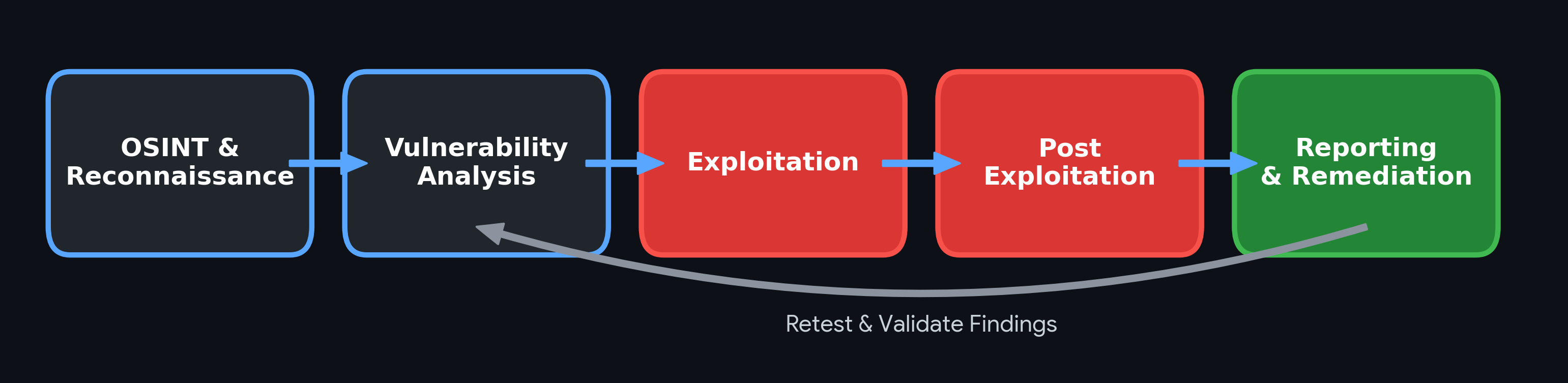
Reference lifecycle from scope/authorization to testing, analysis, reporting and remediation review. Always follow the approved rules of engagement and document evidence custody.
| Playbook | Description | Complexity |
|---|---|---|
| BlueTeam_IncResp_Simple.md | Simplified blue team incident response playbook for quick reference | Beginner-Friendly |
| BlueTeam_IncResp_Enhanced.md | Comprehensive blue team incident response with detailed procedures | Advanced |
| Playbook | Description | Complexity |
|---|---|---|
| PurpleTeam_Simple.md | Basic purple team collaboration playbook | Beginner-Friendly |
| PurpleTeam_Detailed.md | Detailed purple team operations and procedures | Intermediate |
| PurpleTeam_Multi-Scrip.md | Multi-scenario purple team playbook with various attack simulations | Advanced |
| Playbook | Description | Complexity |
|---|---|---|
| PNWC Cyberdeck Public Reference | Portable hardware and seven-stage authorized network review workflow; no private app published | Reference |
| NetworkAuditPlayBook.md | Comprehensive network security audit and penetration testing playbook | Intermediate |
| HackRFAuditPlayBook.md | RF survey engagement, evidence collection, and controlled bench validation; pair with the SDR index | Intermediate |
| ../Mobile/mobile_pentest_sop.md | Full engagement SOP for pentesting with Kali NetHunter on OnePlus 6: pre-engagement, passive/active recon, Evil AP, HID, BadUSB, Metasploit, evidence handling, reporting | Intermediate |
| Playbook | Description | Complexity |
|---|---|---|
| GitHubPlaybooks.md | GitHub security operations and DevSecOps procedures | Intermediate |
| Playbook | Description | Complexity |
|---|---|---|
| cybersecurity_playbooks.md | General cybersecurity operational playbooks and procedures | Comprehensive |
| Playbook | Description | Complexity |
|---|---|---|
| sop_phishing_analysis.md | Standard operating procedure for triaging and analyzing reported phishing emails | Beginner-Friendly |
| unauth_access.md | Investigation procedures for brute force attacks and impossible-travel account compromise alerts | Intermediate |
Purpose: Defensive security operations and incident response procedures.
What's Covered:
- Incident detection and triage
- Threat hunting procedures
- Log analysis and correlation
- Security monitoring workflows
- Incident containment strategies
- Eradication and recovery procedures
- Post-incident analysis
- Security control validation
Playbooks:
- BlueTeam_IncResp_Simple.md: Quick-reference guide for common incidents
- BlueTeam_IncResp_Enhanced.md: Comprehensive incident response framework
Use Cases:
- SOC operations and monitoring
- Security incident response
- Threat detection and hunting
- Security event analysis
- Defensive security operations
- Incident management
- Security monitoring
Target Audience:
- SOC analysts
- Incident responders
- Security operations teams
- CSIRT/CERT teams
- Security managers
- IT operations teams
Purpose: Collaborative security testing combining offensive and defensive perspectives.
What's Covered:
- Red team and blue team collaboration
- Attack simulation scenarios
- Detection capability testing
- Security control validation
- Gap analysis procedures
- Continuous improvement workflows
- Threat-informed defense
- Detection rule development
Playbooks:
- PurpleTeam_Simple.md: Basic collaborative testing framework
- PurpleTeam_Detailed.md: Comprehensive purple team methodology
- PurpleTeam_Multi-Scrip.md: Multiple attack scenario simulations
Use Cases:
- Security control validation
- Detection capability testing
- Red team/blue team collaboration
- Threat emulation exercises
- Security posture assessment
- Detection rule tuning
- Security team training
Target Audience:
- Purple team operators
- Red team members
- Blue team analysts
- Security architects
- Security trainers
- SOC managers
Purpose: Systematic network security assessment and penetration testing procedures.
What's Covered:
- Network reconnaissance methodology
- Vulnerability assessment procedures
- Penetration testing workflows
- Wireless security auditing
- Network segmentation testing
- Security control validation
- Configuration review processes
- Reporting and documentation
Playbooks:
- NetworkAuditPlayBook.md: Complete network security audit framework
Use Cases:
- Internal network penetration testing
- Wireless security assessments
- Network security audits
- Compliance validation
- Security architecture review
- Network segmentation testing
- Perimeter security assessment
Target Audience:
- Penetration testers
- Network security engineers
- Security auditors
- Network administrators
- Security consultants
- Compliance teams
Purpose: Security procedures for development environments and code repositories.
What's Covered:
- GitHub security best practices
- Code repository security
- DevSecOps workflows
- Secure development procedures
- Access control management
- Secret scanning and management
- Vulnerability management in code
- Supply chain security
Playbooks:
- GitHubPlaybooks.md: GitHub security operations procedures
Use Cases:
- Code repository security
- DevSecOps implementation
- Secure development practices
- Access management
- Secret management
- Vulnerability remediation
- Supply chain security
Target Audience:
- DevSecOps engineers
- Developers
- Security engineers
- DevOps teams
- Security architects
- Application security teams
Purpose: Comprehensive security operational procedures across multiple domains.
What's Covered:
- Cross-functional security operations
- Security program management
- Operational procedures library
- Security team coordination
- Multi-domain security workflows
- Security orchestration
- Compliance procedures
- Security governance
Playbooks:
- cybersecurity_playbooks.md: General operational procedures
Use Cases:
- Security operations management
- Cross-team coordination
- Security program operations
- Compliance management
- Security governance
- Operational excellence
- Process standardization
Target Audience:
- Security managers
- CISO/security leadership
- Security operations teams
- Compliance officers
- Security architects
- Risk management teams
Purpose: Focused, single-incident-type response procedures for the two alert categories a SOC handles most often - phishing reports and access-abuse alerts (brute force, impossible travel, credential stuffing).
What's Covered:
- Phishing email header, URL, and attachment analysis
- Secure Email Gateway (SEG) alert triage
- Brute force and password-spraying investigation
- Impossible-travel and geo-anomaly login analysis
- Credential-stuffing detection and containment
- MITRE ATT&CK mapping (T1110 Brute Force, T1078 Valid Accounts, T1566 Phishing)
- Evidence collection for both incident types
- Escalation and closure criteria
Playbooks:
- sop_phishing_analysis.md: Short-form SOP - header analysis, URL/attachment sandboxing, and containment steps for a single reported phishing email
- unauth_access.md: Longer-form investigation playbook for brute force and impossible-travel alerts, from initial triage through containment
Use Cases:
- Triaging a user-reported phishing email
- Investigating a SIEM/Microsoft Entra ID/Okta brute-force or impossible-travel alert
- Building tier-1 SOC analyst runbooks
- Standardizing phishing/access-abuse response across a team
Target Audience:
- Tier-1/Tier-2 SOC analysts
- Incident responders
- Help desk / IT support staff handling escalations
- Security awareness teams (source material for training)
Daily Operations:
   └─> Use blue team playbooks for incident handling
   └─> Follow incident response procedures systematically
   └─> Document all actions using playbook templates
   └─> Track incidents through defined workflows
   └─> Maintain playbook updates based on lessons learned

Incident Response:
   └─> Reference appropriate incident type playbook
   └─> Follow triage and assessment procedures
   └─> Execute containment strategies per playbook
   └─> Document timeline and actions taken
   └─> Conduct post-incident review
   └─> Update playbooks with new findings

Continuous Improvement:
   └─> Review playbook effectiveness regularly
   └─> Update procedures based on new threats
   └─> Incorporate lessons learned from incidents
   └─> Train team members on playbook usage
   └─> Validate playbooks through purple team exercises
Planning Phase:
   └─> Select appropriate purple team playbook
   └─> Define objectives and success criteria
   └─> Coordinate with red and blue teams
   └─> Schedule testing windows
   └─> Prepare testing environment

Execution Phase:
   └─> Follow attack simulation procedures
   └─> Monitor blue team detection and response
   └─> Document detection gaps and successes
   └─> Test specific security controls
   └─> Validate detection rules and alerts

Analysis Phase:
   └─> Compare attacker actions vs. detections
   └─> Identify coverage gaps
   └─> Assess response effectiveness
   └─> Document improvement recommendations
   └─> Update detection rules and playbooks

Improvement Phase:
   └─> Implement recommended changes
   └─> Re-test improved controls
   └─> Update documentation
   └─> Train teams on new procedures
   └─> Schedule follow-up exercises
Pre-Assessment:
   └─> Review network audit playbook
   └─> Obtain written authorization
   └─> Define scope and boundaries
   └─> Prepare testing environment and tools
   └─> Review rules of engagement

Assessment Execution:
   └─> Follow playbook methodology systematically
   └─> Document all findings with evidence
   └─> Track progress through checklist
   └─> Maintain detailed activity logs
   └─> Report critical findings immediately

Post-Assessment:
   └─> Compile findings using playbook template
   └─> Provide risk ratings and recommendations
   └─> Deliver comprehensive report
   └─> Present findings to stakeholders
   └─> Archive assessment documentation
Repository Security:
   └─> Implement GitHub security playbook procedures
   └─> Configure security controls per playbook
   └─> Monitor for security events
   └─> Manage access controls systematically
   └─> Scan for secrets and vulnerabilities

Continuous Security:
   └─> Integrate security into CI/CD pipelines
   └─> Automate security testing per playbook
   └─> Monitor code quality and security
   └─> Track and remediate vulnerabilities
   └─> Maintain security documentation

Incident Response:
   └─> Follow code security incident procedures
   └─> Investigate security alerts promptly
   └─> Contain and remediate issues
   └─> Document and communicate findings
   └─> Update security controls
Adapting Playbooks to Your Environment:
1. Environment Assessment:
   └─> Evaluate your specific security context
   └─> Identify relevant playbook sections
   └─> Note environment-specific constraints

2. Customization:
   └─> Modify procedures for your tools
   └─> Add organization-specific steps
   └─> Update contact information and escalation paths
   └─> Incorporate internal policies
   └─> Adjust timelines and SLAs

3. Testing:
   └─> Validate playbooks through tabletop exercises
   └─> Test procedures in controlled environments
   └─> Gather feedback from team members
   └─> Refine based on testing results

4. Maintenance:
   └─> Review playbooks quarterly
   └─> Update based on lessons learned
   └─> Incorporate new threat intelligence
   └─> Train team on updates
   └─> Version control all changes
⚠️ IMPORTANT: AUTHORIZED USE ONLY ⚠️

These security playbooks contain operational procedures for:

✅ AUTHORIZED USES:
   • Security operations within your organization
   • Authorized incident response activities
   • Internal security testing with proper approval
   • Purple team exercises with authorization
   • Network security audits with written permission
   • SOC operations and monitoring
   • Security training in controlled environments
   • Compliance and audit activities with authorization

🚫 STRICTLY PROHIBITED:
   • Unauthorized penetration testing or security assessments
   • Testing on systems without explicit written permission
   • Using playbooks to attack unauthorized systems
   • Exceeding authorized scope of security operations
   • Conducting incident response without authority
   • Accessing systems or data without authorization
   • Using procedures for malicious purposes
   • Any activities violating laws or organizational policies
Before executing any playbook procedures that involve:
- Network scanning or vulnerability assessment
- Penetration testing or security testing
- Access to production systems
- Incident response on organizational assets
- Purple team testing or attack simulation
- Security monitoring or log analysis
You MUST have:
☐ Explicit written authorization from appropriate authority
☐ Clear scope definition and boundaries
☐ Defined rules of engagement
☐ Emergency contact information
☐ Authorization for specific procedures and techniques
☐ Data handling and confidentiality requirements
☐ Approved time windows and restrictions
☐ Incident escalation procedures
✅ REQUIRED:
   • Follow organizational security policies
   • Comply with IT acceptable use policies
   • Adhere to data handling requirements
   • Respect privacy and confidentiality rules
   • Follow change management procedures
   • Maintain audit trails and documentation
   • Report security incidents per policy
   • Protect sensitive information

🚫 PROHIBITED:
   • Violating organizational policies or procedures
   • Exceeding granted authority or access levels
   • Bypassing security controls without authorization
   • Accessing data beyond your authorized scope
   • Sharing sensitive information inappropriately
   • Conducting unauthorized security activities
   • Causing service disruption without approval
⚠️ WARNING: Incident Response Operations

AUTHORIZATION REQUIREMENTS:
   • Explicit authority to access affected systems
   • Permission to collect and analyze data
   • Authorization for containment actions
   • Approval for forensic activities
   • Clear chain of command and escalation

LEGAL CONSIDERATIONS:
   • Privacy laws apply to data collection (GDPR, CCPA, etc.)
   • Chain of custody required for evidence
   • Legal hold procedures may be necessary
   • Attorney-client privilege considerations
   • Regulatory notification requirements may apply

CRITICAL REMINDERS:
   ✓ Document all actions with timestamps
   ✓ Maintain chain of custody for evidence
   ✓ Follow proper escalation procedures
   ✓ Preserve evidence integrity
   ✓ Coordinate with legal and compliance teams
⚠️ WARNING: Purple Team Testing

AUTHORIZATION REQUIREMENTS:
   • Written authorization for attack simulation
   • Approval from system owners and management
   • Clear scope and boundaries defined
   • Coordination with IT and security teams
   • Approval for specific attack techniques

TESTING CONSIDERATIONS:
   • Test in non-production when possible
   • Have rollback procedures ready
   • Monitor system stability during testing
   • Communicate status to stakeholders
   • Document all activities thoroughly

PROHIBITED:
   🚫 Testing without proper authorization
   🚫 Exceeding approved scope or techniques
   🚫 Causing service disruption without approval
   🚫 Accessing production data without permission
   🚫 Using testing as pretext for unauthorized access
⚠️ WARNING: Network Security Testing

LEGAL REQUIREMENTS:
   • Computer Fraud and Abuse Act (CFAA) applies
   • Unauthorized access is a federal crime
   • Wiretap Act applies to network interception
   • State computer crime laws also apply

AUTHORIZATION MUST INCLUDE:
   ✓ Specific IP ranges and systems in scope
   ✓ Approved testing methodologies
   ✓ Time windows for testing activities
   ✓ Out-of-scope systems explicitly noted
   ✓ Emergency contact procedures
   ✓ Data handling requirements

PENALTIES FOR UNAUTHORIZED TESTING:
   • Up to 10 years imprisonment (CFAA)
   • Significant financial penalties
   • Civil liability for damages
   • Professional license revocation
   • Career-ending consequences
Core Principles:
- Authorization: Always operate within granted authority
- Integrity: Act honestly and document accurately
- Confidentiality: Protect organizational information
- Competence: Execute only procedures you understand
- Responsibility: Accept accountability for actions
- Professionalism: Maintain high standards
- Legal Compliance: Follow all applicable laws
✅ DO:
   • Verify authorization before executing playbooks
   • Follow playbook procedures systematically
   • Document all actions and findings thoroughly
   • Escalate issues through proper channels
   • Protect sensitive information discovered
   • Maintain professional certifications
   • Continue training and education
   • Coordinate with relevant teams

🚫 DON'T:
   • Execute playbooks without proper authorization
   • Exceed your granted authority or scope
   • Skip documentation or logging steps
   • Share sensitive findings inappropriately
   • Use playbooks for personal gain or malicious purposes
   • Ignore organizational policies or procedures
   • Bypass security controls without authorization
   • Cause unnecessary risk or disruption
Incident Response:
- Inadvertent evidence destruction
- System instability from containment actions
- Service disruption during investigation
- Privacy violations during data collection
- Improper evidence handling
- Legal exposure from improper procedures
Purple Team Testing:
- Unintended system damage or disruption
- Production impact from testing
- Detection evasion leading to real compromises
- Confusion between real and simulated attacks
- Credential theft during testing
- Data exposure or loss
Network Security Audits:
- System crashes from vulnerability scanning
- Network congestion from testing
- False positive alerts overwhelming SOC
- Accidental access to sensitive data
- Service disruption
- Detection and blocking by security controls
✅ Mitigation Measures:

Planning & Authorization:
   • Comprehensive written authorization
   • Clear scope and boundaries
   • Risk assessment before execution
   • Coordination with stakeholders
   • Emergency response procedures

Technical Controls:
   • Test in non-production first
   • Use snapshots and backups
   • Monitor system health during operations
   • Have rollback procedures ready
   • Maintain emergency contacts

Operational Practices:
   • Follow playbook procedures exactly
   • Document every action taken
   • Communicate status regularly
   • Escalate issues promptly
   • Conduct post-operation reviews
⚠️ DISCLAIMER OF WARRANTIES ⚠️

These security playbooks are provided "AS IS" without warranty of any kind,
either expressed or implied, including but not limited to:

• Warranties of accuracy or completeness
• Warranties of effectiveness or suitability
• Warranties of non-disruption
• Warranties of legal compliance
• Warranties of fitness for particular purpose

THE AUTHORS, CONTRIBUTORS, AND MAINTAINERS:
• Make no guarantees about playbook effectiveness
• Are not responsible for damages from playbook use
• Do not warrant procedures will work in all environments
• Are not liable for operational or legal consequences
• May update or change content without notice
• Disclaim all liability for unauthorized use

USERS EXPLICITLY ACKNOWLEDGE:
• They use these playbooks at their own risk
• They are responsible for obtaining proper authorization
• They must comply with organizational policies and laws
• They are liable for their operational activities
• They understand risks of security operations
• They accept all consequences of playbook execution

CRITICAL REMINDER:
These playbooks involve SECURITY OPERATIONS that can:
   - Cause system disruption or outages
   - Result in data loss or exposure
   - Lead to legal consequences if misused
   - Trigger security alerts and responses
   - Have significant organizational impact
The Authors, Contributors, and Maintainers are NOT liable for:
- Direct, indirect, incidental, or consequential damages
- System failures, crashes, or service disruptions
- Data loss, corruption, or exposure
- Security breaches or compromises
- Legal consequences from unauthorized use
- Organizational policy violations
- Professional consequences or termination
- Regulatory penalties or fines
- Operational failures or errors
- Any damages arising from playbook use
Maximum Liability: To the extent permitted by law, total liability shall not exceed the amount paid for these playbooks (zero for free distribution).
We welcome contributions from security professionals to improve and expand this collection.
To Submit a New Playbook:
- Fork the repository
- Create playbook following operational standards
- Include clear procedures and decision points
- Add appropriate warnings and authorization requirements
- Test playbook in controlled environment
- Document expected outcomes and metrics
- Submit pull request with detailed description
Playbook Quality Standards:
- ✅ Clear, step-by-step procedures
- ✅ Decision trees and escalation paths
- ✅ Authorization requirements clearly stated
- ✅ Risk assessments included
- ✅ Expected outcomes documented
- ✅ Metrics and success criteria defined
- ✅ Communication templates provided
- ✅ Lessons learned section included
High Priority:
- Cloud security operations playbooks (AWS, Azure, GCP)
- Container security incident response
- Zero-trust architecture operations
- Threat hunting playbooks
- Security automation workflows
- SOAR integration playbooks
- Ransomware response procedures
- Supply chain security operations
- NIST SP 800-61: Computer Security Incident Handling Guide
- SANS Incident Response: https://www.sans.org/security-resources/
- NIST Cybersecurity Framework: https://www.nist.gov/cyberframework
- ISO/IEC 27035: Information security incident management
- CISA Incident Response: https://www.cisa.gov/topics/cyber-threats-and-response/incident-response
- MITRE ATT&CK: https://attack.mitre.org/
- Cyber Kill Chain: Lockheed Martin framework
- Diamond Model: Threat intelligence framework
- OODA Loop: Decision-making framework
- Purple Team Framework: https://www.mitre.org/
- GCIH: GIAC Certified Incident Handler
- GCFA: GIAC Certified Forensic Analyst
- GCIA: GIAC Certified Intrusion Analyst
- CISSP: Certified Information Systems Security Professional
- CISM: Certified Information Security Manager
- CEH: Certified Ethical Hacker
- SANS Reading Room: https://www.sans.org/reading-room/
- US-CERT: https://www.cisa.gov/
- FIRST: Forum of Incident Response and Security Teams
- NIST Computer Security Resource Center: https://csrc.nist.gov/
- 🏠 Main Repository
- 🎯 START HERE Guide
- 💻 Cybersecurity Master Guide
- 🔍 OSINT Resources
- ✅ Security Checklists
- 📚 Documentation
- 🔒 OPSEC Guidelines
- 📄 PDF Library
📁 Current Playbooks: 8 operational playbooks
📖 Categories: Blue Team, Purple Team, Network Audit, DevSecOps, General Operations
🔄 Last Updated: November 2024
👥 Maintained by: Pacific Northwest Computers (PNWC)
📝 Status: Active & Growing
Authorization & Approval:
- ✅ Written authorization for all security operations
- ✅ Proper approval from management and system owners
- ✅ Clear scope and boundaries documented
- ✅ Emergency procedures and contacts defined
- ✅ Regular communication with stakeholders
Operational Excellence:
- ✅ Follow playbook procedures systematically
- ✅ Document all actions with timestamps
- ✅ Maintain chain of custody for evidence
- ✅ Escalate through proper channels
- ✅ Conduct post-operation reviews
Professional Standards:
- ✅ Maintain confidentiality of findings
- ✅ Protect organizational information
- ✅ Follow ethical guidelines
- ✅ Continue professional development
- ✅ Collaborate with relevant teams
- Open an issue on GitHub
- Review playbook procedures thoroughly
- Consult with your security team
- Seek guidance from management when uncertain
- Respect organizational policies
- Share lessons learned from playbook use
- Propose procedure enhancements
- Contribute new playbooks
- Report inaccuracies or gaps
- Help improve documentation
- NIST - Incident response and cybersecurity frameworks
- SANS Institute - Incident response methodology
- MITRE - ATT&CK framework and threat intelligence
- FIRST - Incident response community
- CISA - Cybersecurity resources and guidance
- SOC analysts and incident responders
- Purple team practitioners
- Security operations professionals
- Network security engineers
- DevSecOps practitioners
- Security researchers and educators
Thank you for professional security operations and incident response.
📖 Execute Playbooks Responsibly: Authorization and Professionalism Required
Operational security requires authorization, documentation, and accountability.
Repository: ULTIMATE CYBERSECURITY MASTER GUIDE
Maintained by: Pacific Northwest Computers
⭐ Star this repo if you find it useful! ⭐
- Client Assessment Findings: DefectDojo and Retesting Workflow
- Cybersecurity Operational Playbooks
- Ethical CTF, research and professional assessment training pathways
- GitHub Security Playbooks & DevSecOps Resources
- HACKRF RF SPECTRUM & WIRELESS SECURITY AUDIT PLAYBOOK
- Incident Response Playbook
- Incident Response Playbook (Enhanced)
- PNWC Staged Security Assessment: Integration Blueprint
- Purple Team Detection Validation: Atomic Red Team, Sigma and Wazuh
- Purple Team Playbook (Detailed)
- Purple Team Playbook (Simple)
- Purple Team Playbook - Multi-Platform Scripts
- 🎣 SOP: Phishing Email Analysis
- 🔓 Unauthorized Access Investigation Playbook
- WIRELESS & NETWORK SECURITY AUDIT PLAYBOOK
📂 Folder: PlayBooks | ✏️ Suggest an edit | 🗺️ Browse by Topic