Repository navigation
Incident Response
Blue Team operations, threat detection, digital forensics, and standardized response procedures
Part of the ULTIMATE CYBERSECURITY MASTER GUIDE


More defensive resources: Curated detection, DFIR, Suricata and YARA research maps external source projects to existing PNWC field guides.
Packet Capture & Triage
| Reference | Description |
|---|---|
| Wireshark Master Filter List | Indexed display/capture filters for packet triage |
| Wireshark Field Cheat Sheet | Protocol-focused display filter reference |
| Advanced Capture Guide | Deeper packet capture analysis and troubleshooting |
Capture scope and evidence interpretation are separate from Wazuh detection rules.
Honeypots & Wireless Monitoring
| Reference | Description |
|---|---|
| Endpoint Visibility Index | Windows/Linux host telemetry, Sysmon, auditd and osquery |
| IDS & IPS Index | Wired and wireless detection setup, sensor visibility and verification |
| Honeypot Index | Select a deception platform and review deployment constraints |
| Raspberry Pi Lab | Small dedicated decoy sensor |
| Proxmox Lab | Isolated virtualized decoys |
| ESP32-S3 Lab | Microcontroller-based deception examples |
| Honeypot → Wazuh | Export decoy telemetry to SIEM |
| Kismet + Wazuh | Correlate wireless findings with SIEM alerts |
| nzyme + Wazuh | Wireless monitoring and log correlation |
Threat-intelligence and vulnerability API reference: Security API Catalog covers NVD CVE 2.0, the official CISA KEV feed, GHSA, URLhaus, VirusTotal, GreyNoise and safe enrichment workflows. See the OSINT threat-feed script for existing provider integrations, with the documented URLhaus authentication review still outstanding.
Evidence Collection & Detection Validation
| Reference | Description |
|---|---|
| Velociraptor/ForensicArtifacts Triage | Authorized evidence collection and triage |
| Sigma/Elastic/Wazuh Validation | Verify detection rules and event mappings |
| Atomic Red Team Lab Verification | Confirm detections with controlled simulations |
Scope collection and simulations before using any client environment.
Index for the Incident Response section - covering blue team operations, log aggregation infrastructure, network intrusion detection and response, DFIR processes, and SIEM integration guides.
Links to log aggregation and visibility setup (log_agg.md), wireless/network intrusion response procedures (network_intrusion.md), and provides an attack taxonomy, tool ecosystem reference, playbook overview, and SIEM configuration guidance.
Enable blue team operators to quickly find the right IR procedure, log source configuration, or detection rule for an active or suspected incident.
- Starting incident response work: find the right playbook or log configuration file
- Setting up a new SIEM or log aggregation infrastructure from scratch
- Responding to a wireless intrusion, rogue AP, or physical plant hack scenario
- Overview
- Tool & Infrastructure Categories
- PNWC field-response toolkit
- Deployment & Operations Workflow
⚠️ CRITICAL Security, Privacy & Legal Warning- Contributing
- Resources
For incident interpretation and source-backed historical research, see Case Studies, including physical access control and security-token incidents.
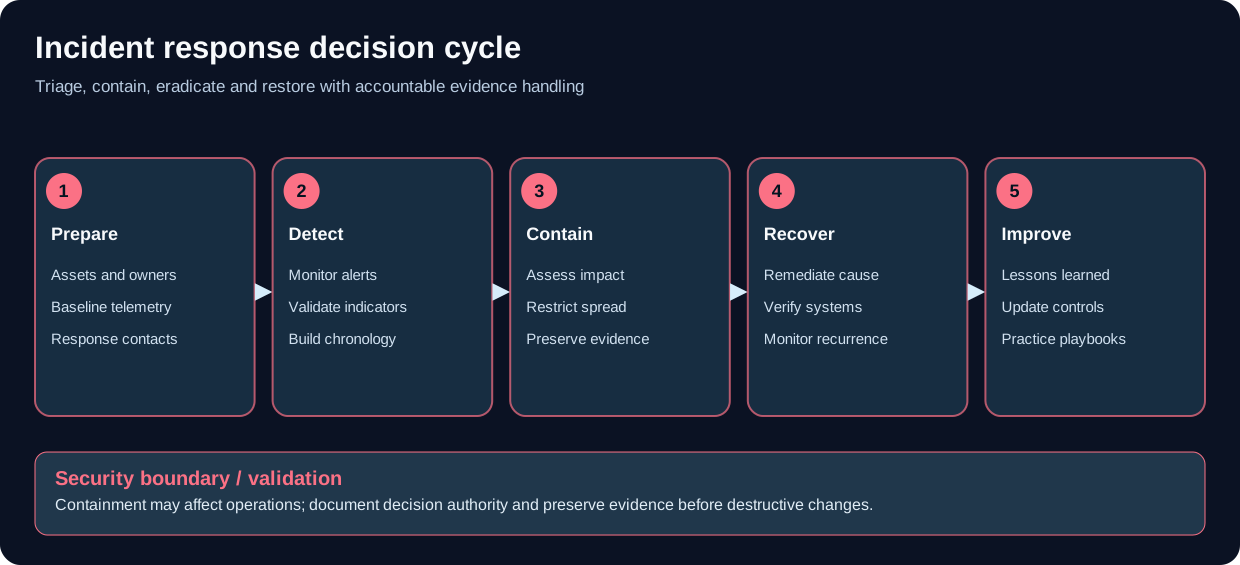
Coordinate containment with business needs and preserve evidence before destructive changes.
Welcome to the Incident Response (IR) and Digital Forensics section. This directory focuses strictly on visibility, detection, and defense. It provides the architecture, configurations, and standard operating procedures (SOPs) required to ingest telemetry, hunt for adversaries, and respond to active threats systematically.
Core Objectives:
- Centralize Logs: Ingest data from endpoints, servers, and network devices into a SIEM.
- Detect Threats: Write SIGMA rules and custom alerts to catch malicious activity generated in your environment.
- Analyze Artifacts: Perform digital forensics on memory (RAM) and disk images to establish timelines and indicators of compromise (IoCs).
- Standardize Response: Utilize playbooks to handle specific incidents (e.g., Ransomware, Insider Threat) consistently and thoroughly.
Central nervous systems for security telemetry.
| Platform / Guide | Description | Deployment Complexity |
|---|---|---|
| ELK Stack (Elastic) | Docker compose files and configs for Elasticsearch, Logstash, and Kibana. | 🟡 MEDIUM |
| Wazuh | Deployment guides for the Wazuh manager, agent registration, and rule tuning. | 🟡 MEDIUM |
| Splunk | Setup for Splunk Free/Enterprise trial and creating optimal data indexes. | 🟢 LOW |
| Graylog | Configuration for lightweight, scalable log management and parsing. | 🟡 MEDIUM |
Instrumentation for host-level telemetry.
| Tool / OS | Description | Integration |
|---|---|---|
| Windows (Sysmon) | Installation scripts and configs (SwiftOnSecurity/Olaf Hartong) for granular event tracing (Process creation, network connections). | High |
| Linux (Auditd/Syslog) | Hardening logging configurations for Linux servers and standardizing syslog output. | Medium |
| Osquery | SQL-powered operating system instrumentation for proactive threat hunting. | High |
Kismet + Wazuh Wireless IDS Lab: Deploy a fixed-channel 802.11 intrusion sensor, forward alerts into Wazuh, classify deauthentication events and build correlation/timeline dashboards. This is complementary to Ethernet-layer Snort/Suricata. The nzyme + Wazuh integration adds per-network disconnection thresholds, webhook/syslog forwarding and multi-sensor investigation guidance.
Visibility into East/West and North/South traffic flows.
| Technology | Focus Area | Common Tools |
|---|---|---|
| Zeek (Bro) | Connection logging, protocol analysis, and metadata extraction. | Zeek, RITA |
| IDS / IPS | Signature-based network threat detection and prevention. | Suricata, Snort |
| Packet Capture | Workflows for capturing and analyzing raw .pcap files. |
Wireshark, TShark, TCPDump |
| Wi-Fi Deauthentication Detection | Analyze legitimate vs spoofed 802.11 disconnects; PMF, monitor-mode capture, Kismet WIDS alerts and SIEM triage | Kismet, Wireshark, TShark, AP/controller logs |
| Guide | Use |
|---|---|
| OpenBSD PF Firewall | PF rulesets, NAT, network-edge deployments, high availability, and logging |
Pair firewall enforcement with network intrusion response and log aggregation. For analysis of an acquired binary, use the Reverse Engineering index after the sample is contained. For a dedicated, isolated malware-triage workstation, see the REMnux Malware Analysis Guide.
Step-by-step containment, eradication, and recovery guides.
| Playbook | Scenario | Focus |
|---|---|---|
| Malware Outbreak | Ransomware / Worms | Isolation, identification, and eradication steps. |
| Phishing Analysis | Malicious Emails | Header analysis, attachment detonation, URL scanning. |
| Unauthorized Access | Compromised Credentials | Investigating brute force and impossible travel alerts. |
| Wireless Intrusion | Rogue APs / Network Breaches | Investigating unauthorized access to local/private networks. |
Post-incident artifact extraction and timeline reconstruction.
| Domain | Description | Primary Tools |
|---|---|---|
| Memory Analysis | Cheatsheets for extracting malware, processes, and keys from RAM. | Volatility, Rekall |
| Disk Forensics | Guides for parsing NTFS artifacts, registry hives, and event logs. | Autopsy, KAPE, FTK Imager |
| Live Response | Scripts for gathering volatile data safely from a compromised host. | KAPE, Custom Scripts |
| Tsurugi Bento Portable DFIR | Windows-first field response USB, triage workflows, evidence export and verification. | Bento / SyMenu, Sysinternals, imaging and hashing tools |
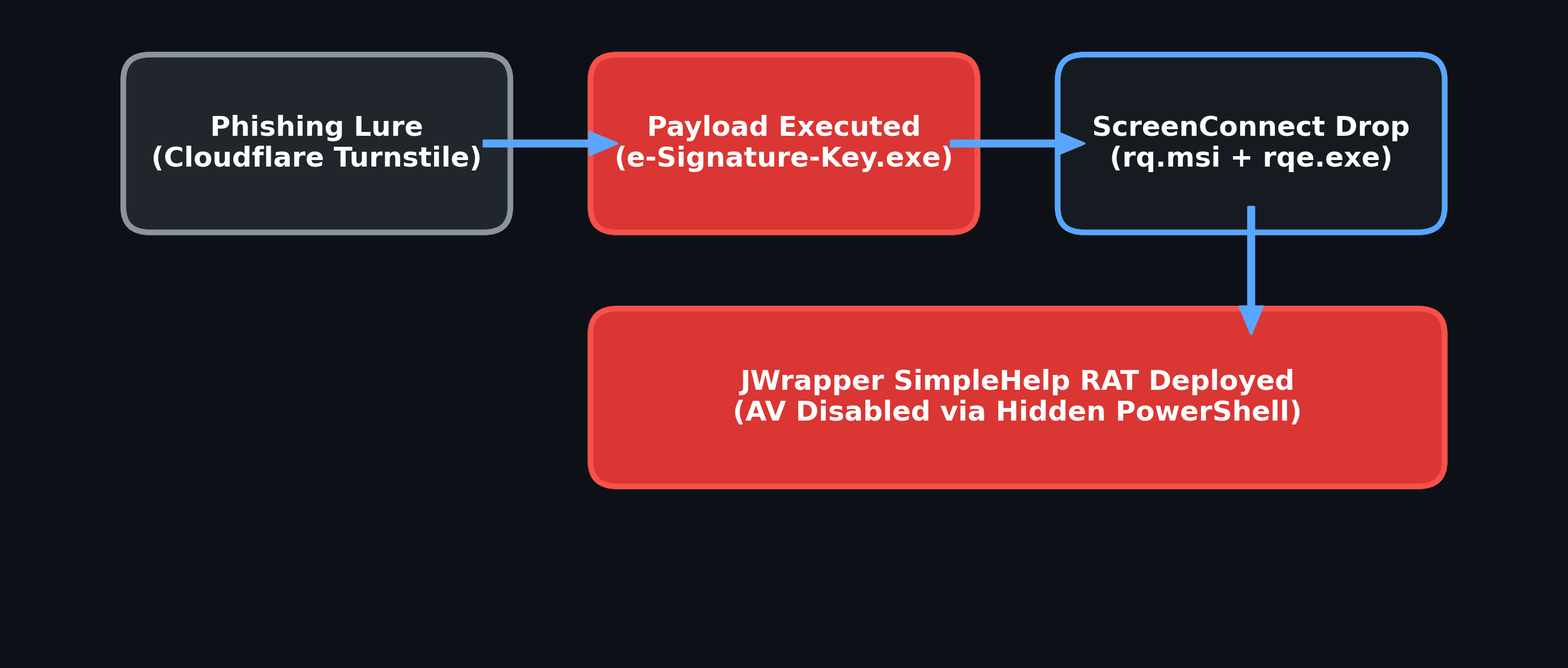
Case-study attack-path diagram illustrating a possible remote-access software abuse chain. This is not proof that a JWrapper or ScreenConnect installation is malicious; verify the installation and client authorization using read-only triage first.
The PNWC JWrapper & ScreenConnect RAT Remediation Toolkit documents investigation and remediation of a specific remote-access-software abuse pattern observed in PNWC field cases. Use its read-only detection workflow first and preserve evidence before considering the state-changing remediation functions. A ScreenConnect installation alone is not evidence of malware; validate the installer, publisher, customer authorization, persistence mechanisms, timeline and network indicators. Verify the current IOCs and attribution independently rather than treating a dated campaign description as a current threat advisory.
Cross-reference the live-response guide for evidence acquisition, and the phishing analysis SOP for initial delivery-vector triage.
1. Infrastructure Standup:
   └─> Choose a SIEM (Wazuh or ELK recommended for beginners).
   └─> Deploy the centralized log server using the guides in `/SIEM/`.

2. Telemetry Ingestion:
   └─> Deploy Agents (Sysmon + Winlogbeat, or Wazuh Agent) to your Homelab VMs.
   └─> Verify logs are indexing correctly in your SIEM dashboard.

3. Attack Simulation (Red -> Blue):
   └─> Generate noise! Run an attack from your Kali machine against a target VM.
   └─> Execute a reverse shell, run a port scan, or drop an EICAR file.

4. Threat Hunting & Analysis:
   └─> Pivot to your SIEM.
   └─> Write queries to trace the attack chain (Initial Access -> Execution -> C2).
   └─> Trigger alerts and follow the corresponding IR Playbook to "respond."
═══════════════════════════════════════════════════════════════
                    ⚠️ CRITICAL WARNING ⚠️
═══════════════════════════════════════════════════════════════

While this section focuses on DEFENSE, mishandling incident data, logs,
and malware carries significant legal, regulatory, and operational risks.

1. DATA PRIVACY & COMPLIANCE (PII/PHI)
   ► Log aggregators often capture highly sensitive data (Passwords, PII, PHI).
   ► DO NOT upload sensitive organizational data to public log repositories.
   ► Violating data handling procedures can breach GDPR, HIPAA, CCPA, and PCI-DSS.
   ► Always anonymize or sanitize logs before sharing for educational purposes.

2. MALWARE HANDLING
   ► Analyzing live malware (Phishing attachments, Ransomware binaries) is dangerous.
   ► NEVER detonate malware on a production or host-connected network.
   ► DO NOT upload proprietary, targeted malware to public sandboxes (e.g., VirusTotal)
     as it alerts the attacker that they have been detected.
   ► Only analyze malware in strictly isolated, host-only virtual environments.

3. CHAIN OF CUSTODY (For Professional Responders)
   ► If analyzing a real-world breach that may involve law enforcement:
   ► DO NOT use standard live-response scripts that overwrite volatile memory.
   ► Follow strict Chain of Custody (CoC) procedures.
   ► Ensure write-blockers are used for disk imaging.
   ► Mishandling evidence renders it inadmissible in court.

4. EDUCATIONAL USE ONLY
   ► These resources are for learning defensive security in authorized environments.
   ► DO NOT use forensic tools on systems you do not own or lack explicit
     written permission to analyze. (Deploying EDR/Forensic tools without consent
     can be legally construed as unauthorized access/wiretapping).

═══════════════════════════════════════════════════════════════
We welcome contributions from SOC Analysts, Threat Hunters, and Incident Responders.
What We Accept:
- ✅ Custom SIGMA rules or SIEM queries (Splunk SPL, KQL, Elastic Lucene).
- ✅ DFIR cheatsheets and artifact mapping (e.g., Windows Registry persistence locations).
- ✅ Playbooks for emerging threats.
- ✅ Hardening configs for endpoints.
Submission Guidelines:
- Fork the repository.
- Ensure any shared logs or PCAPs are completely sanitized of real-world PII/credentials.
- Document prerequisites and tool versions for SIEM configurations.
- Submit a Pull Request with a clear description of the defensive value.
- NIST SP 800-61 Rev. 2: Computer Security Incident Handling Guide
- MITRE ATT&CK: Adversary Tactics, Techniques, and Common Knowledge
- SANS IR Poster: Incident Response & Digital Forensics
- Sigma Rules: Generic Signature Format for SIEM Systems
- The DFIR Report: Real-world attack timelines and artifact analysis
- Blue Team Labs Online: BTLO Defensive Cyber Range
- 🏠 Main Repository
- 🎯 START HERE Guide
- 💻 Cybersecurity Master Guide
- 🏠 Homelab Setup
- ✅ Security Checklists
- 📚 Documentation
- 🔒 OPSEC Guidelines
📁 Categories: SIEM, EDR, NSM, Forensics, Playbooks
🔍 Focus: Threat Hunting, Log Aggregation, Artifact Analysis
💻 Core Platforms: Windows, Linux, ELK, Wazuh, Splunk
🔄 Last Updated: June 2026
👥 Maintained by: Pacific Northwest Computers (PNWC)
📝 Status: Active - Defensive Operations Ready
- log_agg.md - Log aggregation and SIEM feed configuration (the visibility prerequisite for all IR work)
- network_intrusion.md - Wireless intrusion / rogue AP / plant hack IR procedure (Scenario IR-NET-001)
- ../Documentation/wireshark.md - Wireshark filters for the PCAP analysis referenced in network_intrusion.md
- ../Documentation/bjorn_pi.md - Bjorn Pi is exactly the kind of "plant" device described in IR-NET-001
- ../Homelab/ - Homelab lab setup where this IR infrastructure would be deployed and tested
🛡️ Use These Resources Responsibly: Authorization is MANDATORY
Visibility is the foundation of security - use these tools ethically and legally.
Repository: ULTIMATE CYBERSECURITY MASTER GUIDE
Maintained by: Pacific Northwest Computers
⭐ Star this repo if you find it useful! ⭐
Master Index | Start Here | Legal Notice
- 🔎 Digital Forensics (DFIR)
- 🧰 Tsurugi Bento — Portable DFIR and Live-Response Field Guide
- Velociraptor and ForensicArtifacts: Endpoint Evidence Triage
- 🍯 Cowrie — High-Fidelity SSH/Telnet Honeypot
- 🍯 Dionaea — Malware-Capturing Honeypot
- DIY Minimal HTTP Honeypot: Raspberry Pi, VM and Mini PC
- ESP32 and Other Tiny DIY Honeypots
- ESP32-S3 Honeypots: ShadowSentry S3 and HoneyMire
- 🍯 HoneyPi — Simple Internal-Network Honeypot (PSAD-based)
- 🍯 Honeypot Deployment Guides
- Honeypot Telemetry in Wazuh: OpenCanary, Cowrie, DIY and IoT
- 🍯 Open-Source Honeypot Deployment with OpenCanary
- Proxmox VM Honeynet: Isolation, Decoys and Wazuh
- Raspberry Pi Honeypot Lab: OpenCanary, Cowrie and Tiny HTTP Decoys
- 🍯 T-Pot — The All-In-One Multi-Honeypot Platform
- 📡 DIY WiFi Intrusion Detection with Nzyme
- 🚫 Fail2Ban: Log-Triggered Automatic Banning
- 🛡️ IDS & IPS Deployment Guides
- 🛡️ Intrusion Detection & Intrusion Prevention with Suricata & Zeek
- Kismet + Wazuh: Hands-on Wireless Intrusion Detection Lab
- nzyme + Wazuh: Wireless Detection and Alert Integration
- 🧅 Security Onion: Turnkey Network Security Monitoring
- 🐷 Snort: Signature-Based IDS/IPS
- Detection Engineering: Sigma, Elastic and Wazuh
- 🦌 ELK Stack SIEM Deployment Guide
- 🟢 Graylog SIEM Deployment Guide
- 📊 SIEM Deployment Guides
- 🔷 Splunk SIEM Deployment Guide
- 🦁 Wazuh Deployment Guide
📂 Folder: IncidentResponse | ✏️ Suggest an edit | 🗺️ Browse by Topic