Repository navigation
Container Image and Runtime Security
Caution
Authorized use only. Assess only images and hosts you own or have explicit permission to review. See LEGAL.md.
Operational CLI companion: Docker operations and diagnostics provides inspection examples. Supply-chain extension: SBOMs, secret scanning and signatures.
Explain image, runtime and host trust boundaries for Docker/OCI workload reviews.
Connect artifact provenance, secret handling, effective runtime privileges and host security to a practical hardening review. Benchmark references inform the review; this page does not claim a complete CIS control mapping.
Produce concrete findings supported by an exact image digest, configuration, platform and version, while distinguishing possible impact from demonstrated compromise.
- Reviewing a container artifact or its deployment configuration.
- Investigating exposed host resources or excessive runtime authority.
- Designing workload hardening and a repeatable assessment record.
Source and visual review: November 17, 2026. No container, daemon, scan, escape attempt or host change was executed for this review.
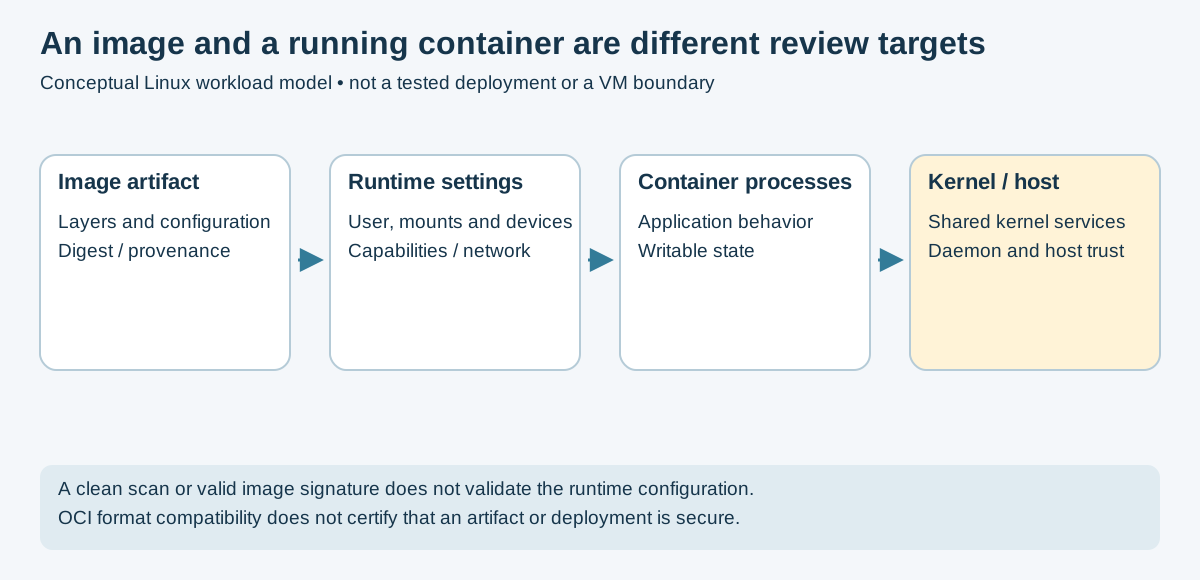
Original conceptual Linux workload model, not a tested environment. OCI separates image and runtime specifications. Docker Desktop and other VM-backed deployments add another host layer; inspect the actual platform.
| Review Area | Evidence And Limit |
|---|---|
| Vulnerabilities | Scan supported OS/application packages; record digest, platform and tool/database version. Clean output does not establish that unknown or unsupported components are safe. |
| Base image | Choose a maintained source appropriate to the application. Minimal, official and distroless are not blanket security guarantees. |
| Digest pinning | Identifies a specific artifact; pair it with a controlled update/rebuild process. A digest is not an endorsement. |
| Provenance | Verify the expected signer identity/key, issuer and artifact digest under policy. A valid signature alone does not prove harmless contents. Admission enforcement depends on the orchestrator and configured policy. |
| Secrets | Review layers, configuration, caches and logs. A source-repository scanner is not a complete image-layer audit. |
# Source-reviewed vulnerability filter; placeholder image, not executed.
trivy image --scanners vuln --severity HIGH,CRITICAL myorg/app:1.2.3
Use the reviewed digest for an actual assessment. This command is a vulnerability severity filter, not a full misconfiguration audit or a CI failure policy. Check the installed Trivy image-scanning documentation.
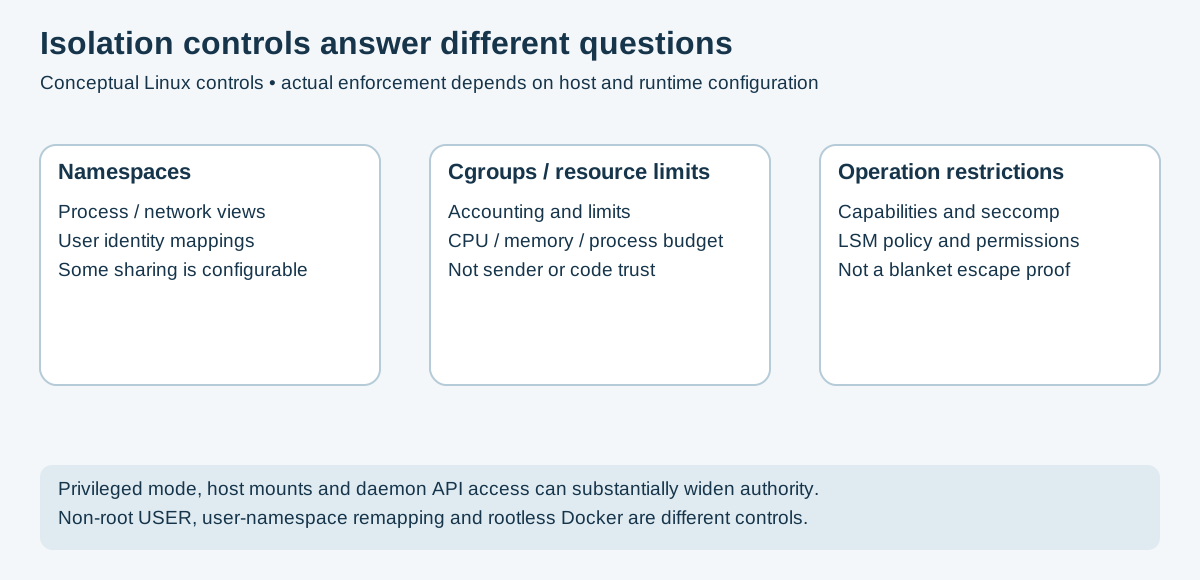
Original conceptual control map. Docker runtime privileges and resource constraints describe different controls. Names or configured limits alone do not establish effective enforcement.
| Configuration | Risk To Review |
|---|---|
--privileged |
Broad capabilities and device access significantly reduce default restrictions. Exact authority depends on daemon, user namespace, host and platform; every mode is not identical to host-root access. |
| Docker socket/API | Access grants authority over that daemon. Rootful daemon control can usually create host-impacting workloads. A read-only filesystem mount of a socket does not itself impose read-only API permissions. |
| Excessive capabilities | Evaluate capabilities in their actual namespace and policy context. CAP_SYS_ADMIN is broad but is not an unconditional escape guarantee. |
| Host mounts / namespaces | Docker bind mounts and Kubernetes hostPath are distinct surfaces. Host PID/network sharing removes particular boundaries; sensitive writable host paths expose host state directly. |
| Root user / writable state | Non-root execution and a read-only root filesystem reduce some exposure. They do not replace patching, application permissions or controlled writable mounts. |
For ordinary Linux containers, namespace and cgroup controls operate through a shared kernel. Review the Docker security model for daemon authority, kernel features and configured restrictions.
Treat escape investigation as an evidence review, not a request to execute an escape.
| Evidence | Interpretation And Limit |
|---|---|
| Image and runtime configuration | Record digest, user, capabilities, devices, mounts, namespace modes and security profiles. Inspection output can include secrets and requires controlled handling. |
| In-container markers |
/.dockerenv and /proc/1/cgroup are heuristics. Their absence does not prove a bare-metal host; runtime and cgroup versions differ. |
| Daemon/API reachability | Identify daemon identity, transport permissions and policy without creating privileged workloads. |
| Kernel/runtime advisories | Verify applicability and patch status. A version or configuration alone does not prove an escape was exercised. |
Possible paths include host-resource exposure, privileged device access, daemon authority and kernel/runtime defects. Some are direct configuration exposure, rather than exploitation of a software flaw. Report prerequisites and distinguish possible impact, verified configuration and demonstrated compromise.
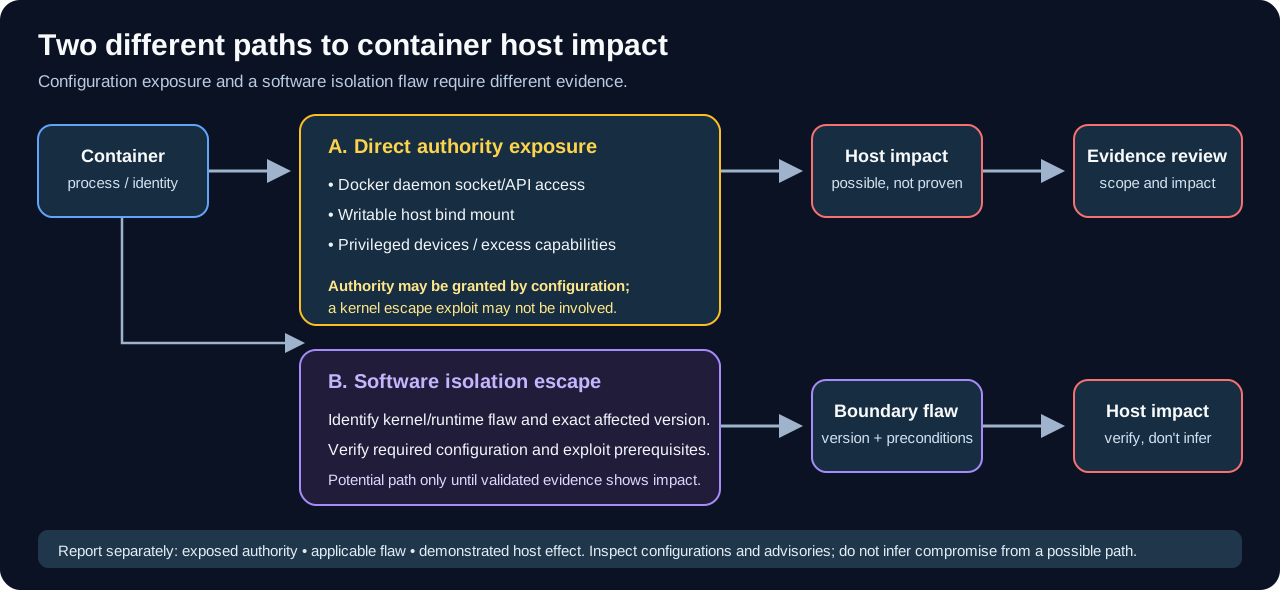
Conceptual comparison. Docker daemon access, writable bind mounts, or broad runtime privileges can expose host authority through configuration; a software escape claim needs an applicable flaw and evidence for its prerequisites. See Docker Engine security and runtime privilege options.
| Control | What To Verify |
|---|---|
| Least privilege | Avoid privileged mode; reduce capabilities and devices to demonstrated application requirements. Validate seccomp/LSM policy where supported. |
| Application identity | Run under the intended non-root identity and test file access. A Dockerfile USER is different from user-namespace remapping or a rootless daemon. |
| Rootless / user namespaces |
Rootless Docker runs the daemon and containers without host-root privileges; userns-remap keeps a rootful daemon. Check prerequisites and limits for the chosen mode. |
| Filesystem | Use a read-only root filesystem where compatible, with explicit writable locations. Mounted data is not automatically read-only. |
| Host exposure | Avoid daemon sockets, sensitive host paths and unnecessary namespace sharing. Scope any required exceptions narrowly. |
| Resource budget | Configure and verify CPU, memory and process limits. They reduce some exhaustion risk; they do not address every denial-of-service path. |
| Artifact lifecycle | Rebuild and re-evaluate pinned images, dependencies and provenance after relevant changes. |
| Runtime visibility | Evaluate Falco and SIEM integration against expected and unexpected behavior; no detector has universal coverage. |
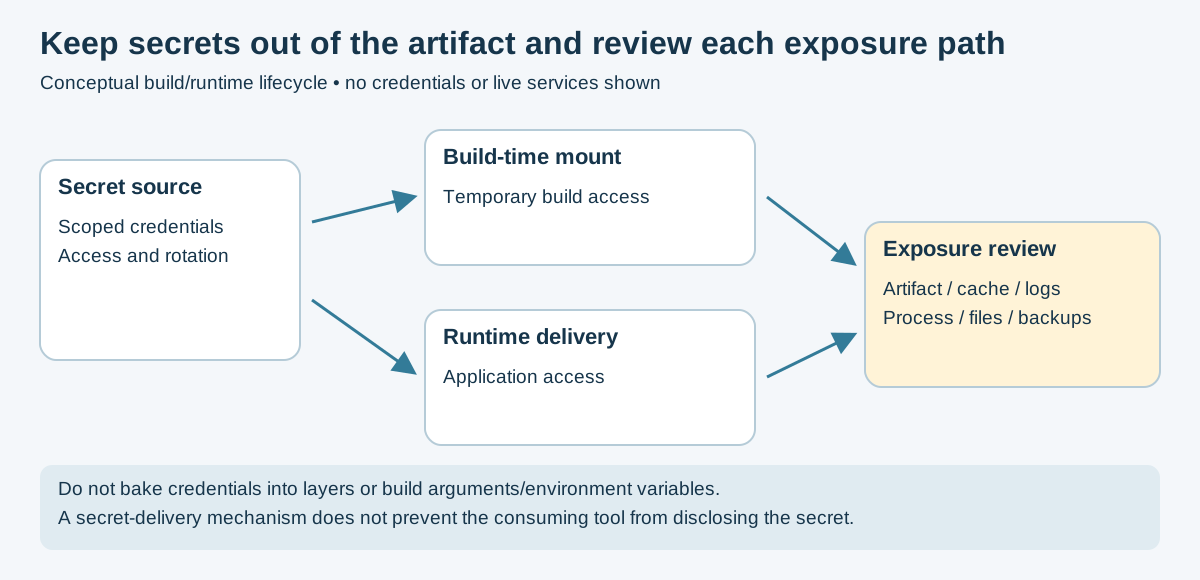
Original conceptual lifecycle based on Docker build secrets. Temporary secret mounts avoid automatically baking credentials into image layers; the consuming build step can still copy or print a secret. Runtime delivery is a separate configuration.
Use scoped build secret mounts or SSH mounts instead of build arguments and environment variables for credentials. Review outputs and logs, and configure runtime delivery, access and rotation independently.
Use Docker Bench for Security with the exact CIS benchmark version and platform scope. A passing result is benchmark evidence, not proof against every container escape.
- Docker Engine security.
- Docker runtime configuration.
- Rootless mode.
- Resource constraints.
- Build secrets.
- OCI overview and specifications.
- Trivy image scanning.
- Sigstore / Cosign.
- MITRE ATT&CK Containers.
- README.md — Container & Kubernetes Security index.
- kubernetes.md — Kubernetes security.
- ../Cloud/README.md — Cloud security.
📄 Source: ContainerSecurity/containers.md | ✏️ Suggest an edit | ⬅️ Back to Container Security