Repository navigation
Container Security
Older container-security ecosystem: Cypherpunk toolkit curation cross-references legacy scanners and emphasizes current supply-chain and Kubernetes policy verification.
Threat model, attack surface, and hardening for containers and Kubernetes
Part of the ULTIMATE CYBERSECURITY MASTER GUIDE


DevSecOps and source-analysis references: Awesome DevSecOps, static-analysis tools and the curated project map.
Vulnerability intelligence: Use the Security API Catalog to prioritize image/runtime findings with NVD, GHSA and CISA KEV; verify package/version applicability before remediation.
Software supply-chain workflow: OpenSSF Scorecard, Syft SBOM, OSV-Scanner, Trivy, Gitleaks and Cosign complement the Docker/OCI runtime security and Docker CLI guides.
Dedicated home for container and Kubernetes security - the image/runtime attack surface, container escape, the Kubernetes threat model, and hardening for both.
Indexes the Container Security section: cross-cutting fundamentals and tooling (this file), container/image security and escape techniques (containers.md), and Kubernetes security - RBAC, Pod Security Standards, secrets, network policy, attack paths, and hardening (kubernetes.md) - each pairing offense with defense.
Give practitioners a single reference for how containerized and orchestrated workloads are attacked and how to harden them, complementing the Cloud section.
- Assessing or hardening a container image, runtime, or Kubernetes cluster
- Looking up container-escape vectors or Kubernetes attack paths
- Selecting scanning/runtime-security tooling
- Reviewing a cluster against the CIS Kubernetes Benchmark
Containers and Kubernetes are now the default way applications ship and run, and they add attack surface at several layers - the image, the container runtime, the host, and the orchestrator. This section consolidates container security (previously scattered across the master guides) into fundamentals plus depth on containers and Kubernetes.
Like Cloud and Tradecraft, the material is dual-use: each guide pairs the offensive view (how workloads are attacked and escaped) with hardening and detection.
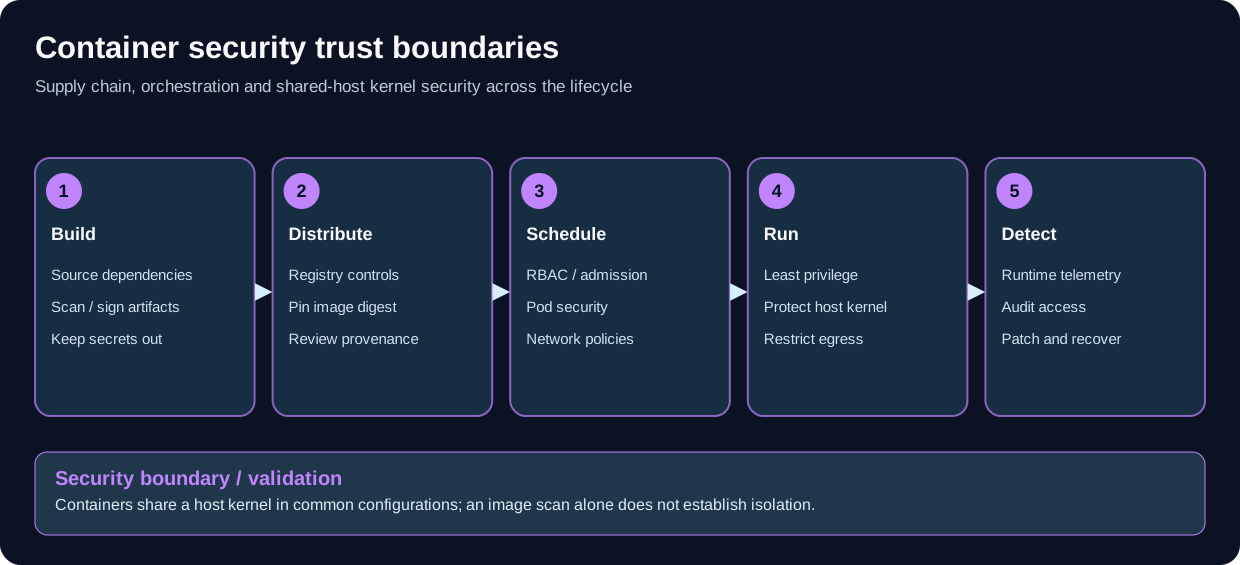
Conceptual security layers; actual containment depends on the runtime and host.
Attack surface spans four layers:
| Layer | Example risks |
|---|---|
| Image | Vulnerable packages, embedded secrets, untrusted base images, no signing |
| Runtime | Privileged containers, over-broad capabilities, mounted docker.sock, hostPath
|
| Host | Container escape to the node; shared kernel; weak isolation |
| Orchestrator (K8s) | Over-permissive RBAC, exposed API server, weak Pod Security, flat networking |
The defining property: containers share the host kernel, so isolation is weaker than a VM - a misconfiguration or kernel vulnerability can lead to escape.
| Tool | Role |
|---|---|
| Trivy | Image, filesystem, and IaC vulnerability + misconfiguration scanning |
| kube-bench | CIS Kubernetes Benchmark checks |
| kubescape | Cluster risk analysis, misconfiguration, and compliance scanning |
| Falco | Runtime threat detection (syscall-based); CNCF |
| Docker Bench for Security | CIS Docker Benchmark checks |
| kube-hunter | Cluster penetration-testing scanner (authorized use) |
| File | Description | Status |
|---|---|---|
| containers.md | Image and runtime security, container escape vectors, and hardening (Docker/OCI) | ✅ Complete |
| Docker Operations Cheat Sheet | Inspect-first Docker CLI/Compose, images, networks, volumes, secure runtime settings, and destructive cleanup cautions | ✅ Reference |
| kubernetes.md | RBAC, Pod Security Standards, secrets, network policy, attack paths, and hardening | ✅ Complete |
Caution
Authorized use only. The techniques here are for authorized assessment, education, and defensive research. Test only clusters and images you own or have explicit written permission to assess - and where the cluster runs on a cloud provider, follow that provider's penetration-testing policy too. See LEGAL.md.
- CIS Kubernetes Benchmark / CIS Docker Benchmark
- NSA/CISA Kubernetes Hardening Guidance
- Kubernetes Security documentation
- MITRE ATT&CK Containers Matrix
- OWASP Kubernetes Top 10
Repository: ULTIMATE CYBERSECURITY MASTER GUIDE
Maintained by: Pacific Northwest Computers
- containers.md - Container image & runtime security
- kubernetes.md - Kubernetes security
- ../Cloud/README.md - Cloud security (managed K8s: EKS/AKS/GKE)
- CLI field commands - Inspection-first Docker and Compose quick reference
- ../LEGAL.md - Legal notice and authorized-use terms
⬅️ Back to Master Index | 🎯 Role Navigation | Legal Notice
- 🐳 Container Image & Runtime Security
- Docker Operations, Diagnostics and Hardening Cheat Sheet
- ☸️ Kubernetes Security
- Software Supply-Chain Assessment and SBOM Workflow
📂 Folder: ContainerSecurity | ✏️ Suggest an edit | 🗺️ Browse by Topic