Repository navigation
Reverse Engineering
Historical x86/CTF source: Cypherpunk Symposium curation routes its older debugger and assembly notes into current Ghidra/binary-analysis references and documents decompilation limitations.
Last reviewed: 2026-10-07
Caution
Authorized use only. Reverse engineering, disassembly, decompilation, binary patching, and comparison techniques in this section are for systems you own, have explicit written authorization to analyze, or that are provided as legal lab or CTF material. Unauthorized analysis or modification of software can violate license terms and criminal law. See LEGAL.md.
Software reverse engineering with Ghidra: from first listing to headless pipelines
Part of the ULTIMATE CYBERSECURITY MASTER GUIDE
Reverse engineering and CTF study: RPISEC MBE, Awesome Reversing, and structured PNWC training.
Detection engineering lab: YARA-X rule authoring and synthetic positive/negative fixtures complements Ghidra and REMnux. External signature libraries require rule-by-rule license and compatibility review.
Index and entry point for software reverse engineering (SRE) in this repository. The working tool is Ghidra, NSA's open-source SRE suite. The long-form text lives in ghidra-guide-index.md.
Routes a reader to the right chapter of the Ghidra guide, the official install docs, and the neighboring repo sections (firmware, IR, lab) without forcing a linear read of all 23 chapters.
Get an authorized analyst from "I extracted a zip" to a repeatable workflow: classify the file, import it honestly, repair the listing, type the data, automate what repeats, and compare versions.
- First Ghidra install, or a JDK mismatch after a Ghidra upgrade
- Malware or unknown-binary triage after the sample is contained
- Sourcing real samples safely for practice or detection work (vx-underground)
- Firmware dumped in HardwareHacking that now needs a listing
- An IDA habit you want to map onto Ghidra keys and project layout
- Standing up headless analysis or a shared Ghidra Server later
Prerequisites: command line, basic C, how a program lands in memory. Practice only in an isolated lab: Homelab.
Note
Public Ghidra 12.1.x wants a 64-bit JDK 21. Development docs already
describe 12.2 and JDK 25. Trust the GettingStarted.md inside your
extracted zip, not a remembered version number.
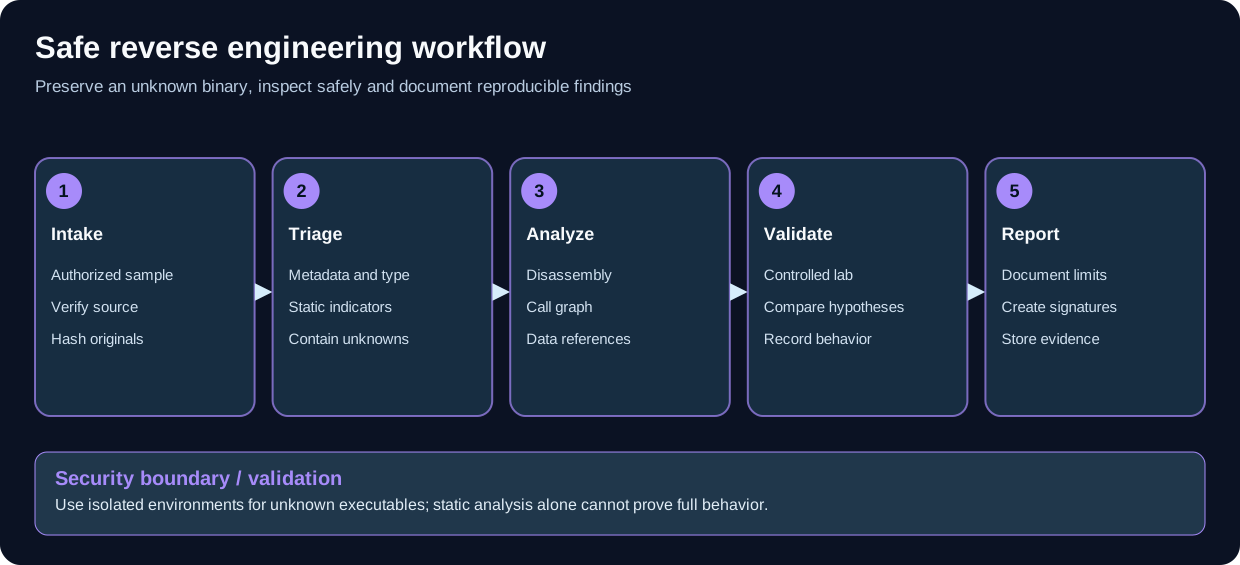
Use controlled lab environments and retain original sample hashes.
| If you need… | Open |
|---|---|
| Build a malware-analysis and DFIR lab with REMnux | REMnux Malware Analysis Guide |
| The full standalone guide | ghidra-guide-index.md |
| Official release zip only |
Ghidra Releases (ghidra_<version>_PUBLIC_<date>.zip) |
| Current JDK / launch / server notes | GettingStarted.md |
| Official classroom labs | GhidraClass |
| Real malware samples, source, and papers to practice on | vx-underground guide |
Download only the PUBLIC zip. The two GitHub "Source Code" archives are not
the runnable release.
All chapter text is in ghidra-guide-index.md. Use the anchors below, or scroll the file's own table of contents.
| Part | Chapters | Jump |
|---|---|---|
| I. Getting Started | 1–3 Disassembly theory, lab tools, install Ghidra | Part I |
| II. Basic usage | 4–10 Import, windows, listing repair, types, xrefs, graphs | Part II |
| III. Extending Ghidra | 11–16 Server, config, extensions, PyGhidra, GhidraDev, headless | Part III |
| IV. Deeper dive | 17–20 Loaders, SLEIGH processors, decompiler, compiler output | Part IV |
| V. Applications | 21–23 Obfuscation, patching, BSim and other diffs | Part V |
| Appendix | IDA keymap and first-session checklist | Appendix |
New to SRE?
  -> Part I (what a listing is, then install)
  -> Part II through Chapter 9 (stop when you can name a function from a string xref)
  -> Appendix lab checklist
  -> Parts III–V when a real sample demands them

Comfortable in IDA?
  -> Appendix first (keys and project model)
  -> Chapter 8 (types) and Chapter 19 (decompiler)
  -> Chapter 11 or 16 if you need a team or a pipeline

Need a pipeline, not a GUI?
  -> Chapter 3 (install layout) then Chapter 16 (analyzeHeadless)
  -> Chapter 14 (PyGhidra) if the script is the product
| Section | Why it sits next to this one |
|---|---|
| Homelab | Where you run Ghidra and untrusted binaries |
| HardwareHacking | Firmware comes off the bench; this section reads it |
| IncidentResponse | Sample intake, containment, and what the listing must answer |
| Tradecraft | Capability questions the listing is often asked to confirm |
| GLOSSARY.md | Shared terms |
-
REMnux — Malware Analysis & DFIR Workstation (VMs, static triage, PCAPs, documents and evidence handling)
Back to Master Index | Role Navigation | Legal Notice
- 🔍 Ghidra Master Guide
- 🧪 REMnux — Malware Analysis, Reverse Engineering & DFIR Workstation Guide
- 🦠 vx-underground: Malware Research Library
- YARA-X Rule Authoring and Malware Triage Lab
📂 Folder: ReverseEngineering | ✏️ Suggest an edit | 🗺️ Browse by Topic