Repository navigation
Data Quality and Schema Contracts
Validation, nulls, duplicates, schema evolution, compatibility gates, quarantine, and producer/consumer expectations
Declared contracts • Record and batch checks • Null rates • Breaking-change detection • Reject handling
Part of the ULTIMATE CYBERSECURITY MASTER GUIDE


Last reviewed: 2026-11-18. The validator and compatibility checker were executed against synthetic fixtures; see the Verification Record for limits.
Prerequisites: Data Engineering Fundamentals for quarantine and identity, and ETL & ELT Pipeline Design for where validation sits in a load.
Replace the implicit assumptions inside a loader with an explicit, versioned contract — a file that states what a valid record is, what the batch as a whole must look like, and which changes to that definition are allowed to ship without coordination.
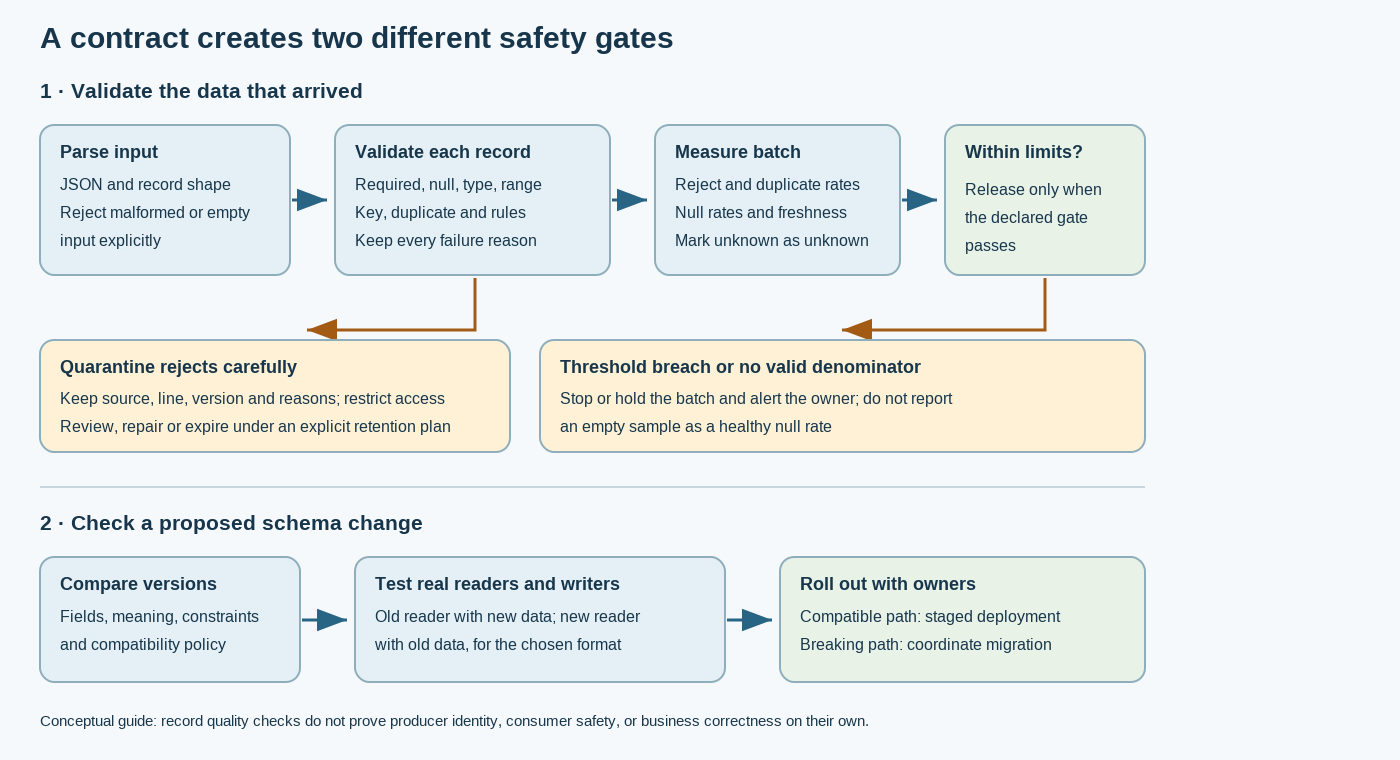
Original conceptual diagram. Record validation and compatibility checks are separate gates; passing either alone does not establish business correctness or consumer safety.
Define the six dimensions of data quality; separate record-level from batch-level checks; handle nulls and duplicates deliberately; build a contract-driven validator that quarantines rejects with reasons and enforces batch expectations; build a compatibility checker that classifies schema changes as compatible or breaking and fails a build on the latter; and set out the obligations a producer and a consumer owe each other.
Enable a practitioner to point at a file and say "this is what valid means", have a failing batch stop before it reaches consumers with a named reason, and have a breaking schema change rejected in review rather than discovered by a downstream outage.
- Adding validation to any pipeline built in this section.
- Diagnosing a consumer complaint about missing, duplicated, or nonsensical data.
- Planning a schema change to a dataset other teams already read.
- Establishing what a data producer is accountable for.
- Deciding whether a bad batch should fail the run or be quarantined.
Audience: Practitioners responsible for a dataset that someone else depends on.
Prerequisites: Python 3.10 or later. The lab uses only json, re, datetime, collections, and logging, so it runs anywhere without installation. Production alternatives such as JSON Schema, Pydantic, Avro, Great Expectations, and dbt tests are referenced but not required.
Note
The contract format used here is deliberately minimal so the validation logic is fully visible. In production, prefer an established specification — the concepts transfer directly, and a standard format brings tooling and a registry with it.
- 📐 1. The Six Dimensions of Quality
- 📜 2. What a Contract Contains
- 🔎 3. Record-Level Validation
- 📊 4. Batch-Level Expectations
- 🕳️ 5. Nulls
- 👯 6. Duplicates
- 🧪 7. Lab: The Contract Validator
- 🔀 8. Schema Evolution and Compatibility
- 🚧 9. Quarantine and Reject Handling
- 🤝 10. Producer and Consumer Obligations
- 🎓 11. Self-Check
- ✅ Verification Record
- 🤝 Contributing
- 📚 Resources
- 🔗 Quick Links & Related Guides
- 📊 Guide Details
"Bad data" is not a diagnosis. These six dimensions turn it into one, and each maps to a check that can be automated.
| Dimension | Question | Automated check |
|---|---|---|
| Completeness | Is every expected value and record present? | Null rates; source-versus-destination counts |
| Validity | Does each value conform to its declared type and domain? | Type, enum, pattern, range checks |
| Uniqueness | Does each real-world entity appear once? | Distinct primary key count versus row count |
| Consistency | Do related values agree with each other? | Cross-field rules; referential integrity |
| Timeliness | Is the data recent enough to be useful? | Freshness and lag measurement |
| Accuracy | Do the values match reality? | Reconciliation against an authoritative source |
A validation rule checks a declared expectation. Confirming accuracy usually requires independent evidence about the underlying event or record. Completeness also depends on knowing which records should exist.
Tip
When a consumer reports "the data is wrong", ask which dimension. Check whether the data is stale or the consumer expects a different population of records before changing the transformation.
A schema says what the fields are. A contract adds the promises around them and the rules for changing them.
| Element | Purpose |
|---|---|
| Name and version | Identify the dataset and the contract revision |
| Field specifications | Type, required, nullable, and value constraints |
| Primary key | Which fields define record identity, and therefore the grain |
| Batch expectations | Thresholds the batch as a whole must satisfy |
| Compatibility policy | Which changes may ship without consumer coordination |
| Ownership | Who is accountable, and how they are contacted |
| Freshness commitment | How current consumers may assume the data is |
The contract used in the lab:
{
  "name": "asset_checkin",
  "version": 1,
  "primary_key": ["serial", "checked_at"],
  "fields": {
    "serial":     {"type": "string",  "required": true,  "nullable": false, "pattern": "^SN-[0-9]{4}$"},
    "hostname":   {"type": "string",  "required": true,  "nullable": false, "max_length": 63},
    "site":       {"type": "string",  "required": true,  "nullable": false, "enum": ["vancouver","portland","seattle"]},
    "checked_at": {"type": "timestamp", "required": true, "nullable": false},
    "cpu_pct":    {"type": "number",  "required": true,  "nullable": true,  "min": 0, "max": 100},
    "status":     {"type": "string",  "required": true,  "nullable": false, "enum": ["ok","warn","fail"]}
  },
  "expectations": {
    "max_null_rate": {"cpu_pct": 0.25},
    "max_duplicate_rate": 0.0,
    "max_reject_rate": 0.20
  }
}This distinction causes more contract disputes than any other:
required |
nullable |
Meaning |
|---|---|---|
true |
false |
The key must be present and hold a real value |
true |
true |
The key must be present; null is a valid, meaningful value |
false |
true |
The key may be absent entirely |
false |
false |
If present, it must hold a real value |
cpu_pct is required: true, nullable: true — the agent must always report the field, but null is the legitimate way to say "I could not measure this". That is deliberately different from omitting the field, which would mean the agent is an older version that does not know about it.
The contract belongs in version control, in the same repository as the pipeline, reviewed through the same process. A contract maintained in a wiki drifts from the code within weeks and then actively misleads. See the Git workflow section of data_pipelines.md.
Record-level checks examine one record in isolation and answer: is this record admissible?
| Check | Catches |
|---|---|
| Presence | A required key absent from the record |
| Nullability |
null where a real value is mandatory |
| Type | A string where a number is declared |
| Enum | A status value the consumer has no branch for |
| Pattern | A malformed identifier that would break joins |
| Range | A percentage of 150 |
| Length | A hostname exceeding the destination column |
| Timestamp | A time with no timezone offset (see Python for Data Processing) |
| Unknown fields | A producer-side addition the contract has not agreed to |
def validate_record(contract: dict, record: dict) -> list[str]:
    if not isinstance(record, dict):
        return ["record: expected JSON object"]
    errors = [e for n, s in contract["fields"].items()
              if (e := validate_field(n, s, record))]
    unknown = set(record) - set(contract["fields"])
    if unknown:
        errors.append(f"unknown fields present: {sorted(unknown)}")
    return errors
Returning a list rather than raising on the first problem matters operationally: a producer fixing rejects wants the complete defect list for a record, not to rediscover a new problem on each iteration.
Three defensible policies, and the contract must state which applies:
| Policy | Behavior | Use when |
|---|---|---|
| Strict | Reject records with unrecognized fields | The contract is authoritative and producers are coordinated |
| Ignore | Drop unknown fields silently | Wide, evolving sources; consumers take only declared fields |
| Capture | Store unknown fields in a catch-all column | Raw retention matters and the producer iterates fast |
The lab uses strict, which surfaces producer-side changes immediately. For a high-churn telemetry source, capture is usually better: the data is preserved, and a review of the catch-all column shows what the producer started sending.
Some failures are invisible at record level. Every record can be individually valid while the batch as a whole is clearly wrong.
| Expectation | Detects |
|---|---|
| Max reject rate | A producer-side format change or a broken upstream job |
| Max duplicate rate | A double delivery or a failed deduplication |
| Max null rate per field | A sensor or agent that stopped reporting a value |
| Min/max row count | An empty extract or a runaway duplication |
| Freshness | A source that has stopped producing |
| Distribution shift | A category that vanished or a mean that moved sharply |
A threshold of "fewer than 50 rejects" fails differently on a 100-row batch than on a 10-million-row batch. Rates are stable across volume. Keep absolute floors only where they genuinely apply — for example, a minimum expected row count that catches an empty extract.
Do not invent thresholds. Measure the pipeline for a period, observe the normal rate, and set the limit above the observed range with margin. A threshold set below normal variation generates alerts that get muted, which is worse than having no threshold at all.
Warning
A batch expectation that fails must actually stop something. A check that logs a warning into a stream nobody reads is decorative. Decide per expectation: does a breach halt the load, quarantine the batch for review, or page someone? Write that decision into the contract.
null is a legitimate value meaning unknown. The failure is never that nulls exist — it is that they are undifferentiated.
Three distinct situations are routinely collapsed into one null:
| Situation | Meaning | Should be distinguishable |
|---|---|---|
| Not measured | The agent could not read the value | Yes — a rising rate is an incident |
| Not applicable | The field has no meaning for this record type | Yes — never a defect |
| Lost in the pipeline | A join missed or a parse failed | Yes — always a defect |
The third is the dangerous one, because it looks exactly like the first two. Two practices separate them:
-
Never substitute a default that is indistinguishable from a real value. Writing
0for an unmeasured CPU percentage corrupts every average computed afterwards, permanently and unrecoverably. -
Record the reason alongside the value where it matters. A
cpu_pct_statuscolumn holdingmeasured/unavailable/not_applicablecosts one column and eliminates an entire class of ambiguity.
SELECT COUNT(*) AS rows,
       COUNT(cpu_pct) AS with_value,
       ROUND(1.0 * (COUNT(*) - COUNT(cpu_pct)) / COUNT(*), 3) AS null_rate
FROM dw_checkins
WHERE checked_at >= date('now', '-1 day');
A null rate that moves from 2% to 40% overnight is a real incident that no record-level check fires on — every one of those nulls is contractually valid. This is exactly what batch expectations exist to catch.
A duplicate is defined relative to the primary key in the contract. Until the key is declared, "duplicate" has no meaning.
| Type | Definition | Usual cause |
|---|---|---|
| Exact | Every field identical | Retry, double delivery, overlap window |
| Key | Same primary key, different attributes | A restatement, or a genuine key collision |
| Near | Same entity, different representation | Casing, whitespace, or formatting differences |
Near-duplicates are defeated at the transformation step, not the deduplication step. "SN-1001", "sn-1001 ", and "SN‑1001" (with a non-breaking hyphen) are three distinct strings and one physical asset. Apply Unicode normalization, trimming, and case folding before the key is computed — the normkey() pattern from Python for Data Processing.
| Location | Mechanism | Strength |
|---|---|---|
| Validator | In-memory set of seen keys per batch | Within a batch only |
| Destination |
UNIQUE constraint plus upsert |
Across all batches, always |
| Consumer |
SELECT DISTINCT or window deduplication |
Fragile; every consumer must remember |
The destination constraint is the only one that holds unconditionally. The batch check is still worth having because it attributes the duplicate to a specific batch and line, which the constraint cannot do.
Note
Key duplicates within a single batch are ambiguous by nature: two records claim the same identity with different attributes, and nothing in the data says which is correct. The defensible options are to reject both and alert, or to apply a documented tiebreaker such as "highest source timestamp wins". Silently keeping whichever arrived last is the option to avoid.
Save the contract from §2 as contract_v1.json, then create batch.jsonl with ten records containing a representative spread of defects:
{"serial":"SN-1001","hostname":"ws-acct-01","site":"vancouver","checked_at":"2026-09-10T14:00:00+00:00","cpu_pct":12.5,"status":"ok"}
{"serial":"SN-1002","hostname":"ws-acct-02","site":"vancouver","checked_at":"2026-09-10T14:05:00+00:00","cpu_pct":null,"status":"ok"}
{"serial":"SN-1003","hostname":"srv-file-01","site":"portland","checked_at":"2026-09-10T14:07:00+00:00","cpu_pct":38.4,"status":"ok"}
{"serial":"SN-1001","hostname":"ws-acct-01","site":"vancouver","checked_at":"2026-09-10T14:00:00+00:00","cpu_pct":12.5,"status":"ok"}
{"serial":"1004","hostname":"ws-ops-07","site":"portland","checked_at":"2026-09-10T14:09:00+00:00","cpu_pct":22.0,"status":"ok"}
{"serial":"SN-1005","hostname":"ws-ship-03","site":"spokane","checked_at":"2026-09-10T14:11:00+00:00","cpu_pct":81.0,"status":"warn"}
{"serial":"SN-1006","hostname":"ws-spare-01","site":"seattle","checked_at":"2026-09-10 14:13:00","cpu_pct":5.0,"status":"ok"}
{"serial":"SN-1007","hostname":"ws-lab-02","site":"seattle","checked_at":"2026-09-10T14:15:00+00:00","cpu_pct":150,"status":"ok"}
{"serial":"SN-1008","hostname":"ws-lab-03","site":"seattle","checked_at":"2026-09-10T14:17:00+00:00","cpu_pct":44.0,"status":"degraded"}
{"serial":"SN-1009","hostname":"ws-lab-04","site":"portland","checked_at":"2026-09-10T14:19:00+00:00","status":"ok"}
Each defect is deliberate: a duplicate key, a serial failing the pattern, a site outside the enum, a timestamp without an offset, a CPU above the maximum, an unknown status, and a missing required field.
validate.py:
#!/usr/bin/env python3
"""Validate a JSON Lines batch against a declared data contract."""
from __future__ import annotations
import datetime as dt, json, logging, math, pathlib, re, sys
from collections import Counter

logging.basicConfig(level=logging.INFO, format="%(levelname)s %(name)s %(message)s")
log = logging.getLogger("validate")

CHECKERS = {
    "string":  lambda v: isinstance(v, str),
    "number":  lambda v: (isinstance(v, int) and not isinstance(v, bool))
                         or (isinstance(v, float) and math.isfinite(v)),
    "integer": lambda v: isinstance(v, int) and not isinstance(v, bool),
    "boolean": lambda v: isinstance(v, bool),
}


def check_timestamp(value) -> str | None:
    if not isinstance(value, str):
        return "expected timestamp string"
    try:
        parsed = dt.datetime.fromisoformat(value.replace("Z", "+00:00"))
    except ValueError:
        return f"unparseable timestamp: {value!r}"
    if parsed.tzinfo is None:
        return f"timestamp lacks timezone offset: {value!r}"
    return None


def validate_field(name: str, spec: dict, record: dict) -> str | None:
    present = name in record
    if not present:
        return None if not spec.get("required", False) else f"{name}: required field absent"
    value = record[name]
    if value is None:
        return None if spec.get("nullable", False) else f"{name}: null not permitted"

    ftype = spec["type"]
    if ftype == "timestamp":
        return (lambda e: f"{name}: {e}" if e else None)(check_timestamp(value))
    if not CHECKERS[ftype](value):
        return f"{name}: expected {ftype}, got {type(value).__name__}"
    if "enum" in spec and value not in spec["enum"]:
        return f"{name}: {value!r} not in allowed values {spec['enum']}"
    if "pattern" in spec and not re.fullmatch(spec["pattern"], value):
        return f"{name}: {value!r} does not match {spec['pattern']}"
    if "max_length" in spec and len(value) > spec["max_length"]:
        return f"{name}: length {len(value)} exceeds {spec['max_length']}"
    if "min" in spec and value < spec["min"]:
        return f"{name}: {value} below minimum {spec['min']}"
    if "max" in spec and value > spec["max"]:
        return f"{name}: {value} above maximum {spec['max']}"
    return None


def validate_record(contract: dict, record: dict) -> list[str]:
    if not isinstance(record, dict):
        return ["record: expected JSON object"]
    errors = [e for n, s in contract["fields"].items()
              if (e := validate_field(n, s, record))]
    unknown = set(record) - set(contract["fields"])
    if unknown:
        errors.append(f"unknown fields present: {sorted(unknown)}")
    return errors


def reject_constant(token: str):
    raise ValueError(f"non-standard JSON constant: {token}")

def main(contract_path: str, batch_path: str) -> int:
    contract = json.loads(pathlib.Path(contract_path).read_text())
    exp = contract.get("expectations", {})
    pk = contract["primary_key"]

    accepted, rejected = [], []
    seen, dup_keys = set(), Counter()
    null_counts, reason_counts = Counter(), Counter()
    total = 0

    with open(batch_path, encoding="utf-8") as fh:
        for line_no, line in enumerate(fh, start=1):
            if not line.strip():
                continue
            total += 1
            try:
                record = json.loads(line, parse_constant=reject_constant)
            except (json.JSONDecodeError, ValueError) as exc:
                rejected.append({"line": line_no, "errors": [f"malformed json: {exc}"],
                                 "raw": line[:200]})
                reason_counts["malformed json"] += 1
                continue

            errors = validate_record(contract, record)
            if errors:
                rejected.append({"line": line_no, "errors": errors, "raw": record})
                for e in errors:
                    reason_counts[e.split(":")[0] if ":" in e else e] += 1
                continue

            key = tuple(record.get(k) for k in pk)
            if key in seen:
                dup_keys[key] += 1
                rejected.append({"line": line_no, "errors": ["duplicate primary key"],
                                 "raw": record})
                reason_counts["duplicate primary key"] += 1
                continue
            seen.add(key)

            for name in contract["fields"]:
                if record.get(name) is None:
                    null_counts[name] += 1
            accepted.append(record)

    pathlib.Path("accepted.jsonl").write_text(
        "".join(json.dumps(r, sort_keys=True) + "\n" for r in accepted))
    pathlib.Path("quarantine.jsonl").write_text(
        "".join(json.dumps(r, sort_keys=True) + "\n" for r in rejected))

    n_acc = len(accepted)
    reject_rate = len(rejected) / total if total else 0.0
    dup_rate = sum(dup_keys.values()) / total if total else 0.0

    log.info("records=%d accepted=%d rejected=%d reject_rate=%.2f duplicate_rate=%.2f",
             total, n_acc, len(rejected), reject_rate, dup_rate)
    for reason, count in reason_counts.most_common():
        log.info("  reason %-28s %d", reason, count)

    breaches = []
    if total == 0:
        breaches.append("empty batch: no records to validate")
    if reject_rate > exp.get("max_reject_rate", 1.0):
        breaches.append(f"reject_rate {reject_rate:.2f} > {exp['max_reject_rate']}")
    if dup_rate > exp.get("max_duplicate_rate", 1.0):
        breaches.append(f"duplicate_rate {dup_rate:.2f} > {exp['max_duplicate_rate']}")
    for field, limit in exp.get("max_null_rate", {}).items():
        if n_acc == 0:
            breaches.append(f"null_rate[{field}] not evaluable: no accepted records")
            continue
        rate = null_counts[field] / n_acc
        log.info("  null_rate %-28s %.2f (limit %.2f)", field, rate, limit)
        if rate > limit:
            breaches.append(f"null_rate[{field}] {rate:.2f} > {limit}")

    if breaches:
        for b in breaches:
            log.error("EXPECTATION BREACH: %s", b)
        return 1
    log.info("all batch expectations met")
    return 0


if __name__ == "__main__":
sys.exit(main(sys.argv[1], sys.argv[2]))python3 validate.py contract_v1.json batch.jsonl; echo "exit=$?"Actual output:
INFO validate records=10 accepted=3 rejected=7 reject_rate=0.70 duplicate_rate=0.10
INFO validate   reason cpu_pct                      2
INFO validate   reason duplicate primary key        1
INFO validate   reason serial                       1
INFO validate   reason site                         1
INFO validate   reason checked_at                   1
INFO validate   reason status                       1
INFO validate   null_rate cpu_pct                      0.33 (limit 0.25)
ERROR validate EXPECTATION BREACH: reject_rate 0.70 > 0.2
ERROR validate EXPECTATION BREACH: duplicate_rate 0.10 > 0.0
ERROR validate EXPECTATION BREACH: null_rate[cpu_pct] 0.33 > 0.25
exit=1
Three things are worth reading closely:
-
cpu_pctappears twice in the reason counts — once for the value of 150 exceeding the maximum, once for the field being absent on the final record. Grouping by field name shows a producer which field to investigate. -
The null-rate breach is the subtle one. One of the three accepted records has
cpu_pct: null, which is contractually valid per-record. Only the batch-level view reveals that a third of accepted records carry no CPU reading. - The exit status is 1. This is what makes the validator usable as a gate in an orchestrated pipeline rather than an advisory script.
Inspect the rejects — each carries its line number, every failing rule, and the original record:
python3 -c "
import json
for l in open('quarantine.jsonl'):
r = json.loads(l); print(r['line'], r['errors'])"Schemas change. The question is whether a given change breaks the consumers that already exist.
| Mode | Definition | Enables |
|---|---|---|
| Backward compatible | New readers can read old data | Upgrade consumers before producers |
| Forward compatible | Old readers can read new data | Upgrade producers before consumers |
| Full | Both | Upgrade in any order |
| Breaking | Neither | Requires coordinated deployment |
These labels are directional and format-specific, not guarantees. Test both old-reader/new-data and new-reader/old-data paths with the actual serialization format, validation policy and deployed consumers.
| Change | Classification | Reason |
|---|---|---|
Add an optional field (required: false) |
Often compatible | Verify readers tolerate unknown fields under the chosen format and policy |
| Add a required nullable or non-nullable field | Breaking |
nullable allows null; it does not allow a required field to be absent |
| Remove a field | Breaking | Consumers referencing it break |
| Change a field type | Treat as breaking in this checker | Actual compatibility depends on format, reader/writer behavior and value ranges |
| Add an enum value | Compatible for producers, breaking for strict consumers | A consumer with an exhaustive branch has no case for it |
| Remove an enum value | Breaking | Existing data becomes invalid |
| Loosen a range | Compatible | Previously valid values stay valid |
| Tighten a range | Breaking | Existing data may now fail |
| Make an optional field required | Breaking | Old records lack it |
| Make a nullable field non-nullable | Breaking | Existing nulls become invalid |
| Change the primary key | Breaking | Redefines identity and the grain |
| Rename a field | Breaking | Equivalent to remove plus add |
Caution
Adding an enum value is the change most often misfiled as safe. It may parse at the wire level while still breaking consumers with an exhaustive match, a CHECK constraint, or a lookup table. Classify it by what consumers actually do, not by the storage type — and tell consumers before shipping it.
compat.py:
#!/usr/bin/env python3
"""Classify the difference between two contract versions as compatible or breaking."""
from __future__ import annotations
import json, pathlib, sys

def classify(old: dict, new: dict) -> list[tuple[str, str]]:
    findings: list[tuple[str, str]] = []
    of, nf = old["fields"], new["fields"]

    for name in nf.keys() - of.keys():
        spec = nf[name]
        if spec.get("required"):
            qualifier = "nullable" if spec.get("nullable") else "non-nullable"
            findings.append(("BREAKING", f"added required {qualifier} field '{name}'"))
        else:
            findings.append(("COMPATIBLE", f"added optional field '{name}'"))

    for name in of.keys() - nf.keys():
        findings.append(("BREAKING", f"removed field '{name}'"))

    for name in of.keys() & nf.keys():
        o, n = of[name], nf[name]
        if o["type"] != n["type"]:
            findings.append(("BREAKING", f"'{name}' type changed {o['type']} -> {n['type']}"))
        if not o.get("required") and n.get("required"):
            findings.append(("BREAKING", f"'{name}' became required"))
        if o.get("nullable") and not n.get("nullable"):
            findings.append(("BREAKING", f"'{name}' no longer nullable"))
        if "enum" in o and "enum" in n:
            removed = set(o["enum"]) - set(n["enum"])
            added = set(n["enum"]) - set(o["enum"])
            if removed:
                findings.append(("BREAKING", f"'{name}' enum values removed: {sorted(removed)}"))
            if added:
                findings.append(("COMPATIBLE", f"'{name}' enum values added: {sorted(added)}"))
        for bound, worse in (("min", lambda a, b: b > a), ("max", lambda a, b: b < a)):
            if bound in o and bound in n and worse(o[bound], n[bound]):
                findings.append(("BREAKING", f"'{name}' {bound} tightened {o[bound]} -> {n[bound]}"))
    if old.get("primary_key") != new.get("primary_key"):
        findings.append(("BREAKING",
                         f"primary key changed {old.get('primary_key')} -> {new.get('primary_key')}"))
    return findings

def main(old_path: str, new_path: str) -> int:
    old = json.loads(pathlib.Path(old_path).read_text())
    new = json.loads(pathlib.Path(new_path).read_text())
    print(f"{old['name']} v{old['version']} -> v{new['version']}")
    findings = classify(old, new)
    for level, msg in sorted(findings):
        print(f"  [{level:11}] {msg}")
    breaking = [f for f in findings if f[0] == "BREAKING"]
    print(f"\n{len(findings)} change(s), {len(breaking)} breaking")
    return 1 if breaking else 0

if __name__ == "__main__":
    sys.exit(main(sys.argv[1], sys.argv[2]))
Create contract_v2.json as a copy of v1 adding spokane to the site enum, an optional agent_ver field, and a required non-nullable mem_pct:
python3 compat.py contract_v1.json contract_v2.json; echo "exit=$?"asset_checkin v1 -> v2
[BREAKING ] added required non-nullable field 'mem_pct'
[COMPATIBLE ] 'site' enum values added: ['spokane']
[COMPATIBLE ] added optional field 'agent_ver'
3 change(s), 1 breaking
exit=1
The gate fails. Make mem_pct optional and nullable in contract_v3.json — a two-phase rollout where the field is added optionally first, populated by producers, and only then made required:
python3 compat.py contract_v1.json contract_v3.json; echo "exit=$?"asset_checkin v1 -> v3
[COMPATIBLE ] 'site' enum values added: ['spokane']
[COMPATIBLE ] added optional field 'agent_ver'
[COMPATIBLE ] added optional field 'mem_pct'
3 change(s), 0 breaking
exit=0
Revalidating the same batch against v3 shows the effect of widening the enum — SN-1005 at the spokane site is now accepted:
INFO validate records=10 accepted=4 rejected=6 reject_rate=0.60 duplicate_rate=0.10
Tip
Run compat.py in continuous integration on every pull request that touches a contract file, comparing the committed version against the previous one. A non-zero exit forces a human decision about coordination rather than allowing a breaking change to merge unnoticed.
Adding a genuinely required field without an outage always takes two releases:
- Add it as optional. Deploy consumers that tolerate its absence. Deploy producers that populate it. Wait until the null rate reaches zero and stays there.
- Make it required. Now no existing record violates the constraint.
Attempting both in one step guarantees a window where valid production data fails validation.
A rejected record is evidence, not garbage. Quarantine gives it somewhere durable to live.
| Field | Why |
|---|---|
| The original record, unmodified | The producer needs to see exactly what was sent |
| Every failing rule | Fixing one defect at a time wastes cycles |
| Source file and line or offset | Locating the record upstream |
| Batch identifier | Correlating with the run log |
| Contract version | The same record may be valid under a different version |
| Quarantine timestamp | Ageing and retention |
reject ──► quarantine ──► triage ──► ┌─ fix upstream ──► replay ──► accepted
                                     ├─ amend contract ──► replay ──► accepted
                                     └─ confirmed invalid ──► expire per retention
A quarantine that is written and never read is a disk-usage problem rather than a quality control. Three practices prevent that:
- Alert on rate, not on presence. A steady 0.1% reject rate may be normal; a jump to 15% is an incident.
- Give it an owner and a review cadence. Unreviewed quarantine grows until someone deletes the directory.
- Set a retention period. Quarantined records frequently contain the malformed personal or sensitive data that failed validation in the first place, and they inherit the same handling obligations as the source.
| Choose | When |
|---|---|
| Quarantine and continue | Machine-generated sources where individual defects are expected |
| Fail the entire batch | Small curated inputs, financial data, or a reject rate above the contract's threshold |
The lab implements both: individual records are quarantined, and the run still exits non-zero when the aggregate breaches an expectation. That combination — granular tolerance with an aggregate limit — is the pattern worth copying.
Caution
Never write quarantined records to a location with broader access than the source data. A reject file assembled from security logs or customer records carries the same classification as the original, and the fact that a record is malformed does not make it non-sensitive.
A contract is between parties. Most data quality incidents are a failure of one of these obligations rather than a coding error.
| Obligation | Practical meaning |
|---|---|
| Conformance | Emitted records satisfy the declared contract |
| Advance notice | Breaking changes are announced before deployment, with a migration window |
| Version identification | Records or the batch carry the contract version |
| Stable semantics | A field's meaning does not change while its name and type stay the same |
| Freshness | Data arrives within the committed window, and failures are communicated |
| Documented identity | The primary key is stated and does not change silently |
The fourth obligation is the one most often broken and hardest to detect: repurposing an existing field passes every type, enum, and range check while making every historical value wrong. No automated check catches it. Only communication does.
| Obligation | Practical meaning |
|---|---|
| Use declared fields only | Do not depend on undocumented columns or on row ordering |
| Tolerate compatible changes | New optional fields must not break a reader |
| Handle nulls per contract | Where nullable is declared, handle it |
| Report defects with evidence | Cite the record, the field, and the expectation breached |
| Stay current | Migrate within the announced window |
| Do not silently repair | Fixing bad data locally hides a producer defect from everyone else |
That last obligation matters more than it appears. When each consumer patches around the same upstream defect in its own way, the producer never learns it exists, and the consumers quietly diverge in what they report.
{
  "name": "asset_checkin",
  "version": 3,
  "owner": "platform-team",
  "contact": "platform@example.internal",
  "freshness_sla_minutes": 30,
  "compatibility": "backward",
  "consumers": ["inventory-report", "detection-rules"]
}
Listing consumers is the highest-value line in the file. It converts "who will this break?" from an unanswerable question into a list of people to notify.
- Which of the six quality dimensions cannot be verified without a second source, and why?
- Explain the difference between
requiredandnullable, and give a case whererequired: true, nullable: trueis correct. - The batch had three accepted records and still failed. Which expectation failed and why is it invisible at record level?
- Why does
validate_recordreturn a list of errors instead of raising on the first? - Name the three situations that a single
nullcan conflate, and the practice that separates them. - Why is adding an enum value ambiguous rather than simply compatible?
- Describe the two-phase rollout for adding a required field, and what breaks if it is done in one step.
- Why is the validator's exit status significant?
- What must a quarantine record contain beyond the original data, and why each element?
- Which producer obligation cannot be enforced by any automated check?
| Area | Verification performed | Limitation |
|---|---|---|
| Contract fixtures |
contract_v1.json, contract_v2.json, and contract_v3.json created and parsed |
Custom minimal format, not JSON Schema or Avro |
| Record validation | Executed against the 10-record batch; all seven intended defects rejected with named reasons | Cross-field consistency rules not implemented |
| Batch expectations | Executed; reject_rate=0.70, duplicate_rate=0.10, null_rate[cpu_pct]=0.33 all breached; exit status 1 |
Distribution-shift and row-count checks described, not implemented |
| Duplicate detection | Confirmed the repeated (SN-1001, 2026-09-10T14:00:00+00:00) key rejected as a duplicate |
In-batch only; cross-batch uniqueness relies on a destination constraint |
| Null accounting | Confirmed 1 of 3 accepted records null for cpu_pct, rate 0.33 against a 0.25 limit |
Small sample; rates are volatile at this size |
| Edge handling | Synthetic checks covered non-object records, non-finite values, empty batches, and null-rate denominators with no accepted rows | Does not replace production telemetry or operational alert testing |
| Quarantine output | Confirmed quarantine.jsonl holds all seven rejects with line, errors, and original record |
Contract version and batch id are described as requirements but not emitted by the lab script |
| Compatibility checker | Executed v1→v2: 1 breaking, 2 compatible, exit 1. Executed v1→v3: 0 breaking, exit 0 | Heuristic rules do not prove actual format or consumer compatibility |
| Enum widening effect | Revalidated the same batch against v3; accepted rose from 3 to 4 as spokane became valid |
— |
Local synthetic checks used Python 3.12.14 on Windows 11 with standard-library modules and an in-memory SQLite database. This identifies the verification environment; no live dataset, pipeline or production consumer was exercised.
Submission Guidelines:
- State the contract a check enforces; a check without a declared expectation is an opinion.
- Include a fixture that fails, alongside one that passes.
- Classify any proposed schema change using the table in §8 and justify the classification.
- Keep validation logic free of destination access so it can be unit tested.
- Report the actual output observed, including exit statuses.
- Update the section index when adding a guide.
| Area | Official References |
|---|---|
| 📜 Schema specifications | JSON Schema · Apache Avro specification · Protocol Buffers |
| 🔀 Compatibility | Avro schema resolution · Protobuf update rules · JSON Schema required properties |
| ✅ Validation tooling | Great Expectations · Pydantic · dbt tests |
| 🐍 Python | json · re · collections.Counter |
| 📄 Formats | JSON Lines · RFC 3339 |
- 🗄️ Data Engineering Section Index
- 🧱 Data Engineering Fundamentals
- 🐍 Python for Data Processing
- 🗃️ SQL & Data Modeling
- 🔄 ETL & ELT Pipeline Design
- 🛡️ Secure Data Pipelines
- 📊 Log Aggregation & Visibility
- 📖 Repository Glossary
| Item | Details |
|---|---|
| 🎯 Focus | Declared contracts, automated validation, and safe schema evolution |
| 🧰 Core Technologies | Python standard library; JSON contract files |
| 📘 Format | Reference guide with an executed validator and compatibility gate |
| 🧪 Validation Status | Both lab tools executed; outputs and limitations documented above |
| 📁 Location | Data-Engineering/Phase1/data_quality_schema_contracts.md |
| 🔄 Content Review Date | September 11, 2026 |
✅ Declare the Contract. Quarantine the Rest. Gate the Change.
Data quality is not a dashboard — it is a written expectation, an automated check, and a build that fails when either is violated.
Repository: ULTIMATE CYBERSECURITY MASTER GUIDE
Pacific Northwest Computers: PNWC on GitHub
🏠 Master Index | 🎯 Role Navigation | 📋 Table of Contents | 📜 Legal Notice
⭐ Star the repository if you find it useful! ⭐
📄 Source: Data-Engineering/Phase1/data_quality_schema_contracts.md | ✏️ Suggest an edit | ⬅️ Back to Data Engineering