Repository navigation
Phase 2 Storage and Integration
Store data deliberately, ingest it reliably, coordinate the work, and consume changes safely
Storage & Formats • API & File Ingestion • Orchestration • Streaming & CDC
Part of the ULTIMATE CYBERSECURITY MASTER GUIDE


Reviewed: 2026-09-11. Four local labs executed with Python 3.12.14 and SQLite 3.53.1. See each guide for its verification scope. Live services and the optional Parquet extension were not exercised.
Extend Phase 1's processing and modeling foundations into the systems that store, collect, coordinate, and deliver data. This phase focuses on clear contracts and recovery behavior at the boundaries between those systems.
Compare storage patterns and formats, build restartable ingestion policies, separate orchestration from processing, and explain streaming and database change capture. Each guide includes a standalone local lab, failure cases, self-check questions, and links to official references where relevant.
Help practitioners make a defensible statement about completeness, freshness, replay, and failure recovery without confusing a local demonstration with a tested distributed deployment.
- Designing raw and analytical storage for an inventory, telemetry, or application dataset.
- Importing recurring files or paginated API results.
- Turning independent scripts into a scheduled dependency workflow.
- Evaluating CDC, streaming state, late records, or historical replay.
- Guide Index
- Prerequisites & Learning Path
- Lab Workflow
- Engineering Boundaries
- Completion Checklist
- Repository Organization
- Contributing & Next Steps
| Order | Guide | Coverage | Local lab |
|---|---|---|---|
| 1 | Data Storage & File Formats | Relational, object, and analytical storage; CSV, JSON Lines, Parquet; partitioning, compression, publication, retention | CSV and compressed JSON Lines round trips, two partitions, SQL checks, corruption detection |
| 2 | API & File Ingestion | Authentication, pagination, rate limits, retries, watermarks, changed files, incomplete downloads | Simulated pages, rollback/restart, replay, partial files, and checksum gating |
| 3 | Workflow Orchestration | Schedules, dependencies, retries, concurrency, parameters, backfills, separation of concerns | Local dependency runner, bounded workers, retry, publication gate, and overlap refusal |
| 4 | Streaming & Change Data Capture | CDC, snapshots, event time, ordering, duplicates, deletes, late records, replay, compatibility | One-partition state/progress transaction, replay, deletion protection, and late-event simulation |
Work through Phase 1 first, especially Python Processing, SQL & Data Modeling, ETL & ELT, and Quality & Contracts.
The suggested Phase 2 order follows the table above. Storage establishes publication boundaries; ingestion adds recovery; orchestration coordinates jobs; streaming introduces continuous changes and ordering. Each guide can also be used independently as a reference.
Core labs require Python 3.10+; database labs require the Python sqlite3 module. Only Python 3.12.14 was tested here. No server, cloud account, broker, or credentials are needed. The optional Parquet example requires PyArrow and is explicitly marked unexecuted.
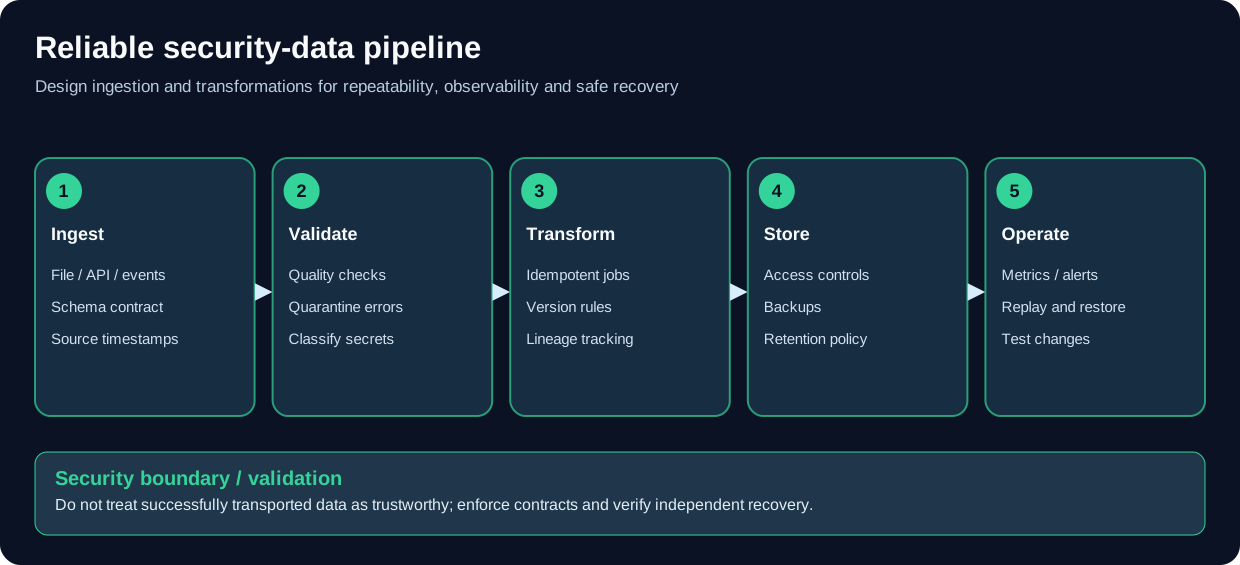
Successful ingestion is not proof of trustworthy data; verify contracts and replay.
- Read the guide's assumptions and Verification Record.
- Save its complete Python block under the filename shown.
- Run with
python3 filename.pyfrom a practice directory, without-O. - Compare its output with the recorded output in the guide.
- Review the assertions and failure cases to understand what they prove.
- Test a real adapter separately before relying on its external-system behavior.
The scripts use temporary directories and clean up their generated artifacts. They are embedded in the Markdown documents; this section is not a preinstalled application. HTTP responses and CDC events are simulated, and the orchestration lab is a local teaching runner.
| Boundary | Question to answer |
|---|---|
| Files to readers | How does a reader know a dataset version is complete? |
| Source to destination | When can extraction progress safely advance? |
| Task to task | What output proves the upstream dependency succeeded? |
| Attempt to retry | Can repeating the work duplicate an effect? |
| Stream to current state | What prevents a stale event from undoing a newer state? |
| Retained history to replay | Are source bytes, contracts, and transformation versions available? |
- Distinguish a storage system, file format, query engine, and table format.
- Explain a CSV null convention and verify a typed round trip.
- Choose partitions from query and arrival patterns.
- Publish complete versions and define retention/recovery ownership.
- Describe pagination termination and mutation assumptions.
- Bound retries and keep authentication failures actionable.
- Commit ingestion progress after durable work and demonstrate replay.
- Distinguish a logical interval from execution time.
- Bound concurrency and prevent overlapping publication.
- Design a backfill with explicit inputs and code versions.
- Explain snapshot/change handoff and ordering scope.
- Preserve deletion semantics through stale events and replay.
- Define late-record and incompatible-schema policies.
- Identify which guarantees still require a live-system test.
| Folder | Role |
|---|---|
Data-Engineering/Phase1/ |
Foundation documents |
Data-Engineering/Phase2/ |
This Storage & Integration index (README.md) and four guides |
Data-Engineering/Phase3/ |
Published Phase 3 index, with four Operations & Governance guides |
All four Phase 2 guides use sibling links and ../Phase1/ for prerequisites. This directory's canonical index is README.md (case-sensitive on Linux). Phase 3 is already published; see Pipeline Observability, Testing & CI/CD, Governance & Lineage, and Backup & Replay.
Contribute reproducible corrections with synthetic inputs, runtime versions, expected behavior, and observed output. Keep claims in the Verification Record limited to checks actually executed.
Apply these patterns to Secure Data Pipelines & Security Automation, or return to the Data Engineering overview for the broader roadmap. The parent index now links all three published phases; verify cross-links whenever a phase guide changes.
⬆ Back to Contents · ← Data Engineering Overview · Repository Home
📄 Source: Data-Engineering/Phase2/README.md | ✏️ Suggest an edit | ⬅️ Back to Data Engineering