Repository navigation
PNWC Cyberdeck
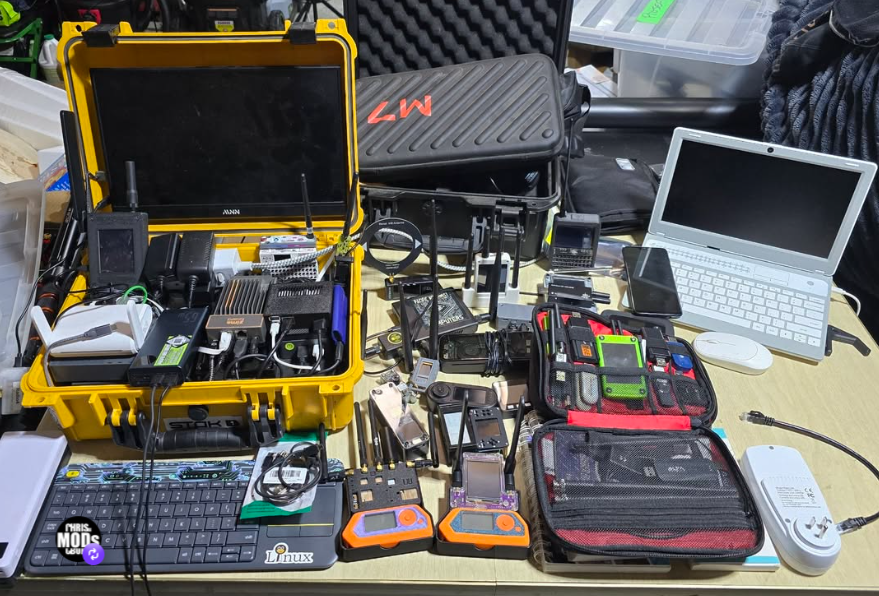
Portable Network Security Assessment & Evidence Workflow
Public documentation & offline reference utility
Part of the ULTIMATE CYBERSECURITY MASTER GUIDE by Pacific Northwest Computers


Navigate: Main Guide · Start Here · Ultimate · Enhanced · Specialized Topics · All Documentation.
Publication boundary: This is a deliberately limited, independently readable public companion to a separate private, proprietary PNWC Cyberdeck prototype. It is not a copy of the private repository, a release of its local operator portal, a working penetration-testing appliance, or an offer of production-ready automation.
| Resource | What It Provides |
|---|---|
| Build & Operations Runbook | Minimum build, zone policy worksheet, bring-up, field closeout and troubleshooting |
| Acceptance & Qualification Matrix | Measurable lab and field readiness gates without unverified hardware claims |
| Public-to-Private Implementation Roadmap | Milestones, private data contracts and completion criteria for expanding your own setup |
| Architecture & Network Zones | Portable layout, GL.iNet/MikroTik boundary and visibility limitations |
| Portable Wireless & Field Device Operations | Field deployment and evidence workflows for Flipper Zero, WiFi Pineapple, Bruce, M5StickC Plus2 and standalone/Flipper Marauder, excluding hardware-hacking bench procedures |
| Assessment Workflow | Authorization-first staged field process and example engagement profiles |
| Evidence, Privacy & Custody | Local evidence handling, hashes, redaction, retention and limits |
| Hardware & Feature Status | What the private prototype reports as implemented versus planned, and what is actually in this public edition |
| Publication Scope & Release Checklist | Safe public/private boundaries, license questions, and standalone-repo handoff |
| Example Engagement Plan | Fictional, editable scope and preflight outline; not a signed authorization or legal agreement |
| Example Evidence Record | Synthetic metadata illustrating a single evidence entry |
| Offline Evidence Manifest Tool | Standard-library Python script to hash an already collected local evidence folder |
| Offline Manifest Verification | Detect added, missing or changed regular files against a protected saved baseline |
| Qualification Record | Record actual hardware, procedure, result, evidence and reviewer |
| Assessment Report Template | Coverage, findings, limitations, delivery and retest structure |
| Generator Tests · Verifier Tests | Offline hashing, comparison, malformed baselines and output safeguards |
Follow the implementation roadmap to connect public design requirements to private implementation work. Start with inventory, reliable evidence handling and a complete manual synthetic case; qualify segmentation before adding supervised integrations. Keep actual configurations, application code and case data in your private environment.
The public reference includes operational worksheets and offline integrity tools. Hardware readiness and private prototype completion require actual qualification records; documentation alone does not complete those gates.
A portable cyberdeck can combine an operator workstation, an upstream connectivity router, a downstream segmentation firewall, a local evidence vault and optional manual/specialist collection devices. The guiding principle is method-first, consent-first, evidence-first: establish precisely what is authorized, choose a bounded procedure, record what actually happened, and independently review findings.
                   Approved upstream connection
                               |
                     GL.iNet (WISP / router)
                               |
                     MikroTik (routed policy)
                         /       |       \
                MGMT zone    SENSOR     LAB zone
                Operator     Evidence   Isolated validation
                workstation  storage    systems
                               |
                         Local evidence import
                               |
                  Human review & client report

        Separate offsite observation origin: PLANNED, NOT PROVIDED
        Client network test interface: ONLY WITH WRITTEN AUTHORIZATION
This is a logical reference topology, not an assertion that any user's GL.iNet, MikroTik, ZimaBoard or downstream interfaces have been configured, hardened, wired or validated. See Device & Platform References for the official hardware and software links. A router only controls traffic that traverses it; an unmanaged switch does not magically give a passive sensor all network traffic.
The architecture diagram and hardware status matrix use device families and possible roles, not a verified bill of materials. The links below go to manufacturer or project documentation; check the exact device model, hardware revision, firmware and interface support before following an installation guide.
| Referenced Device or Platform | Intended Role | Official Product or Project Reference |
|---|---|---|
| GL.iNet travel router | Approved upstream uplink, WISP/repeater or routed connection | GL.iNet Travel Routers |
| MikroTik router with RouterOS | Segmentation, firewall and downstream policy | MikroTik RouterOS Manual |
| Windows 11 mini PC / Linux operator computer | Local control interface and manual field workflow | Mini PC manufacturer/model not specified; select documentation after identifying the installed hardware |
| ZimaBoard | Possible local evidence storage host | Zima Hardware Overview |
| ZimaBlade (original hardware) | Optional small wired/edge sensor | ZimaBlade Hardware Guide · ZimaBoard SE Product Update |
| Raspberry Pi | Optional dedicated/portable sensor or lab host | Raspberry Pi Product Family |
| ESP-KVM / IP-KVM | Optional out-of-band operator console | ESP-KVM Project — confirm your actual board and firmware match this project |
| Flipper Zero | Portable Wireless Field Workflow: optional supervised specialist device | Flipper Zero Product · Guide's Flipper References |
| ESP32-based boards | Marauder & Bruce Field Workflow: optional supported wireless/embedded devices | Espressif ESP32 SoC Families · Board/Firmware Catalog |
| Hak5 devices, including WiFi Pineapple | Mark VII / Pager Operations: optional separately authorized specialist hardware | Hak5 Official Gear Catalog · Guide's Wireless Lab References |
| Kismet, Snort, Wazuh & nzyme | Software projects, not additional devices; applicable only with supported sensors and feeds | Kismet · Snort · Wazuh · nzyme |
Zima naming update (October 2026): The manufacturer announced that new ZimaBlade products are becoming ZimaBoard SE. Owners of earlier ZimaBlade models should continue using their actual hardware specifications; the new SE memory, storage and CPU configuration should not be assumed to apply to an older unit. See the manufacturer's update.
These are official reference links, not verified device integrations, endorsements or purchase recommendations. The topology diagram is plain text and cannot contain individual clickable device links; use this table to open each reference.
| Stage | Outcome | Gate |
|---|---|---|
| 1. Intake & Written Authorization | Named owner, assets, vantage points, windows, exclusions, contacts and permitted methods | Reviewed and accepted scope before active tests |
| 2. Outside-In Observation | Manual review from a genuinely separate approved source | External runner is not included in this edition |
| 3. Onsite Wired Network Review | Authorized host/service inventory, config checks and zone visibility | No implied permission from physical access |
| 4. Controlled Resilience Review | Optional benign canary/segmentation/detection validation | Separate exact methods and observer approval |
| 5. Wireless/Hardware Review | Passive, source-attributed observations where lawful and approved | Device firmware and RF limitations documented |
| 6. Evidence & Findings | Local copies, SHA-256 hashes, observed-versus-inferred labeling | Human analysis and privacy review |
| 7. Report & Close | Limitations, actionable remediation and planned retest | Secure delivery, equipment removal and retention review |
Scope limitation: The underlying private prototype focuses on network and infrastructure assessment, not web-app/API exploitation. A short field engagement is not a comprehensive penetration test or a security guarantee.
Python 3.10+ is sufficient; no third-party packages, network access, target discovery or special hardware are needed.
From the root of the main Guide repository:
python Cyberdeck/tools/evidence_manifest.py \
  --input Cyberdeck/examples/synthetic-evidence \
  --output /tmp/pnwc-demo-evidence-manifest.json
python Cyberdeck/tools/verify_manifest.py \
  --input Cyberdeck/examples/synthetic-evidence \
  --manifest /tmp/pnwc-demo-evidence-manifest.json
python -m unittest discover -s Cyberdeck/tests -v
On Windows, replace the output destination with a folder you control, for example $env:TEMP\pnwc-demo-evidence-manifest.json, and run Python with py -3 if appropriate. The tool only reads existing local files and writes a JSON manifest to a separate destination. It does not scan a network, capture traffic, sign manifests or establish a custody chain on its own.
Never put client data, case folders, credentials, signed authorization forms or real assessment exports into Git. Use an approved encrypted location outside this checkout.
| Included In This Public Edition | Intentionally Not Published |
|---|---|
| Sanitized conceptual topology and documented security boundaries | Private Python operator portal and workflow engine |
| Generic phased assessment and reporting workflow | Live customer records, scopes, signing packets and evidence |
| Fictional template examples and a harmless offline SHA-256 utility | Authentication tokens, service endpoints, VPN/router configs or credentials |
| Hardware categories, integration caveats and staged roadmap | Proprietary deployment scripts, internal SOPs, vendor-connection details and unreviewed implementations |
Current status: The separate private prototype has a localhost dashboard, engagement records, bounded authorized single-target Nmap functions, manual device-export intake and draft reports. Wider device automation, public-vantage scanning, real e-sign verification and validated encrypted evidence-vault deployment are not completed by publication of this reference.
| Topic | Reference |
|---|---|
| Lab isolation and traffic visibility | Homelab |
| Engagement assessment process | Assessment Service Integration |
| Authorized network audit | Network Audit Playbook |
| Wireless surveying | Wardriving |
| Portable wireless field operations | Flipper, Pineapple, M5StickC Plus2, Bruce & Marauder · Wireless Survey Guide |
| Device and firmware references | Device & Platform References · Firmware Catalog |
| Defensive monitoring | IDS & IPS |
| Printed enclosures, mounts and cable strain relief | CAD & 3D Printing · Mockups & Fit Checks |
| Operating and legal terms for the parent guide | Legal Terms |
Copyright © 2026 Pacific Northwest Computers. This public reference has no separately granted open-source license; visibility on GitHub must not be mistaken for permission to redistribute proprietary private project materials. See publication notes.
- Acceptance & Qualification Matrix
- Build, Bring-Up & Field Operations
- Cyberdeck Architecture & Network Zones
- Evidence, Privacy & Integrity
- Hardware Roles & Implementation Status
- Portable Wireless & Field Device Operations for the PNWC Cyberdeck
- Public Reference to Private Implementation
- Public/Private Separation & Publication Checklist
- Staged Cyberdeck Assessment Workflow
- Cyberdeck Assessment Report — Fictional Training Template
- Cyberdeck Qualification Record — Blank Training Template
- Example Cyberdeck Engagement Plan — Fictional Training Scenario
📂 Folder: Cyberdeck | ✏️ Suggest an edit | 🗺️ Browse by Topic