Repository navigation
Data Protection Regulations
Important
Educational reference, not legal advice. Regulatory thresholds, definitions, and penalties change and depend on jurisdiction, industry, and the data involved. Consult qualified legal counsel for your specific situation. See the section notice.
A practitioner's orientation to the major data-protection regulations - who they apply to, what they require, and their breach-notification duties.
Covers GDPR (EU/EEA), HIPAA (US healthcare), and CCPA/CPRA (California), plus the common thread of breach notification, at the level a security practitioner needs to know when they apply and what controls they drive.
Let a reader recognize which regulation applies to a given system or dataset and what security obligations follow - then route to counsel for specifics.
- Determining whether a regulation applies to a system or dataset
- Understanding the security controls a regulation implies
- Preparing breach-notification readiness
- GDPR (EU/EEA)
- HIPAA (US Healthcare)
- CCPA / CPRA (California)
- Breach Notification (Common Thread)
- What This Means for Security
- Resources
The EU General Data Protection Regulation - the most influential privacy law globally.
- Applies to: processing in the context of a controller's or processor's establishment in the Union, regardless of where the processing occurs. For an entity without a Union establishment, Article 3 can also apply when processing relates to offering goods or services to people in the Union or monitoring their behavior there. A person's EU residence or data location alone does not decide territorial scope; assess the Article 3 criteria.
- Key principles: lawfulness, purpose limitation, data minimization, accuracy, storage limitation, integrity/confidentiality, and accountability.
- Data-subject rights: access, rectification, erasure ("right to be forgotten"), portability, and objection.
- Security duty: "appropriate technical and organizational measures" (Art. 32) - encryption, resilience, testing.
- Penalties: up to €20 million or 4% of global annual turnover, whichever is higher.
The US Health Insurance Portability and Accountability Act - protects health information.
- Applies to: covered entities (providers, health plans, clearinghouses) and their business associates handling Protected Health Information (PHI).
- Security Rule: requires administrative, physical, and technical safeguards for electronic PHI (access control, audit controls, integrity, transmission security).
- Privacy Rule: governs use and disclosure of PHI.
- Breach Notification Rule: applies to breaches of unsecured PHI, subject to defined exceptions and a risk assessment. Notification duties and timing vary by affected population and recipient.
- Penalties: tiered civil penalties per violation, up to substantial annual caps.
The California Consumer Privacy Act, amended and strengthened by the California Privacy Rights Act (CPRA).
- Applies to: for-profit businesses handling California residents' personal information that meet thresholds (revenue, volume of data, or data-selling share).
- Consumer rights: know, delete, correct, opt out of sale/sharing, and limit use of sensitive personal information.
- CPRA additions: a dedicated enforcement agency (CPPA), a "sensitive personal information" category, and data-minimization/retention duties.
- Current rules: California's 2025 CCPA regulatory package, effective January 1, 2026, added requirements for certain businesses covering cybersecurity audits, risk assessments, and automated decisionmaking technology. Check the CPPA's current regulations and the update package.
- Note: many other US states have since enacted comparable laws - check the specific state(s) where your users reside.
Nearly every regime requires timely notification after a personal-data breach:
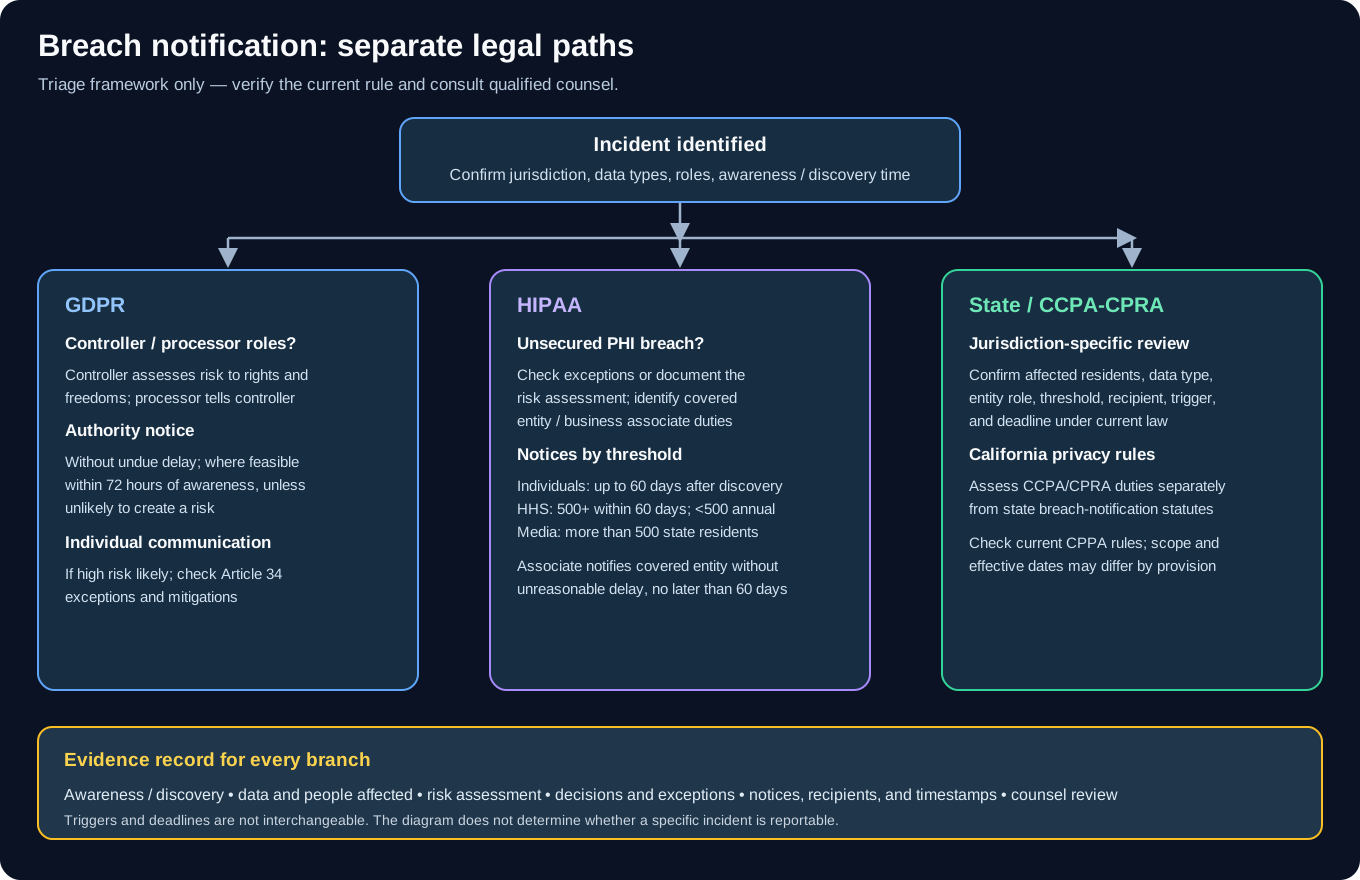
Conceptual triage aid only; it is not a legal decision tool. Confirm the current law, jurisdiction, roles, facts, and deadlines with qualified counsel.
- GDPR: the controller notifies the supervisory authority without undue delay and, where feasible, within 72 hours after becoming aware, unless the breach is unlikely to result in a risk to people's rights and freedoms. A processor notifies the controller without undue delay. Notify individuals without undue delay when high risk is likely, subject to Article 34 exceptions.
- HIPAA: for a breach of unsecured PHI, apply the rule's exceptions or document the required risk assessment. Notify affected individuals without unreasonable delay and no later than 60 days after discovery. Notify HHS within 60 days for breaches affecting 500 or more individuals; breaches affecting fewer than 500 may be reported annually, within 60 days after year-end. Media notice applies when more than 500 residents of a state or jurisdiction are affected. Business associates notify the covered entity without unreasonable delay and no later than 60 days after discovery.
- US state laws: triggers, deadlines, thresholds, and recipients vary by jurisdiction; CCPA/CPRA duties and other state breach laws should be assessed separately.
There is no universal breach-notification clock: GDPR uses awareness, HIPAA uses discovery, and state laws set their own triggers. Preserve a timeline of discovery or awareness, data types, affected people, risk findings, notices, and the rationale for each decision. See IncidentResponse.
Regulations rarely prescribe specific technology, but consistently drive the same controls:
- Data inventory & classification - you must know what personal data you hold.
- Access control & MFA - limit who can reach regulated data.
- Encryption - in transit and at rest. Encryption changes a notification outcome only when the applicable law's conditions are met; GDPR Article 34 has defined exceptions to individual communication, and HIPAA's breach rule applies to PHI not rendered unusable, unreadable, or indecipherable under HHS guidance.
- Logging & monitoring - to detect and evidence incidents within notification windows.
- Incident response - a tested plan that meets the notification clocks.
- Data minimization & retention - collect and keep less.
Implement these once (see the technical sections of this repo) and map them to each applicable regulation and framework - see Control Mapping.
- GDPR - official text (EUR-Lex)
- HHS Breach Notification Rule
- California CCPA (OAG)
- California Privacy Protection Agency regulations
- CPPA 2025 CCPA updates
- README.md - Compliance & GRC section index
- frameworks.md - security control frameworks
- ../IncidentResponse/README.md - detection & response that breach-notification duties require
📄 Source: Compliance/regulations.md | ✏️ Suggest an edit | ⬅️ Back to Compliance