Repository navigation
Part III The Space Segment
Space segment attack and defense guide - covering onboard computer (OBC) architecture, flight software (FSW) vulnerabilities, RTOS security (VxWorks, RTEMS, FreeRTOS), memory corruption in space-grade processors, and supply chain risks in COTS satellite components.
Covers: spacecraft software architecture layering (mission apps/FSW/RTOS/BSP), memory protection unit limitations, RTOS-specific vulnerabilities, FSW patching constraints (bandwidth-limited uplinks), SEU/radiation-induced fault injection, and CubeSat COTS hardware attack surface.
Understand the unique constraints of space-segment software security - where patching may require months, memory protection is limited, and hardware faults (SEU) can be weaponized - to assess and improve spacecraft software security posture.
- Assessing a spacecraft FSW codebase for vulnerabilities before launch
- Understanding why space software security differs from terrestrial embedded systems
- Red-teaming a CubeSat or small satellite with COTS OBC hardware
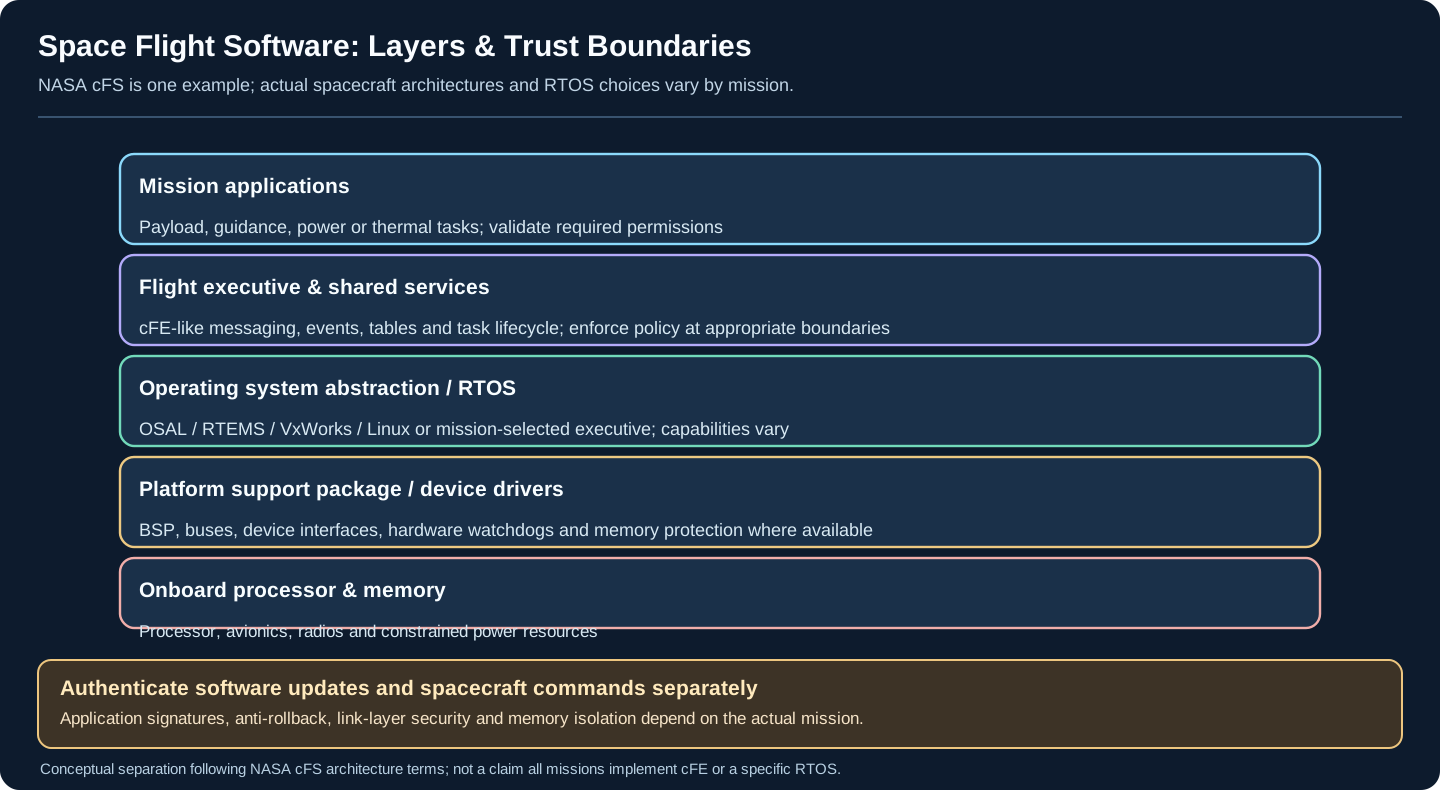
Architectural example, not an assertion that every spacecraft uses NASA cFS. The NASA cFS project documents modular mission applications, the core Flight Executive and supported platform/OS abstractions. Every mission's code, RTOS, update mechanism, memory protection and deployed access controls require separate evidence.
| RTOS | Usage | Known Issues |
|---|---|---|
| VxWorks | Legacy GEO satellites, many heritage platforms | CVE-2019-12255 (URGENT/11 TCP/IP stack bugs); numerous historical CVEs |
| RTEMS | Open-source; many CubeSats, NASA missions | Smaller CVE surface but limited security hardening |
| FreeRTOS | Proliferated LEO, smallsats | CVE-2018-16528 (AWS FreeRTOS mbedTLS context corruption in TLS connect path, CVSS 8.1 RCE) and related |
| Linux | Modern commercial satellites | Kernel CVEs; often unpatched in flight due to update risk |
| INTEGRITY (GHS) | High-assurance defense platforms | Proprietary; limited public vulnerability data |
| Language | Usage | Key Risk |
|---|---|---|
| C | Dominant in heritage FSW | Memory safety: buffer overflows, use-after-free, integer overflows |
| C++ | Modern FSW, NASA F Prime | Same as C plus class/template complexity |
| Ada / SPARK | High-assurance (ESA, some DoD) | Formally verified subsets; lower risk but not immune |
| Python | Ground tools, some modern smallsats | Injection risks, dependency vulnerabilities |
| Rust | Emerging (experimental satellite use) | Memory-safe by design |
Telecommand software uploads (patches, parameter updates, full FSW loads) represent the highest-risk command type:
- Integrity verification - Is the uplinked binary cryptographically signed and verified before execution?
- Authentication - Is the command chain that initiates an upload authenticated end-to-end?
- Rollback protection - Can an attacker upload a known-vulnerable older version?
- Execution path - Is uploaded code loaded into protected memory? Can it overwrite the bootloader?
Some mission designs may lack strong authenticated software-update and command controls. Do not generalize from mission age or orbit: determine the actual command authorization, payload signature checks, key lifecycle, and rollback handling before claiming a weakness.
Context: Direct spacecraft hacking in the wild requires either compromise of the ground segment command chain or physical/RF proximity with a transmitter. The scenarios below apply to authorized research, CTF environments, and red team engagements with spacecraft operators.
Scenario 1: Command Injection via Compromised MCS
- Attacker has achieved MCS access through ground segment compromise
- Issues malformed or malicious telecommand frames through the legitimate uplink chain
- Target: mode changes, FSW upload, AOCS commands (attitude change), power cycling
Scenario 2: Rogue Uplink (Research/Lab)
- Attacker operates an SDR-based transmitter aimed at the spacecraft
- Requires: knowledge of uplink frequency, modulation, frame format, and command structure
- Practical for unencrypted CubeSats with publicly documented protocols
- Applicable to the growing body of amateur/educational satellites with open TT&C specs
Scenario 3: Side-Channel via Telemetry
- Passive collection of downlinked telemetry reveals operational state
- Can be used for reconnaissance: when is the spacecraft unattended? What mode is it in?
- Timing attacks on encrypted telemetry (traffic analysis)
CubeSats represent the most accessible research target for spacecraft security:
- Many use open-source FSW (OpenSatCom, KubOS, FreeRTOS + custom)
- Frequencies and protocols often published in amateur satellite databases (AMSAT, SatNOGS)
- Some have open command interfaces for ground station operators
# SatNOGS global ground station network - passive telemetry collection
# https://network.satnogs.org

# Decode AX.25-framed CubeSat telemetry
gr_satellites <satellite-name> --wavfile capture.wav --doppler_csv doppler.csv

# Parse decoded frames with mission-specific decoder
python decode_telemetry.py --frames decoded.json| Control | Detail |
|---|---|
| Command authentication | Verify mission-specific cryptographic protection and keys, such as applicable CCSDS SDLS mechanisms; not every command link implements them |
| Replay protection | Use authenticated sequence/nonce/window checks and durable state suited to mission reliability; a plain counter is not an authentication control |
| Encryption in transit | Apply mission-approved authenticated encryption where confidentiality is required, with separately enforced command authenticity and key management |
| Software signing | Cryptographic signature verification before any FSW load/patch execution |
| Watchdog timers | Hardware watchdog to recover from FSW compromise or corruption |
| Safe mode | Autonomous safe mode entry on anomaly; limited command set in safe mode |
| Memory protection | MPU/MMU enforcement; non-executable data regions |
| Radiation hardening | Redundant memory, scrubbing, error-correcting codes (EDAC) - also relevant to fault injection |
📖 Use These Techniques Responsibly: Authorization is MANDATORY
Space systems are critical infrastructure - treat them accordingly.
Repository: ULTIMATE CYBERSECURITY MASTER GUIDE
Maintained by: Pacific Northwest Computers
- README.md - SpaceSecurity section index
- PartII.md - Ground segment: the uplink path to the FSW
- PartIV.md - User segment: the downstream satellite services
- ../HardwareHacking/Chapter3.md - Fault injection: SEU/radiation fault injection has parallels to hardware glitching
⭐ Star this repo if you find it useful! ⭐
📄 Source: SpaceSecurity/PartIII.md | ✏️ Suggest an edit | ⬅️ Back to Space Security