Repository navigation
Windows Build Review
Host-level configuration review checklist. The 22 links below open a general CIS Windows Desktop catalog, not individual check procedures or an authoritative one-to-one mapping.
Last reviewed: 2026-11-17 (documentation review; no hosts inspected or settings changed).
Purpose: A configuration-review (not exploitation) checklist for auditing a single Windows host's build against baseline hardening expectations - the kind of assessment done against a "gold image" before mass deployment, or against an existing production host to establish its current security posture. This is fundamentally different in character from the attack-technique checklists elsewhere in this repo: there's no exploit to run here, only configuration to inspect and compare against a known-good baseline.
Function: The 22 items sweep systematically through a host's attack surface: what's running (active processes, services, network connections), what's exposed (shares, firewall rules, remote management), what may be misconfigured (service paths and permissions that can create local privilege-escalation opportunities under specific conditions), what's missing (patch level, AV, audit logging), and what's policy-controlled (account lockout, local security policy, clear-text password storage). Several items here overlap with Windows Privilege Escalation. A finding is a configuration observation; it does not establish exploitability without validating the relevant permissions, execution context and control requirements.
Goal: Produce an evidence-backed comparison against an explicitly selected baseline for a Windows host or image, independent of whether any vulnerability is exploited. The checklist supports a scoped configuration review; it is not, by itself, a compliance certification or proof that the host can or cannot be compromised.
When & how to use this: Run against a representative sample of hosts (or the gold image itself) during a build review engagement, working through items systematically rather than in attack-priority order since there's no exploitation sequencing here - every item is an independent configuration check. Cross-reference findings against Windows Privilege Escalation and AppLocker. A service-path issue needs both relevant permissions and an executable search opportunity; a missing AppLocker policy is a baseline deviation only if that control is required for the host. Neither label alone establishes exploitability.
Use the CIS Desktop catalog for the appropriate desktop edition, and the CIS Server catalog for server roles. Record the exact OS/build, domain or standalone role, benchmark version/profile, and approved exceptions. A general catalog link does not prove a recommendation applies to a particular system.
Microsoft security baselines are another versioned reference. Select the agreed assessment baseline; do not combine conflicting settings or apply a downloadable policy simply to conduct a read-only review.
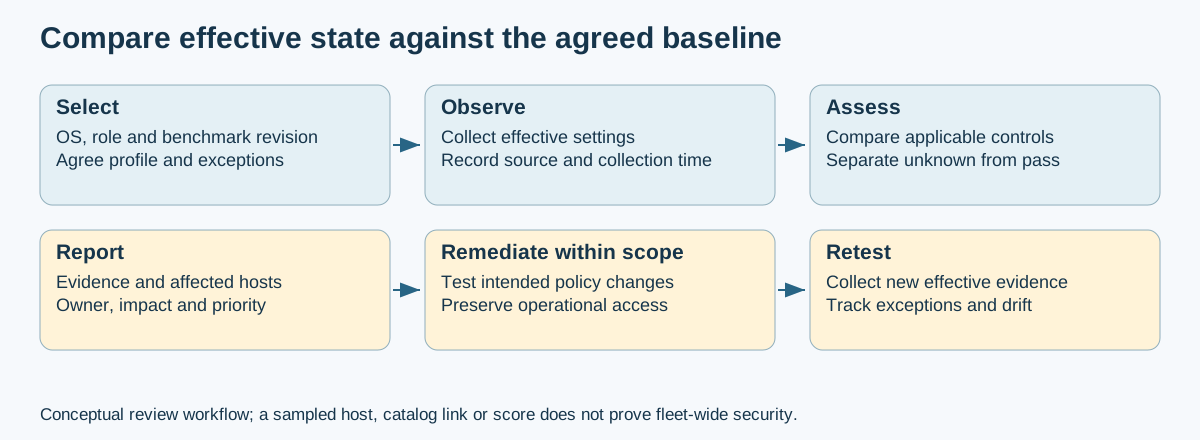
Original conceptual review flow. Checking configured policy, effective settings and observed behavior answers different questions. A sample image or a passing score does not establish the condition of every deployed host.
For each WBR item, retain:
| Record | What to capture |
|---|---|
| Scope | Host/image identifier, role, OS/build and UTC collection time |
| Requirement | Exact baseline revision, profile and recommendation ID, where applicable |
| Observation | Effective value and read-only collection method, not only intended policy |
| Result | Pass, fail, not applicable, not checked, or evidence unavailable |
| Exception | Owner, justification, compensating control and review date |
| Follow-up | Scoped remediation, operational impact and retest evidence |
Protect account, process, network and software inventories as sensitive assessment data. Collect only what is needed; do not copy credentials to prove a clear-text-storage concern. A configuration review does not authorize exploitation or automatic hardening changes. If a numeric score is used, publish its denominator, exclusions and weighting separately; unchecked controls must not count as passes.
- WBR-001 - File System Configuration ★
- WBR-002 - Network Time Protocol ★
- WBR-003 - Start-up Executables ★
- WBR-004 - Active Processes ★
- WBR-005 - Active Network Connections ★
- WBR-006 - Routing Table ★
- WBR-007 - Local Services ★
- WBR-008 - Exploit Mitigation Technologies ★
- WBR-009 - Weak Service Permissions ★
- WBR-010 - Unquoted Service Paths ★
- WBR-011 - Available Shares ★
- WBR-012 - User Accounts Review ★
- WBR-013 - Clear-Text Passwords ★
- WBR-014 - Storage Mechanism of Password Hashes ★
- WBR-015 - Account Lockout Policy ★
- WBR-016 - Local Security Policy ★
- WBR-017 - Events Auditing ★
- WBR-018 - Host Based Firewall ★
- WBR-019 - Antivirus Software Review ★
- WBR-020 - List Available Software ★
- WBR-021 - Windows Patch Level ★
- WBR-022 - Remote Management ★
Authorization: Review only hosts and evidence within the engagement scope. Follow repository legal terms and use a separate change process for remediation.
- README.md - Checklists section index
Section Index | Master Index | Legal Notice
📄 Source: Checklists/Windows-Build-Review-Checklist.md | ✏️ Suggest an edit | ⬅️ Back to Checklists