Repository navigation
Space Security
Offensive and defensive security across ground, space, and user segments of modern space systems
Part of the ULTIMATE CYBERSECURITY MASTER GUIDE


Index for the Space Security section - covering offensive and defensive security across all three space system segments:
- Ground: Mission control, TT&C, Ground stations
- Space: Flight software, OBC, RTOS
- User: SATCOM terminals, GNSS receivers, VSATs.
Links to four content parts (Foundations, Ground Segment, Space Segment, User Segment) and one appendices file. Provides attack surface taxonomy, regulatory reference CFAA, ITAR/EAR, FCC, tool ecosystem, and career path overview.
Serve as the starting point for space security work - directing practitioners to the right Part file for their current focus area (ground infrastructure, flight software, or SATCOM terminal attacks).
- Choosing which Part to read based on assessment focus (ground vs. space vs. user segment)
- Legal/regulatory reference: ITAR/EAR controls, RF transmission authorization requirements
- Understanding how SDR techniques apply specifically to satellite communication systems
- Overview
- Section Guides
- Space System Segments
- Why Space Security Matters Now
- Threat Landscape Summary
- Tools Reference
- Security & Legal Disclaimer
- Resources
Space systems underpin critical infrastructure worldwide: from GPS-enabled financial trading to military communications to commercial aviation. Yet most operational satellites were designed before modern cybersecurity practices existed, and the expanding commercial space sector has introduced a rapidly growing attack surface across orbital altitudes, radio frequencies, ground infrastructure, and end-user hardware.
This section provides a comprehensive security reference covering the entire space domain, organized by segment.
What You'll Find Here:
- 📡 Ground segment penetration testing: mission control, TT&C uplink chains, ground station networks
- 🛰️ Space segment security: flight software vulnerabilities, RTOS exploitation, command injection
- 📺 User segment attacks: SATCOM terminal hacking, GNSS spoofing and jamming, VSAT modem analysis
- 📻 RF link analysis: CCSDS protocol dissection, signal interception, passive reconnaissance
- 🔐 Hardening strategies: command authentication, encryption, network segmentation, defense-in-depth
- 📊 Historical incident analysis: Viasat KA-SAT wiper attack, Turla satellite C2, GNSS spoofing campaigns
- 🧪 Testing methodology: legal frameworks, assessment approaches, lab setup for space security research
| Guide | Segment | Description |
|---|---|---|
| PartI.md | Foundations | Space security primer, threat landscape, threat actor categories, STRIDE modeling for space systems, security testing methodology, legal/regulatory framework, and tools overview |
| PartII.md | Ground | Ground-space communications, link architecture, frequency bands, CCSDS protocol stack, mission control system architecture, ground segment exploitation, protocol fuzzing, network penetration paths, and hardening controls |
| PartIII.md | Space | Spacecraft software architecture, RTOS platforms (VxWorks, RTEMS, FreeRTOS), flight software vulnerabilities, software upload security, spacecraft hacking scenarios, CubeSat security research, and space segment hardening |
| PartIV.md | User | SATCOM terminal architecture, terminal firmware analysis, VSAT attack surface, GNSS overview and signal weaknesses, jamming and spoofing techniques, real-world GNSS attacks, countermeasures, and industry/regulatory appendices |
| Appendices.md | Reference | Repo sub-section topic appendices |
New to space security?
  └─> Start with Part I (Foundations) for terminology, threat landscape, and methodology
  └─> Then Part II (Ground): most attacks originate here
  └─> Then Part IV (User): highest practical applicability for pentesters
  └─> Then Part III (Space): advanced/research context

Experienced practitioner?
  └─> Jump directly to the segment relevant to your engagement
  └─> Part II for ground system / mission control assessments
  └─> Part IV for SATCOM terminal testing or GNSS security
  └─> Part III for spacecraft FSW analysis or CubeSat research
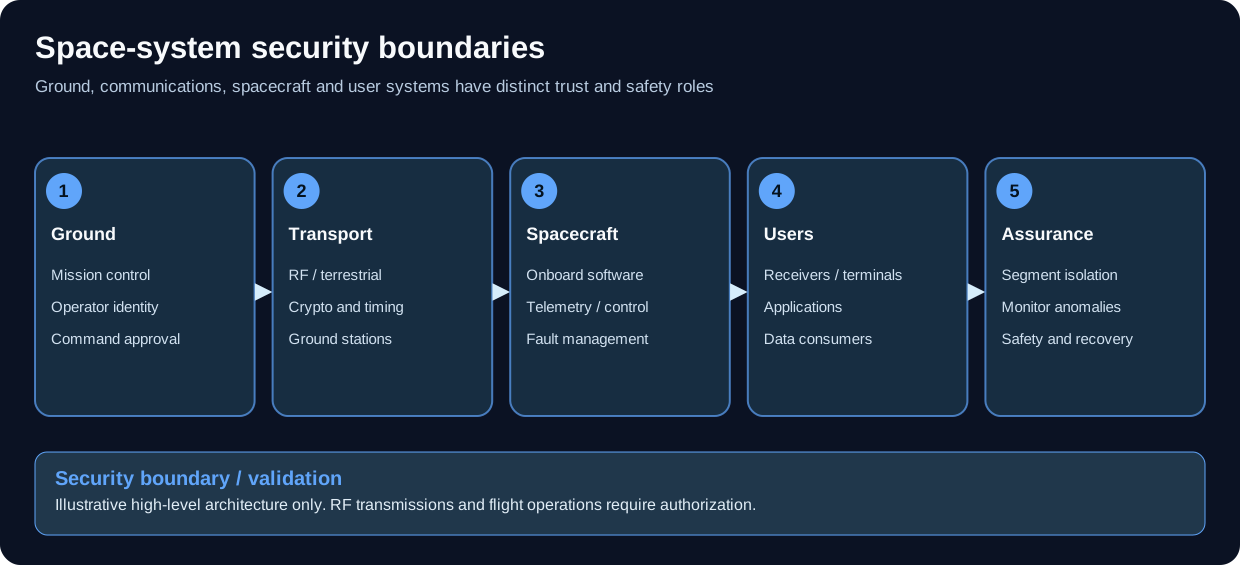
Conceptual space-system boundaries; real missions have diverse topologies and safety constraints.
Every space system consists of three interdependent segments. A compromise of any one segment can cascade across the others.
| Segment | Description | Key Attack Surface | Primary Risk |
|---|---|---|---|
| Ground | Earth-based infrastructure that commands and controls spacecraft | Mission control systems, TT&C uplink, ground station networks, VPN/remote access | IT/OT lateral movement → command injection |
| Space | Spacecraft and payloads in orbit | Onboard computer, flight software, RTOS, communication subsystems | FSW exploitation, malicious uploads |
| User | End-user equipment receiving satellite services | SATCOM terminals, GNSS receivers, VSAT modems | Firmware exploitation, GNSS spoofing/jamming |
         ┌─────────────┐
         │   GROUND     │  Mission control, ground stations
         │   SEGMENT    │  TT&C uplink/downlink
         └──────┬───────┘
                │
    Commands ───┤──── Telemetry
                │
         ┌──────┴───────┐
         │    SPACE      │  Satellites, CubeSats
         │   SEGMENT     │  FSW, OBC, payloads
         └──────┬───────┘
                │
   Service ─────┤──── Data
                │
         ┌──────┴───────┐
         │    USER       │  SATCOM terminals, GNSS receivers
         │   SEGMENT     │  VSAT modems, timing systems
         └──────────────┘
Key insight from the Viasat KA-SAT attack (2022): Attackers compromised the ground segment management plane → issued legitimate provisioning commands → deployed the AcidRain wiper to ~50,000 user terminals across Europe. Ground segment access = mass user segment impact.
- Proliferated LEO constellations (Starlink, OneWeb, Kuiper) serve millions of users and carry critical infrastructure traffic
- GNSS is everywhere: financial systems, power grids, cellular networks, aviation, maritime, and autonomous vehicles all depend on GPS/Galileo/GLONASS timing and positioning
- Military dependence on commercial SATCOM: DoD and allied forces rely heavily on commercial satellite communications for operations
- Nation-state ASAT programs: Russia, China, Iran, and North Korea actively develop kinetic and cyber capabilities targeting space systems
- Legacy design: Most operational GEO satellites were designed and launched before modern cybersecurity practices existed; many lack basic command authentication
- Expanding attack surface: CubeSats with open-source FSW, COTS components, and publicly documented protocols lower the barrier for security research and adversarial activity
| Actor Type | Motivation | Capability | Historical Example |
|---|---|---|---|
| Nation-state | Strategic advantage, disruption, espionage | Kinetic ASAT, RF jamming/spoofing, cyber intrusion | GRU: Viasat KA-SAT wiper (2022) |
| Criminal | Financial gain | Ground segment ransomware, data theft | Ransomware on satellite ground ops |
| Hacktivist | Political messaging | Low-level jamming, signal hijacking | Signal hijacking incidents |
| Researcher | Disclosure, learning | Variable: CTF, lab research | DEFCON Aerospace Village, Hack-A-Sat |
| Insider | Sabotage, espionage | High: privileged access to command systems | Undetected until damage occurs |
| Year | Incident | Impact |
|---|---|---|
| 2007–2008 | NASA/USGS satellite interference (China alleged) | Multiple TT&C intrusions on ground systems |
| 2018 | Turla (Snake) APT: satellite internet C2 | Covert exfiltration via hijacked satellite links |
| 2022 | Viasat KA-SAT cyberattack (Sandworm) | ~50,000 VSAT modems bricked across Europe |
| 2022–present | GNSS jamming/spoofing in Ukraine/Eastern Europe | Aviation GPS outages, maritime position errors |
| Tool | Purpose | Notes |
|---|---|---|
| GNU Radio | SDR signal processing framework | Core platform for all RF analysis |
| SDR# / GQRX / SDR++ | SDR receiver GUI | Spectrum monitoring and visualization |
| gr-satellites | Satellite signal decoder | Supports dozens of amateur/CubeSat formats |
| SatDump | Satellite data decoder | NOAA, Meteor, MetOp weather satellites |
| HackRF One | Half-duplex transceiver (1 MHz – 6 GHz; cannot transmit and receive simultaneously) | TX capability: authorized lab use only |
| USRP B210 | High-performance SDR (70 MHz – 6 GHz) | Research-grade wideband analysis |
| RTL-SDR | Receive-only SDR (500 kHz – 1.75 GHz) | Passive monitoring, entry-level |
| Tool | Purpose | Notes |
|---|---|---|
| Wireshark | Ground network traffic analysis | Custom CCSDS dissectors available |
| COSMOS | Open-source mission control framework | FSW testing and simulation |
| Shodan / Censys | Internet-exposed ground system discovery | Search for exposed MCS interfaces |
| boofuzz | Protocol fuzzing | Target CCSDS parsers and ground APIs |
| Tool | Purpose | Notes |
|---|---|---|
| GPS-SDR-SIM | GPS L1 C/A signal simulator | TX requires HackRF: shielded enclosure only |
| GNSS-SDRLIB | Multi-constellation SDR receiver/generator | Research use |
| Spirent GSS7000 | Commercial GNSS simulator | Professional lab testing |
| Tool | Purpose | Notes |
|---|---|---|
| binwalk | Firmware extraction | Standard first step for terminal analysis |
| QEMU | Firmware emulation | Dynamic analysis of extracted binaries |
| Ghidra / IDA | Reverse engineering | Static analysis of FSW and terminal firmware |
⚠️ LEGAL AND ETHICAL USE ONLY ⚠️

This section contains attack techniques targeting space systems infrastructure.

✅ AUTHORIZED USES:
   • Security assessments with written authorization from spacecraft operators
   • Red team operations with organizational approval
   • Academic research in shielded RF enclosures or simulation environments
   • Blue team training and detection development
   • CTF competitions (DEFCON Aerospace Village, Hack-A-Sat)
   • Passive RF monitoring within legal boundaries
   • Educational study and professional development

🚫 STRICTLY PROHIBITED:
   • Transmitting RF signals toward operational satellites without authorization
   • Unauthorized access to ground station or mission control systems
   • GNSS jamming or spoofing outside shielded test environments
   • Intercepting protected satellite communications
   • Any activity violating CFAA, FCC regulations, ITAR/EAR, or ITU rules
   • Causing disruption to satellite services or critical infrastructure
   • Any illegal or unethical activities
| Law / Regulation | Scope |
|---|---|
| CFAA (18 U.S.C. § 1030) | Covers specified computer-access and damage offenses; elements and penalties vary by offense and facts. |
| FCC radio rules | Required authority depends on the service, station, equipment and frequency. Some devices/services operate under general authorization or license-by-rule; unauthorized satellite or other radio operation can trigger FCC enforcement. |
| ITAR / EAR | Export controls may apply to specifically controlled defense articles, software, technology or technical data and to certain releases or exports; classification and facts matter. |
| EAR (15 CFR 730-774) | Additional export controls on dual-use space technology |
| ITU Radio Regulations | International spectrum coordination framework implemented through national administrations; check the relevant regulator and service rules for operating authority. |
| UK Computer Misuse Act 1990 | Unauthorized access to space-related computer systems |
| EU cybercrime laws | National implementation and territorial scope vary; determine applicable local law for the system and activity. |
These materials are provided "AS IS" without warranty of any kind.

THE AUTHORS AND CONTRIBUTORS:
• Make no guarantees about technique effectiveness or accuracy
• Are not responsible for damages from unauthorized use
• Are not liable for legal consequences of misuse
• Disclaim all liability for disruption to space systems or services
• May update content without notice

USERS EXPLICITLY ACKNOWLEDGE:
• Space system attacks can disrupt critical infrastructure affecting public safety
• RF transmission without authorization is a federal crime
• ITAR/EAR export controls may apply to tools and techniques described herein
• They accept all risks associated with using these attack methodologies
• Authorization must be explicit, written, and from the spacecraft operator
| Resource | Description |
|---|---|
| CCSDS 350.0-G-3 | The Application of Security to CCSDS Protocols |
| CCSDS 351.0-M-1 | Security Architecture for Space Data Systems |
| NIST SP 800-53 Rev 5 | Control families applicable to space (SA, SI, SC, AU) |
| NIST IR 8270 | An Overview of Cybersecurity for Commercial Satellite Operations |
| CISA Guidance | Space Systems Critical Infrastructure Security and Resilience |
| Aerospace Corp | Defending Space Systems from Cyber Threats |
| Resource | Description |
|---|---|
| Hack-A-Sat | CTF run by US Space Force / AFRL (2020–2023; see the challenge archive) |
| DEF CON Aerospace Village | Aerospace security community and talks |
| IOActive: SATCOM Security | Pre-auth RCE research across major SATCOM vendors (2014, 2020) |
| Black Hat 2020: Ruben Santamarta | Revisited SATCOM vulnerabilities; aviation implications |
| DEF CON 30 (2022): Starlink (original video unavailable on 2026-11-11) | Historical physical fault-injection research; locate verified original recording before citing playback |
| Resource | URL |
|---|---|
| MITRE ATT&CK for ICS | https://attack.mitre.org/matrices/ics/ |
| SatNOGS Network | https://network.satnogs.org/ |
| Space-Track.org | https://www.space-track.org/ |
| AMSAT | https://www.amsat.org/ |
| CCSDS Publications | https://public.ccsds.org/Publications/default.aspx |
| FCC ULS License Search | https://wireless2.fcc.gov/UlsApp/UlsSearch/searchLicense.jsp |
- 🏠 Main Repository
- 🎯 START HERE Guide
- 💻 Cybersecurity Master Guide
- ✅ Security Checklists
- 🔍 OSINT Resources
- 📚 Documentation
- 🔒 OPSEC Guidelines
- MITRE ATT&CK
- CCSDS Publications
- DEF CON Aerospace Village
- Hack-A-Sat (2020–2023; challenge archive)
- SatNOGS
📁 Sections: 4 (Foundations, Ground Segment, Space Segment, User Segment)
📖 Chapters: 11 + 2 Appendices
🔄 Last Updated: June 2026
👥 Maintained by: Pacific Northwest Computers (PNWC)
📝 Status: Active & Growing
- PartI.md - Foundations: space system segments, threat landscape, attack taxonomy
- PartII.md - Ground segment: TT&C, mission control, ground station attacks
- PartIII.md - Space segment: flight software, RTOS, OBC vulnerabilities
- PartIV.md - User segment: SATCOM terminals, GNSS spoofing, VSAT attacks
- Appendices.md - Industry overview, regulatory bodies, further resources
- ../SDR/sdr_hacking.md - SDR hacking advanced: GPS spoofing and satellite signal analysis techniques used in this section
📖 Use These Techniques Responsibly: Authorization is MANDATORY
Space systems are critical infrastructure: treat them accordingly.
Repository: ULTIMATE CYBERSECURITY MASTER GUIDE
Maintained by: Pacific Northwest Computers
⭐ Star this repo if you find it useful! ⭐
- 🏢 Appendix A: The Space Sector
- 🌍 Part I: Foundations of Space Security
- 📡 Part II: The Ground Segment
- 🚀 Part III: The Space Segment
- 📺 Part IV: The User Segment
📂 Folder: SpaceSecurity | ✏️ Suggest an edit | 🗺️ Browse by Topic