Repository navigation
Search Sorting Indexing and Information Retrieval
Algorithm Index | Foundations | Offline Labs
Looking up a contact, querying a SOC index, finding a matching log entry, and ranking a web page are different problems. Finding, filtering, ordering, and ranking may occur in one workflow but often rely on different data structures and algorithms.
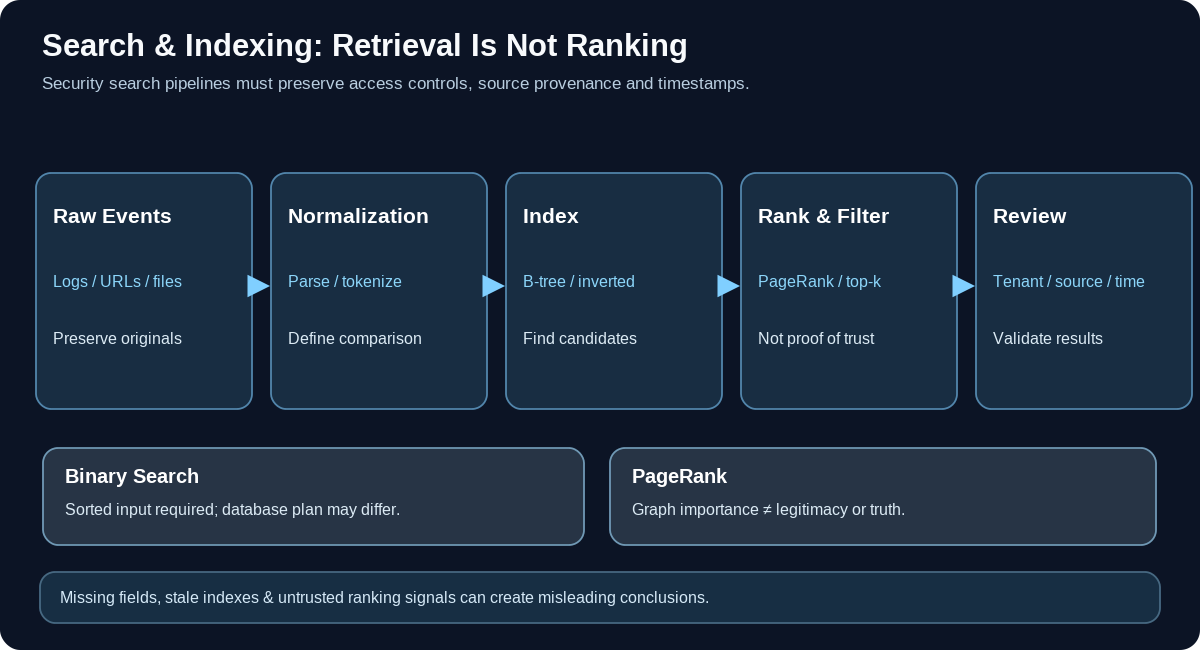
Original conceptual figure. Indexing finds candidates; ranking cannot prove trustworthiness, and source/tenant permissions must be enforced before results are exposed.
Given a sorted array and compatible comparison function, binary search compares the middle element to the target and discards the impossible half. Each step reduces the remaining candidate range, giving O(log n) comparisons and O(1) auxiliary space for an iterative implementation.
Example sorted asset IDs: 10, 14, 21, 29, 35, 47, 53.
To find 47: inspect 29 (search right); inspect 47 (found). When no match exists, search ends with an empty interval.
low = 0
high = length(items)          # half-open interval [low, high)
while low < high:
    mid = low + (high - low) // 2
    if items[mid] < target:
        low = mid + 1
    else:
        high = mid
# low is first index whose item is >= target, if any
This is a lower-bound algorithm, useful for duplicate keys and locating ranges. It works only if the array is already sorted under the same ordering. For random access storage, a phone directory could use a binary-search-like index, but modern contact applications and databases have different indexing structures.
Python cross-check: The standard-library bisect module implements bisection over sorted sequences.
| Index Family | Useful Queries | Trade-Off |
|---|---|---|
| B-tree/B+tree family | Exact values, ordered ranges, prefix scans, sorting | O(log n)-style navigation, write and storage overhead; implementation differs |
| Hash index | Equality under compatible engine rules | Does not inherently support ordered range lookup |
| Inverted index | Which documents contain token/domain/IP/string? | Tokenization, updates and memory/disk cost |
| Bitmap index | Filtering low-cardinality fields | May be inefficient for high-update/high-cardinality workloads |
| Trie / prefix tree | Longest-prefix IP routing, prefix matching | Node overhead and normalization |
| Vector/ANN index | Approximate semantic nearest neighbors | Recall/latency trade-offs; not exact keyword matching |
A SQL WHERE clause does not reveal which algorithm the database engine uses. Consult EXPLAIN, storage engine and query plan; some queries intentionally scan tables or combine multiple indexes.
- Collect/crawl documents or events from an authorized source.
- Parse, normalize and tokenize; preserve the original evidence.
- Build an inverted index mapping terms to document IDs and positions.
- Retrieve candidate documents matching a query.
- Score/rank using terms, statistics, freshness, links, embeddings, or other features.
- Apply privacy, authorization, and presentation policies before returning results.
A search for suspicious domains might first retrieve logs by indexed hostname token, then filter by time, host and event context. A missing or mis-tokenized field can make events invisible even when they exist in storage.
PageRank estimates importance in a directed hyperlink graph. In the classic random-surfer model, a page gains weight from pages linking to it, adjusted by how those linking pages distribute their outgoing influence. A simplified update is:
PR(p) = (1 - d)/N + d × sum(PR(q)/outdegree(q)) over pages q linking to p, for N pages and damping d (often illustrated as 0.85). Production implementations handle dangling pages and convergence carefully.
Illustration: If a respected page links to only a few places, its contribution per link is larger than if it links to thousands. But raw in-degree or number of backlinks is not the whole algorithm, and links are not verified statements of truth or security.
- Google Search has many ranking systems and factors; historical PageRank is not a complete model of current ranking.
- Security uses: find influential infrastructure nodes, detect suspicious link farms, prioritize investigation of related domains, or reason about software dependency importance.
- Threats & limits: link spam, graph manipulation, incomplete crawls, privacy considerations and source trust. A high PageRank score does not prove legitimacy.
- Related methods: HITS (hubs/authorities), personalized PageRank, centrality measures and community detection answer different graph questions.
References: Original Page & Brin research, Google's ranking systems overview.
Split an input into halves, recursively sort the halves, and merge them. Standard comparison merge sort takes O(n log n) time in worst case, and typical array implementations require O(n) additional space. A merge sort can be stable if equal elements retain their prior relative order.
Timsort is an adaptive, stable merge-based algorithm that detects preexisting ordered runs and merges them. It is used for Python's list sorting. Do not assume every spreadsheet, inbox, e-commerce filter, database ORDER BY, or language runtime uses Timsort; implementations vary and may take advantage of indexes or specialized algorithms.
Python's list sort and sorted() are stable: when two events have equal timestamps, their preexisting order is preserved. For reproducible incident reports, define explicit secondary keys instead of relying on ingestion order.
events = [
    {"time": "2026-11-22T10:00:00Z", "id": "evt-B"},
    {"time": "2026-11-22T09:59:59Z", "id": "evt-C"},
    {"time": "2026-11-22T10:00:00Z", "id": "evt-A"},
]
timeline = sorted(events, key=lambda e: (e["time"], e["id"]))
assert [e["id"] for e in timeline] == ["evt-C", "evt-A", "evt-B"]
Note: lexically sorting strings as UTC timestamps is safe only when their format and timezone are normalized consistently. Real logs require time parsing, offsets and uncertainty handling.
| Algorithm | Typical Time | Guarantee / Limitation |
|---|---|---|
| Merge sort | O(n log n) | Worst-case bound; generally O(n) extra space for arrays |
| Timsort | O(n) best for sufficiently ordered inputs; O(n log n) worst | Stable, adaptive; practical memory needs vary |
| Quicksort | O(n log n) expected with suitable pivot strategy | Naive worst-case O(n²); generally not stable |
| Heapsort | O(n log n) | Can sort in place; generally not stable |
| Counting/radix sort | Linear-ish in n and domain/digit parameters | Special key/range assumptions; not generic comparison sorting |
Security dashboards often need the top 20 source IPs or top 10 most common failure codes, not a total sort of millions of events. Use a frequency dictionary and a bounded heap when the task supports streaming; record whether counts are exact. Algorithms such as Count-Min Sketch estimate counts with bounded memory but introduce error. HyperLogLog estimates unique counts; its output is not an exact forensic inventory.
Bloom filters test probable set membership using a bit array and multiple hash-derived positions. With correct construction they give no false negatives for items inserted, but may give false positives. Deletion is not supported by a standard Bloom filter; a counting variant has different behavior. Corrupt state, incorrect normalization, or cross-dataset misuse breaks those assurances.
| Question | Candidate Technique | Validation |
|---|---|---|
| Find events for one device | B-tree or inverted index | Normalize identity, timestamp, tenant & retention |
| Find matching strings across signatures | Trie/automaton matching | Inspect encoded/fragmented data and parser output |
| Find the newest 100 failed logins | Ordered index or top-k | Define timezone and tie-breaking |
| Find related domains | Graph traversal, PageRank or community detection | Avoid assuming that graph proximity means maliciousness |
| Match suspicious binaries | Cryptographic digest lookup | Trusted reference and file bytes required |
| Spot repeated query patterns | Hashing, frequency counters, sketches | Distinguish NAT/shared users from an individual |
Read Wireshark Defensive Investigations, OSINT Index, and Data Engineering for application-specific workflows.
A standard hash-table index is optimized for lookup; a cryptographic hash is designed for resistance to preimages and chosen collisions under a defined model. A fast hash is generally inappropriate for password verification. A search result with a matching SHA-256 digest still needs an independent trusted source before claiming authenticity. See Algorithmic Cryptography Parallels, Password Storage, and Cryptography.
| Reference | Detail |
|---|---|
| Python bisect | Sorted insertion/search boundaries |
| Python Sorting HOWTO | Stability & Timsort |
| CPython listsort notes | Implementation-level background |
| Google Search: How It Works | Crawling, indexing and serving |
Algorithm Index | Main Index | Legal
📄 Source: Algorithms/search-sorting-and-indexing.md | ✏️ Suggest an edit | ⬅️ Back to Algorithms