Repository navigation
Algorithms
Algorithms Behind Everyday Computing, Networking, Cryptography & Cybersecurity
Part of the ULTIMATE CYBERSECURITY MASTER GUIDE


A practical, source-linked guide to the algorithms behind everyday computing, networking, security monitoring, search, storage, and AI.
Note
Scope: This section explains algorithm families, not a claim that every named consumer product uses a particular implementation. Implementation choices, hardware acceleration, tuning, and protocol versions vary. Labs use invented data and never require traffic from third parties.
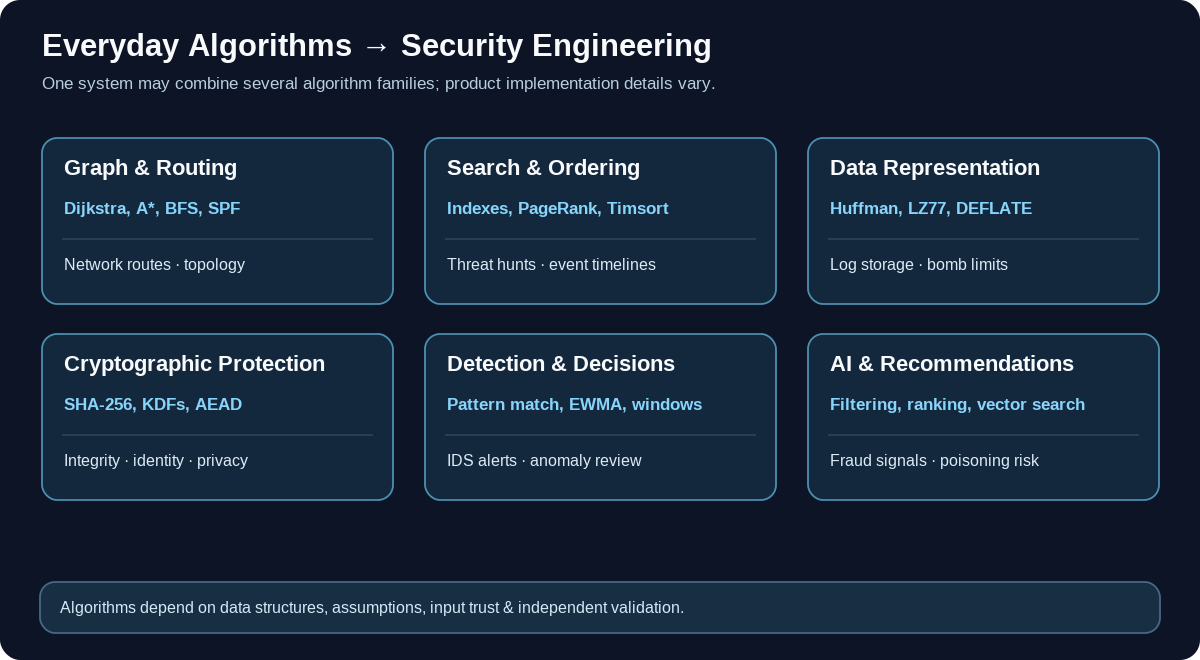
Original conceptual overview. Each algorithm has specific assumptions; real products may use other or combined implementations.
Explain the algorithms behind routine digital tasks, show how they apply to cybersecurity, and correct common misconceptions about routing, search, media formats, cryptography, AI, and detection.
Organize focused guides, authoritative references, original visual diagrams, and safe runnable exercises. An algorithm is a defined procedure that transforms inputs into outputs; a data structure arranges data; a protocol governs communication; and a cryptographic primitive provides a specialized security function. They are related but not interchangeable.
Readers should be able to trace a small algorithm by hand, explain its complexity and assumptions, distinguish mathematical guarantees from product claims, identify cybersecurity uses, and test reproducible synthetic cases.
- Exploring how navigation, search engines, compression, encryption, and recommendations actually work.
- Reviewing computational complexity, throughput, data structures or algorithmic denial-of-service risks.
- Understanding the cryptographic primitives inside TLS, integrity validation, signatures and key derivation.
- Learning how OSPF/BGP, packet matching, anomaly detection, SIEM correlation and AI ranking differ.
- Teaching concepts with original diagrams and offline, standard-library Python exercises.
| Section | Open |
|---|---|
| Guide Collection | Explore The Guides |
| Real-World Connections | Everyday Technology |
| Learning Paths | Choose Your Path |
| Related Sections | Where This Fits |
| Verification & Contributions | Validation & Contribution Notes |
| Guide | What You Will Learn |
|---|---|
| Foundations, Complexity & Data Structures | Pseudocode, input models, Big-O, correctness, heaps, hash tables, graphs, caching, trade-offs & attacker-controlled inputs |
| Pathfinding, Routing & Graph Algorithms | Dijkstra, A*, BFS/DFS, Bellman–Ford, OSPF vs BGP, network topology, weighted paths & routing integrity |
| Search, Sorting & Information Retrieval | Binary search, indexes, B-trees, inverted indexes, PageRank, merge sort, Timsort, top-k, Bloom filters & threat-hunting use |
| Compression, Hashing & Cryptography | Huffman, LZ77, LZW, DEFLATE, ZIP/PNG/MP3, SHA-256, AES, TLS, signatures, integrity & compression side channels |
| Algorithmic Parallels To Cryptography & Trust | Hash tables vs cryptographic hashes; entropy, PKI trust graphs, TLS algorithm composition, KDFs, constant-time practice & PQC |
| Detection, Streaming & Recommendation Algorithms | Pattern matchers, anomaly detection, sliding windows, rate limiting, sketches, correlation, recommender systems & security evaluation |
| Hands-On, Offline Algorithm Labs | Runnable Python standard-library demos; repeatable assertions, synthetic network/log datasets, failure cases & extension exercises |
These are foundational representations rather than algorithms. Learn to inspect raw bytes before applying parsing, hashing, encryption or detection logic.
| Guide | Focus |
|---|---|
| Hexadecimal & Binary Data Analysis | Number bases, byte inspection, endianness, binary editing & security applications |
| ASCII, Unicode & Character Encoding | Text encodings, control bytes, decoding & input validation |
| Hex & ASCII Field Reference & Offline Labs | Full ASCII lookup table, commands, synthetic binary, encoding, YARA & packet labs |
| Everyday Example | Algorithm Or Technique | Security Application & Qualification |
|---|---|---|
| Road navigation | Dijkstra, A*, variants | Network paths & attack-path analysis; real map services may use other preprocessing/heuristics |
| Interior routing | OSPF shortest-path-first | Network topology, route cost, tamper monitoring; BGP is a different protocol family |
| Search results | PageRank & inverted indexes | OSINT graph analysis, link-spam awareness, threat-search pipelines |
| Sorted contacts | Binary search over sorted array | Fast lookups; database indexes may use B-trees or hashes instead |
| ZIP & PNG | DEFLATE: LZ77 + Huffman | Efficient log storage, compression-bomb defense |
| Audio streaming | Lossy perceptual codecs, transforms & entropy coding | Media analysis; not equivalent to LZW or ordinary ZIP compression |
| HTTPS connections | AEAD + authentication + KDFs & hashes | Confidentiality, integrity & authenticated peer identity; hashing alone does not encrypt |
| Live monitoring | Pattern matching, windows, thresholds & statistics | Snort/Suricata rules, SIEM correlation, IDS false-positive control |
| Personalized feeds | Collaborative & content-based filtering, ranking | Abuse-resistant ranking, privacy, bias & adversarial manipulation |
| Ordered inboxes | Stable sorting or indexed retrieval | Log timelines, incident triage & reproducible evidence ordering |
| Goal | Suggested Sequence |
|---|---|
| New reader | Foundations → Labs → another focused guide |
| Network professional | Graphs & Routing → Detection |
| SOC / DFIR analyst | Search & Indexing → Detection → Labs |
| Developer or data engineer | Foundations → Search & Sorting → Compression |
| Crypto learner | Compression, Hashing & Cryptography → Cryptographic Algorithmic Parallels → existing crypto reference |
See also the new cross-disciplinary explanation of cryptographic parallels, which distinguishes search-oriented hashes, password KDFs, cryptographic entropy, signature verification, trust graphs, TLS, and post-quantum primitives.
This section complements rather than duplicates the detailed Cryptography, Data Engineering, Wireshark & Network Investigation, Snort & Network IDS, AI, and Network Segmentation sections. For authoritative specifications, use the references in each focused guide.
Examples labeled toy or educational are not recommended production implementations. Complexity is expressed in terms of the stated input model and assumptions. A shortest-path algorithm does not automatically establish the trustworthiness of the underlying network graph. An anomaly score does not prove malicious intent. Never use sample cryptography code as a new protocol.
Editorial preparation: November 22, 2026. Source references and technical distinctions were reviewed while drafting; the external URLs, diagram rendering, Python runtime, repository-wide Markdown checks, and CI results require independent verification before merge. No production deployment is implied.
Main Index | Role Navigation | Legal Notice
- Algorithm Fundamentals, Complexity & Data Structures
- Algorithmic Parallels To Cryptography, Encryption & Trust
- ASCII, Unicode & Character Encoding
- Compression, Hashing, Integrity & Cryptography
- Detection, Streaming, Recommendation & Decision Algorithms
- Hex & ASCII Field Reference & Offline Labs
- Hexadecimal & Binary Data Analysis
- Offline Algorithm Labs: Pathfinding, Search, Detection & Data Integrity
- Pathfinding, Routing & Graph Algorithms
- Search, Sorting, Indexing & Information Retrieval
📂 Folder: Algorithms | ✏️ Suggest an edit | 🗺️ Browse by Topic