Repository navigation
Algorithmic Parallels To Cryptography Encryption and Trust
Algorithm Index | Compression, Hashing & Cryptography | Cryptography Reference
Important
Learning guide, not a crypto design specification. All diagrams and thought experiments are conceptual. Use established protocols and maintained libraries, do not write your own cipher or key-agreement protocol, and validate any algorithm against its actual threat model and current standards.
Cryptography uses the same foundations found in search, graph analysis, information theory, and systems design: mathematical operations, algorithms, data structures, cost models, complexity bounds, and assumptions about adversarial inputs. But a fast or mathematically elegant algorithm is not necessarily secure. This guide explains the connections without treating algorithms as interchangeable.
Goal: explain why hashing and indexing sound related but protect different properties, how entropy and compression differ from secrecy, how TLS composes multiple algorithms, how certificate and software-supply-chain trust can be modeled as graphs, and why implementation timing can undermine sound cryptography.
| Topic | Explore |
|---|---|
| Algorithmic Families | Broader conceptual map |
| Compression & Information Theory | Huffman, DEFLATE, entropy and side channels |
| Graph Algorithms | Weighted paths; relationship to trust-path reasoning |
| Search & Indexing | Hash tables, indexed lookup and ranking |
| Detection & Anomaly Algorithms | Timing, false positives and security monitoring |
| Cryptographic Parameters | Current algorithm families, legacy rules and post-quantum migration |
| Applied Cryptography | TLS, password storage, randomness, key lifecycle |
| Password & Passkey Security | Phishing-resistant authentication |
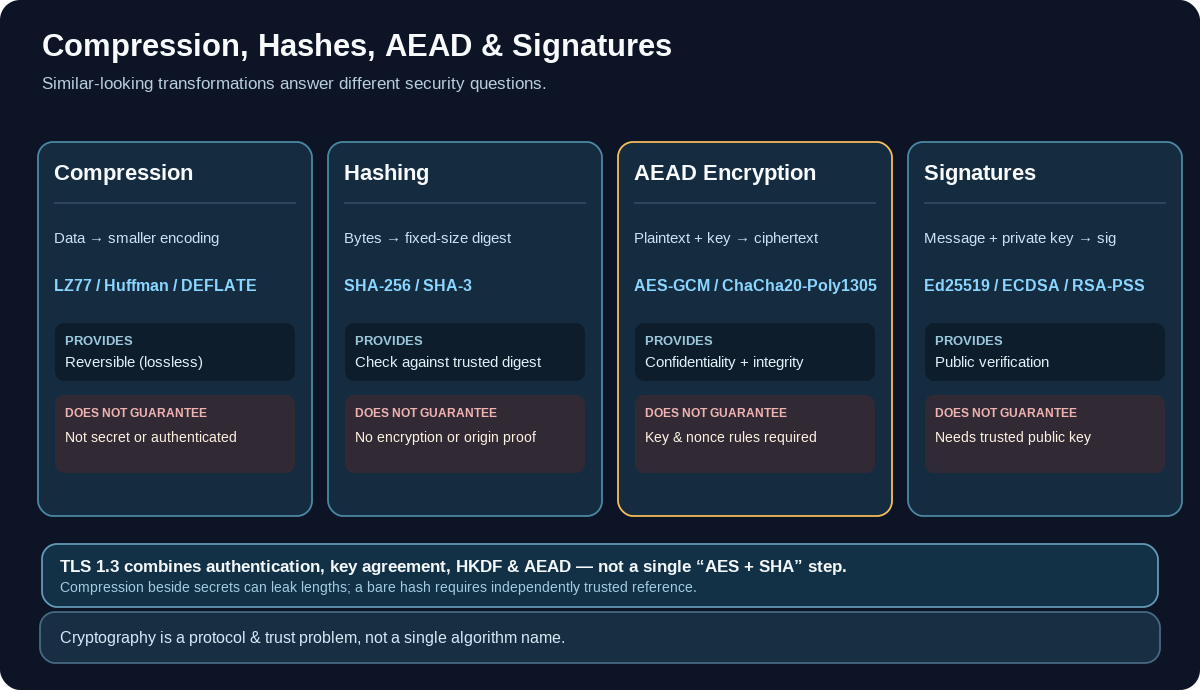
Conceptual decision diagram. Similar input-to-output transformations do not provide the same security property.
Both map input values into derived values, but their performance targets and security properties differ.
| Property | Ordinary Hash Table | Cryptographic Hash (SHA-256, SHA-3) |
|---|---|---|
| Primary goal | Efficient indexing and lookup | Collision, preimage and second-preimage resistance under stated assumptions |
| Output | Usually finite-width bucket/index | Fixed-width digest with a defined cryptographic construction |
| Collisions | Expected and handled by a table | Must be computationally difficult to find deliberately |
| Attacker-chosen inputs | Can trigger uneven buckets and resource exhaustion | Security strength depends on primitive and chosen operation |
| Keying | Some runtimes use randomized/keyed hashing defensively | Plain SHA-256 is unkeyed; HMAC uses a secret key |
| Typical security use | Dictionaries, asset indexing, telemetry aggregation | Digest validation against trusted reference, HMAC, Merkle leaves |
Key distinction: a fast lookup hash is not a secure file-integrity fingerprint; a SHA-256 digest is not an authenticator just because it looks random. Use HMAC or a digital signature where authenticity is needed under the correct trust model, rather than assuming a shared hash is trustworthy.
Birthday paradox parallel: For an ideal n-bit hash, random collisions begin to become likely on the order of 2^(n/2) attempts, while generic preimage search is on the order of 2^n attempts. These are heuristic work-factor scales for idealized functions, not an instruction to use only hash-output length to judge a full system's security.
Reference: NIST FIPS 180-4, HMAC RFC 2104.
Shannon entropy measures uncertainty about symbols under a specified probability distribution; it helps characterize how well data can be compressed. Cryptographic unpredictability concerns what an attacker can predict about secrets even with side information. The two concepts overlap mathematically but are not identical security tests.
- Huffman coding assigns short prefix-free symbols to common inputs and supports compression; it does not hide them from an attacker.
- A ciphertext produced by a secure encryption scheme should not exhibit plaintext's easily exploitable repetitions, but observing an apparently random-looking ciphertext is not proof of security.
- A compressed stream is usually still transparent to anyone with a decompressor.
- A cryptographically secure random-number generator (CSPRNG) requires appropriate entropy sources, seeding and health/operational controls; zip-compressing a predictable sequence does not create secure key material.
- Encrypting a file usually makes lossless recompression ineffective because ciphertext is designed to be computationally indistinguishable from random-looking data under the cipher's security assumptions.
Compression-length side channel: If an attacker can influence some bytes compressed alongside a secret and observe output length, some protocols can leak information. Separating secrets from attacker-controlled data and disabling sensitive response compression where appropriate are design mitigations; TLS encryption alone does not hide ciphertext length. See RFC 7457 (TLS attack context) and BREACH (historical web compression attack).
Dijkstra and A* operate over graphs with specific edge weights and optimization goals. Trust systems can also be depicted as graphs, but certificate path validation is not simply shortest-path routing.
Consider the distinct graphs:
| Graph | Vertices | Edges | Decision |
|---|---|---|---|
| OSPF network | Routers/network vertices | Link-state connectivity/cost | Lowest configured path cost under protocol rules |
| Certificate/PKI trust | Roots, intermediates, end-entity certificates | Issuer/signature relationships and constraints | Is a valid, policy-compliant path rooted in an accepted trust anchor? |
| Software supply chain | Projects, artifacts, builders, signing keys | Dependencies, attestations, signatures | Is provenance and integrity sufficiently verified? |
| Attack-path model | Hosts, identities, privileges, misconfigurations | Permitted transitions/prerequisites | What plausible transitions require mitigation? |
A PKI path has constraints (name validation, permitted usages, dates, policies, basic constraints, revocation policy and algorithm requirements) that cannot be replaced by assigning a cost to links. The shortest chain is not necessarily an acceptable chain. A signature proving bytes came from a key is not proof that the software is free from vulnerabilities.
References: RFC 5280 on X.509 certification path validation, NIST SSDF for secure software development. Related repository material: Supply Chain Assessment and OSINT.
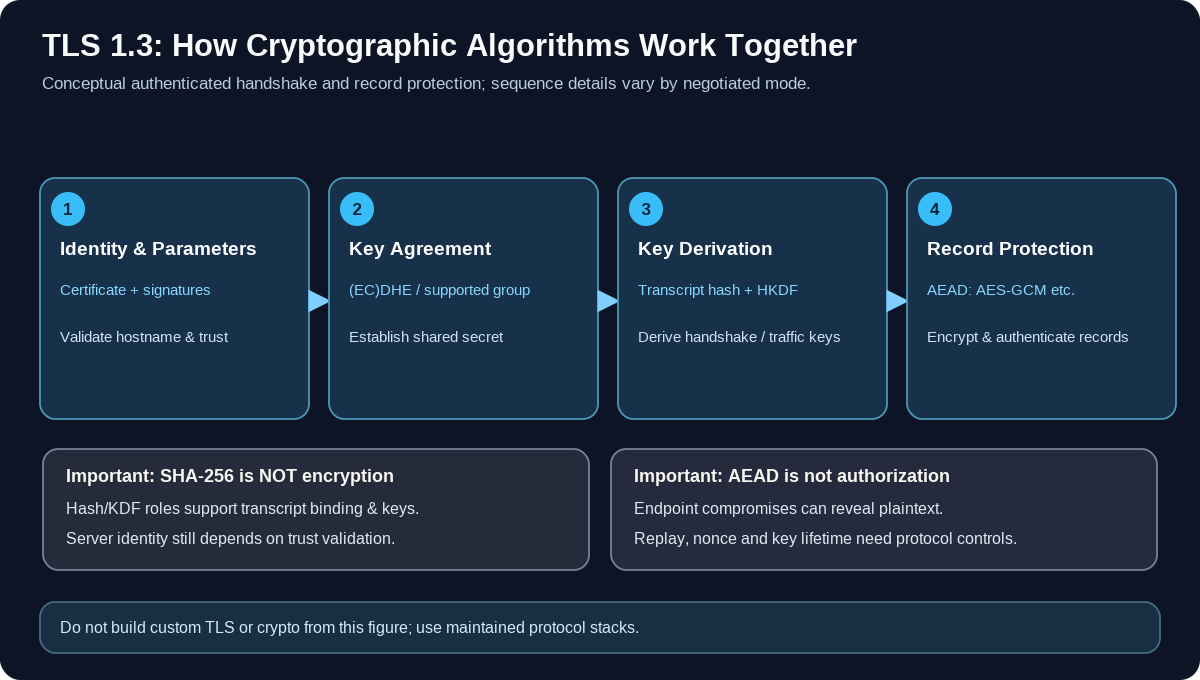
Conceptual TLS 1.3 sequence, not a packet-accurate handshake trace; certificate and signature methods, group negotiations, and resumption/PSK choices are protocol-specific.
A common TLS 1.3 certificate-authenticated handshake combines:
- Negotiation: client and server choose protocol security parameters, including a supported key-exchange group and cipher suite.
- Key establishment: ephemeral (EC)DHE exchanges, or appropriately negotiated alternatives under the relevant profile, create shared secret material; this is not bulk encryption.
- KDF and transcript binding: HKDF derives traffic keys using handshake secrets and transcript-related hashes. A hash algorithm such as SHA-256 is part of that process, not the AES record cipher.
- Authentication: the client verifies the server's certificate and handshake signature according to its trust and hostname policy.
- AEAD record protection: record data uses an agreed authenticated encryption construction, typically AES-GCM or ChaCha20-Poly1305. Authentication failure rejects data.
- Application authorization: the authenticated transport does not itself decide whether the logged-in user should access a record.
The exact cryptographic messages and order are governed by the protocol; the numbered stages are an educational grouping, not wire-level message order. For example, portions of the TLS 1.3 handshake are encrypted before server certificate verification completes; clients must not trust unauthenticated application data.
Algorithm roles to remember: AES = block cipher; AES-GCM = AEAD; SHA-256 = hash; HKDF = KDF; X25519 = key agreement; Ed25519/ECDSA = signatures. The names are not substitutes for complete protocol verification.
References: TLS 1.3 RFC 8446, HKDF RFC 5869, Applied Cryptography.
Binary search is efficient because data is ordered. Password guessing is not an ordinary binary search over sorted secrets. Password defenses need to make each candidate verification sufficiently costly and preferably memory-intensive under an appropriate threat model.
- Do not store passwords as SHA-256(password) or use a bare fast keyed lookup as password protection.
- Use a salted, purpose-built password hashing method such as Argon2id/scrypt/PBKDF2 where appropriate to your compliance and deployment requirements.
- HKDF derives cryptographic keys from suitable input keying material; it is not interchangeable with a password-hardening KDF.
- Search algorithms still matter: breached-password corpus lookup, credential inventory analysis and incident investigations use indexes, set membership, and rate limiting. Those operations do not turn the password hashing problem into binary search.
- Online account authentication adds throttling, lockout safety, user experience, MFA/passkeys, and abuse monitoring. Offline stolen-verifier risks require separate protection.
References: OWASP Password Storage Cheat Sheet and Cryptography's Applied Guide.
Computer science teaches runtime cost (Big-O), worst-case inputs, and optimization. Cryptography adds the question: Does the amount of time or memory access depend on a secret?
| Ordinary Optimization | Possible Cryptographic Hazard |
|---|---|
| Early-exit on mismatch | Observable comparison timing may disclose prefix information |
| Lookup tables indexed by secret bytes | Cache access patterns can leak key-dependent information |
| Variable-time arithmetic | Execution time may correlate with private-key bits |
| Faster but unreviewed primitive | Loss of vetted security assumptions and implementation review |
| Error messages that expose processing differences | Padding-oracle-style information leaks in vulnerable protocols |
| Nonce/counter reuse for convenience | Catastrophic failure for some AEAD schemes, including GCM |
Important: Big-O is about growth as input size increases; a constant-time cryptographic implementation aims to avoid observable secret-dependent differences in timing/behavior for a defined threat model. These are different claims, and a constant-time implementation may still have an ordinary O(n) runtime in public message length. Python scripts in this repository are teaching aids, not audited constant-time crypto code.
Prefer well-maintained cryptography libraries and reviewed protocol implementations. See Cryptography Reference and Applied Cryptography.
Modern public-key cryptography draws on hard mathematical problems, not merely “scrambling” characters:
| Family | Representative Primitive | Underlying View | Role |
|---|---|---|---|
| RSA | RSA-PSS, RSA-OAEP | Modular arithmetic and integer factorization assumptions | Signature / encryption construction, depending on scheme |
| Elliptic curve | ECDH / X25519 | Elliptic-curve group operations and discrete-log assumptions | Key agreement |
| Elliptic curve | Ed25519 / ECDSA | Discrete-log-based signature constructions | Digital signatures |
| Lattice-based PQC | ML-KEM | Module-lattice problem families | Post-quantum key encapsulation |
| Lattice-based PQC | ML-DSA | Module-lattice problem families | Post-quantum digital signature |
| Hash-based PQC | SLH-DSA | Hash-based signatures | Post-quantum digital signature |
A generic shortest-path, sorting or hashing algorithm is not a replacement for these cryptographic security assumptions. Quantum algorithms threaten classical public-key systems in ways that cannot be solved simply by doubling RSA key lengths. Post-quantum cryptography also needs protocol integration, safe implementations, lifecycle management, and side-channel review.
References: NIST FIPS 203 (ML-KEM), NIST FIPS 204 (ML-DSA), NIST FIPS 205 (SLH-DSA). Follow the dedicated Cryptographic Algorithms Guide for algorithm selection details.
A Merkle tree is an algorithmic tree data structure whose internal nodes derive hashes from child nodes. It supports compact membership proofs against a trusted root, and can serve transparency logs and content-addressed systems. The root alone does not authenticate a publisher, supply a time stamp, or prove an observation was accurate.
A responsible evidence workflow separates:
| Step | Data Structure / Algorithm | Trust Requirement |
|---|---|---|
| Acquire | Deterministic byte stream | Proper authorization and process |
| Fingerprint | SHA-256 hash | Independently record trusted digest |
| Record | Append-only log / indexed event store | Accurate timestamps, access controls |
| Aggregate | Merkle tree / signed manifest | Trusted signatures and auditability |
| Search | B-tree, inverted index, binary search | Preserve provenance and tenant separation |
| Verify | Rehash + compare / signature validation | Correct trust anchors and original bytes |
Do not confuse a digest with evidence admissibility, authenticity, or chain of custody. See Digital Forensics and Data Engineering.
Consider algorithmic DoS (catastrophic regex backtracking, decompression bombs, quadratic parsing), nonce/key misuse, timing/cache side channels, malicious input normalization, poisoned graph edges and recommendation feedback loops. Apply bounds and validation, collect independent evidence, and test under synthetic adversarial inputs.
For detection specifically, see Pattern Matching & Anomaly Algorithms and the existing Unified Network Visibility Architecture. For network trust, see Graphs & Routing.
- Compare identical bytes with
hashlib.sha256and deliberately changed bytes; explain why both digest values require a trusted source before asserting authenticity. - Draw a simple mock certificate chain and list validation constraints that would reject an otherwise connected path. Do not implement certificate path validation.
- Compress small synthetic repetitive strings and note how sizes vary; do not place real secrets next to attacker-controlled input while exploring compression effects.
- Explain why password hashing and TLS HKDF use different cost/security goals. Cite a protocol specification for each.
- Draw an example TLS 1.3 stack and annotate key agreement, certificate verification, HKDF, and AEAD with what each does not guarantee.
These exercises are conceptual by design. Repeatable executable examples live in Offline Algorithm Labs. Implementation guidance remains in Applied Cryptography.
| Standard / Guide | Focus |
|---|---|
| RFC 8446 | TLS 1.3 roles and composition |
| RFC 5869 | HKDF extraction and expansion |
| RFC 5280 | Certificate path validation |
| RFC 2104 | Keyed hashes (HMAC) |
| NIST Post-Quantum Standards | PQC standards and migration |
| Algorithms: Compression, Hashing & Crypto | Related algorithm families |
| Cryptography Index | Detailed cryptographic standards and practice |
Algorithm Index | Main Index | Legal
📄 Source: Algorithms/cryptography-parallels.md | ✏️ Suggest an edit | ⬅️ Back to Algorithms